Introductory video for this article — we recommend watching before reading
Yes, we are talking about those familiar situations when a child settles down next to an adult and listens while the adult reads a book aloud.
Although it is the adult who reads, this is called “shared reading.”
Yes, the adult takes on important functions.
First, the technical task of reading itself – translating letters into sounding text. The child will only cope with this task independently by school age.
Second, the adult helps the text “come alive”: bringing intonation into it, and sometimes even different voices, so that the characters come alive and the storyline comes alive too – with approaching danger and unfolding events.
And what remains for the child? The most important thing!
Understanding and experiencing the text, empathising with the characters and following the storyline.
If a child learns this, in the future they will become a real reader.
In shared reading, the child and the adult do the “work of reading” together: the child can empathise with the characters, and as a result their own feelings may change and be transformed.
The main thing is to teach children to read independently
This myth is very widespread, and by “reading” people most often mean the technical side of reading – decoding written text.
In fact: each age has its own developmental tasks. Reading technique is not an essential skill for a preschool child, but it is precisely in the preschool years that a relationship to literary text as a helper in experiencing and transforming one’s feelings and relationships with the world can emerge.
If the “technical” side of reading is too important for adults, children quickly understand that good adult approval depends on a certain skill. Then the book becomes a means of obtaining approval from the adult, and this may prevent the child from encountering the book as an interlocutor.
Some children do not like reading
“I tried reading to him several times, but he doesn’t want to listen, runs away, he isn’t interested.”
In fact: The adult’s task is not targeted formation but creating conditions – and observing what resonates and what does not. In relation to shared reading, this means creating conditions for shared reading – for a special cosy time together. See the section “How to Make Shared Reading a Joy.”
Informational books are more important than fiction
In fact: it is important that reading brings pleasure to everyone involved. If an adult loves books about cars or ships, then reading enthusiastically about cars and ships is also good. But fiction has unique advantages, so it is important to create opportunities for children to encounter it.
Very much indeed! But it is important to say immediately that reading should not be turned into an “instrument for developing” counting skills, logical thinking or memorisation. All of these things will develop through reading by themselves, and they will be side effects of reading.
The main effect of reading is the development of the ability to experience the world through text and to become more emotionally sensitive and mature through books. This is an incredibly complex and important ability that literally opens up a whole world of invaluable resources for the child.
These resources allow a person never to be completely alone and always to have reliable companions in overcoming difficult life situations.
Therefore, reading should not be interrupted with moralising or didactic questions: so how many piglets were there? Did the goat behave well or badly?
Shared reading should be a time of joyful togetherness.
Through the experience of shared reading with an adult, the child develops and forms:
Love of reading
There is a stable relationship between “wanting to read” and “being able to read.”
Numerous studies show:
mutual reinforcement of motivation and skill
the more a child reads on their own initiative → the better they read
the better they read → the more they want to read
This is described as: the Matthew effect: “strong readers become stronger, weaker readers fall behind.”
Trusting relationships with the adult, a sense of safety. Reading together is an experience of security and a safe journey into something new, a contribution to the development of secure attachment.
In this respect, a book leaves much more room than a film, where the creators already provide the visual and auditory image: what the character looked like, how they walked and spoke. The reader must imagine all this independently. This is why there are so many arguments about film adaptations – because books leave room for different interpretations.
You can observe how read stories are reflected in children’s own tales – this is also a manifestation of imagination.
Tick if this sometimes happens:
The child begins to engage in the reading situation
Sharedness begins to appear
The first responses appear
A desire to repeat the reading experience appears
Reading begins to move into life
The most important thing in reading with a child is not so much the text itself as the atmosphere of shared action, when the adult and the child are literally “looking in the same direction.”
You hold one book, follow the same characters, are surprised, laugh, and worry together – and in that moment a shared space of attention and meaning appears. The child feels: we are together now, we are interested in the same thing, and we can talk about it. In such sharedness reading becomes not a lesson, but a meeting – where what matters is not the correct answer, but a shared view of what is happening and the opportunity to share thoughts and feelings.
The strongest magic lies in regularity. Reading should become not a random episode, but a beloved ritual.
Why are rituals so important? They create a sense of safety and anticipation. Remember how the Fox spoke to the Little Prince?
“It is better to come at the same hour,” said the Fox. “For example, if you come at four o’clock in the afternoon, then at three o’clock I shall begin to be happy. The closer it gets to four o’clock, the happier I shall feel… But if you come at just any time, I shall never know at what hour my heart is to be ready to greet you… One must observe the proper rites…”
It is the same with reading. When a child knows that every evening, after supper and before bedtime, twenty minutes cuddled up with a book are waiting for you together, they begin to “prepare their heart” for this moment. It becomes an island of stability and unconditional attention in the flow of everyday life. It is your own special ritual.
Reading needs not only time, but also its own special place.
A sense of privacy is important for independent reading. When a child is only beginning to read independently, outside noises and other people’s attention often distract them. Create a small “reading corner” at home: a cosy beanbag or pouffe near a floor lamp, a windowsill with soft cushions, a blanket teepee. This is the child’s personal cave for immersing themselves in a story. At first a child may sit with a book anywhere, but once reading becomes an independent and serious activity, the importance of such a quiet “own” place increases.
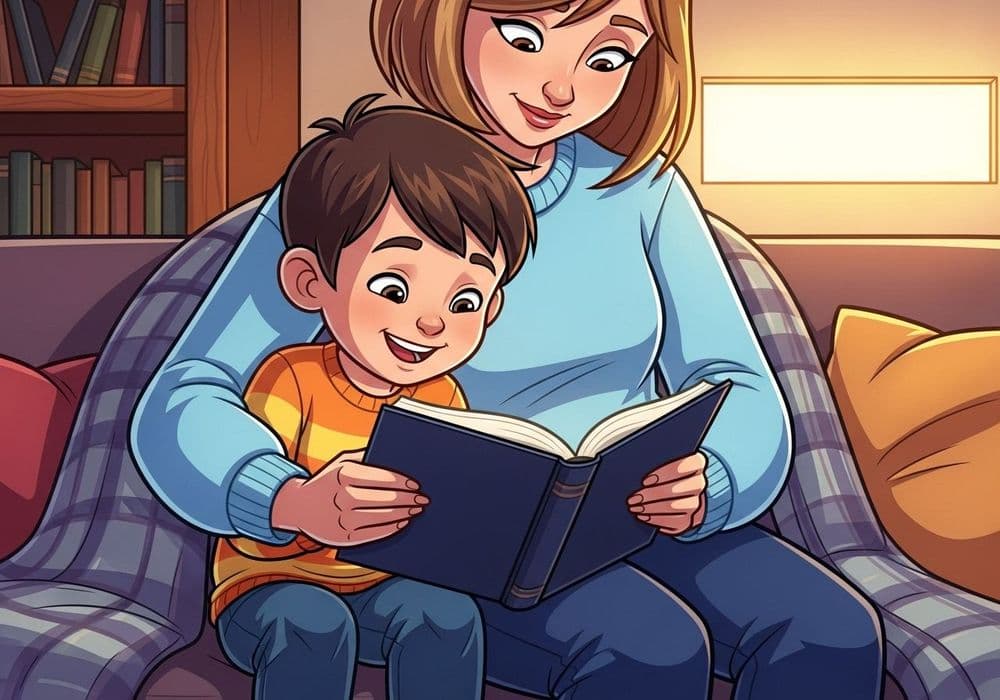
Comfort for shared reading: reading together requires a different kind of place – spacious and soft. A sofa, a large bed, a carpet covered with cushions. The main thing is that both of you can sit (or lie) comfortably side by side, so that the child can snuggle up to you and you can look at the pages and pictures together. This is a zone of physical and emotional comfort where your shared story is born.
The first thing to begin with is creating an attractive space at home where books live. Not just a shelf, but a real mini-library.
Accessibility. Books should be directly accessible to the child. Not on a high mezzanine shelf, but on open shelves at the child’s height. Let the child see the spines, reach for books independently, take them, leaf through them, and look at the covers. Even a toddler who cannot yet read should have the opportunity to interact with a book as an object – this is the first step towards love of reading.
Adding books chosen by the child. Be sure to visit bookshops and libraries together. Allow your son or daughter to choose something independently, even if it seems to you that it is “not the right” book (a comic, a dinosaur magazine, a story about robots). This choice is an act of respect for the child’s interests. Their own book, bought according to their own wish, will be valued and reread many times more often.
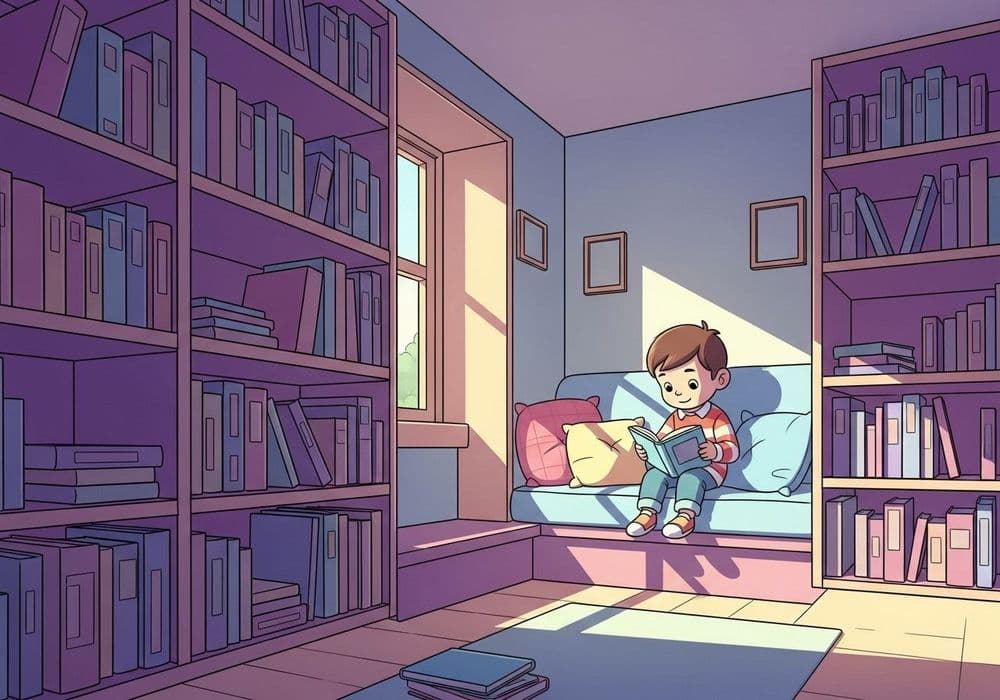
Variety. Fill the library with different genres: fairy tales, poetry, encyclopaedias, comics, adventures. And – a very important point – add “books to grow into.” Place several beautiful, complex, “grown-up” illustrated editions on the upper shelf (myths, classics, books about art). The child will reach for them, leaf through them, and ask questions. This creates an atmosphere of mystery and motivates growth: “I will read this amazing book when I am a little older.”
These are perhaps the most important rules. Violating them can permanently discourage a child from picking up a book.
• Never use reading as a punishment: in such cases reading becomes associated with boredom and tension in relationships. It should be a desired form of leisure, not bitter medicine.
• Never force a child to read. Do not stand over them, demand that they read “just five more lines,” or criticise them for reading slowly. If the child is tired or not in the mood – put the book aside. Pressure creates resistance. Your task is to interest, engage, and show what delight and comfort can be found in books.
• Creating conditions for reading is прежде всего about attention, respect, and willingness to share time together. It is about preparing your hearts together for a meeting with a story. Start small: find fifteen minutes today, settle comfortably in your “place,” open the book the child chose, and simply begin. The magic will come on its own.
A child does not need a “perfect reading parent.”
The child needs a parent who:
“Listen, there’s such an interesting idea here…”
Not: “You must read, it’s useful.”
But: “Let’s see what’s interesting here.”
What should I do if my child does not like listening to books?
I try to read, but the child runs away – does that mean they are not interested? Should I insist?
This does not mean that the child “does not like books.” Most often it means that the conditions in which reading becomes attractive have not yet developed. Shared reading is not a skill that can be “trained,” but a situation that needs to be created: cosy time together, an interesting book, and no pressure.
It is very important not to insist or force. Pressure quickly turns reading into an unpleasant obligation. It is better to begin with small things: short texts, books connected with the child’s interests, reading “in passing” – and observe what the child responds to. Sometimes the path to reading begins with comics, books about dinosaurs, or cars – and this is completely normal.
Why does the child ask to read the same book again and again? Is this normal, or is it better to offer new books?
This is not simply normal – it is a very important developmental process. When a child asks to hear the same book again, they are not merely “repeating,” but deepening their understanding. Each time they:
A familiar story provides a sense of safety and at the same time an opportunity to “practise” emotions. Therefore, there is no need to rush to switch the child to something new – new books can be added gently, but should not replace favourites.
Which books are better: informational or literary?
It is important not to oppose them, but to understand that they serve different functions.
Informational books provide knowledge, but literary texts are what help a child:
Therefore, it is important for a child’s life to include both, but literary books play a special role – they become a “space for experience.” At the same time, if the child is currently fascinated by books about technology, for example, it is possible to build on this interest and gradually broaden the range of reading.
Should I ask questions during reading or explain the meaning of the book? Or does this interfere with interest?
A sense of proportion is important here. If reading turns into constant questioning and explanation, it begins to feel like a test.
It is better to:
It is not necessary to “deliver the meaning” – much more important is that the child lives through the story. Understanding often comes not immediately, but gradually, through repeated readings and conversations.
What should I do if I myself do not like reading?
This is a very common situation – and it is normal.
A child does not need a “perfect reading adult.”
The child needs an adult who:
You can begin with small things:
The important thing is not to “force yourself to love reading,” but to try to find something alive and personally interesting in it. The adult’s attitude is transmitted to the child much more strongly than any words.
How to feel competent in shared reading with your child: tick the statements that are most often true for your family. Not “ideally,” but in real life.
Time
Space
Choice
Atmosphere
The Adult’s Position