Introductory video for this article — we recommend watching before reading
Imagination is one of the ways we come to understand the world.
This may sound unusual: we are used to thinking that understanding means analysing, “breaking things down”, looking for causes and effects. But here a child is clearly inventing something – so can this really be a form of understanding?
Let us take a closer look.
A four-and-a-half-year-old child is riding in a pushchair past a huge excavator that has got stuck near a building site and for a while is blocking the road for both pedestrians and cars. The excavator is “growling”, and people have to stop and watch its clumsy attempts to turn around without hitting the surrounding cars with its bucket. When the child gets home, he takes some blocks and begins to play out busy street traffic: a long blue block is clearly struggling, growling, and from time to time saying in a “machine voice”, “Make way”, “Permission to turn”, while the other block-cars are honking desperately.
This is clearly an echo of a recent experience, but let us look at the remarkably complex tasks the child is solving while creating this imaginary situation:
This allows us to see the extraordinary importance of imagination: it enables the child to
Images created by imagination are never “mechanical”: the child does not simply reproduce – they reinvent. Before our eyes, not a memory but a new story is being born.
This happens because imagination recreates another kind of reality: the reality of the child’s worries – the personal meaning of what is happening for the child, the desire to try something, or, on the contrary, fear, and sometimes both at once.
The child imagines these impressions of the unknown together with the feelings they evoke – that is, gives them form through images: through play (for example, toy cars arguing with one another), through drawings and gestures (if they need to show how a dragon growls and moves), or even through words (this is how first poems appear).
Imagination is the ability to express the overall meaning of a situation (and meaning is always personal – meaning for me) through something concrete and tangible.
People often think that imagination is merely fantasy – something close to irresponsible daydreaming that distracts us from reality.
In fact, imagination is a way of understanding meaning and creating an image of what is desired. What happens next depends largely on whether we are able to distinguish between reality and fiction, and whether we can bring imagined ideas into real life.
People sometimes think that a vivid imagination is dangerous because it intensifies anxiety. After all, an anxious person with a strong imagination may vividly picture every possible outcome – including the worst ones – and become even more anxious.
In reality, this assumption confuses causes and effects. In such situations, what matters is finding the source of the anxiety and helping the child feel loved and accepted.
People often believe that children have “better” imaginations than adults.
This myth sounds convincing: children easily invent things, engage in pretend play, and turn a stick into a rocket. But this does not mean their imagination is “better”. Rather, it is more freely expressed because it is not yet constrained by expectations about “doing things properly” or by fear of making mistakes.
In fact, imagination does not disappear in adulthood – it changes in quality. Adult imagination may become more complex, more coherent, more capable of holding contradictions and bringing ideas into reality. It is adult imagination that creates scientific hypotheses, architectural projects, and works of art. The problem is not that adults have less imagination, but that many stop using it – often because of experiences of evaluation (“I can’t draw”, “I’m not a creative person”).
Another important point is that the development of children’s imagination is not guaranteed. Without supportive conditions – play, open-ended materials, and dialogue with adults – imagination may fail to become more complex and may even weaken. This is why the adult’s role is to create conditions that support imagination, becoming a partner in inventing and exploring together.
Imagination is not a “childhood ability”, but a human ability – one that develops when it is given space in life.
By creating conditions for the development of imagination, we simultaneously support the growth of many other important abilities for which imagination serves as a tool.
For the development of agency: imagination allows the child to imagine themselves as an active participant and to rehearse an active position in thought and play (“I act”, “I can”).
For the development of thinking: imagination helps the child identify what is essential and distinguish it from what is secondary, which later becomes important for the development of abstract and even theoretical thinking.
For the development of play: imagination enables children to create worlds in which they can take on different roles and invent new plots.
For understanding others: imagination allows the child to imagine themselves in another role and to see a situation through someone else’s eyes.
For artistic development: imagination enables children to create works that express feelings through colour, form, words, and movement.
For construction and design: imagination allows the child to create an image that can later be embodied in a construction.
For storytelling: imagination makes it possible to create stories.
How imagination may appear:
In play
The child uses familiar materials to create imaginary situations and plots.
In storytelling
Let us consider an example of a story invented by six-year-old Anya.
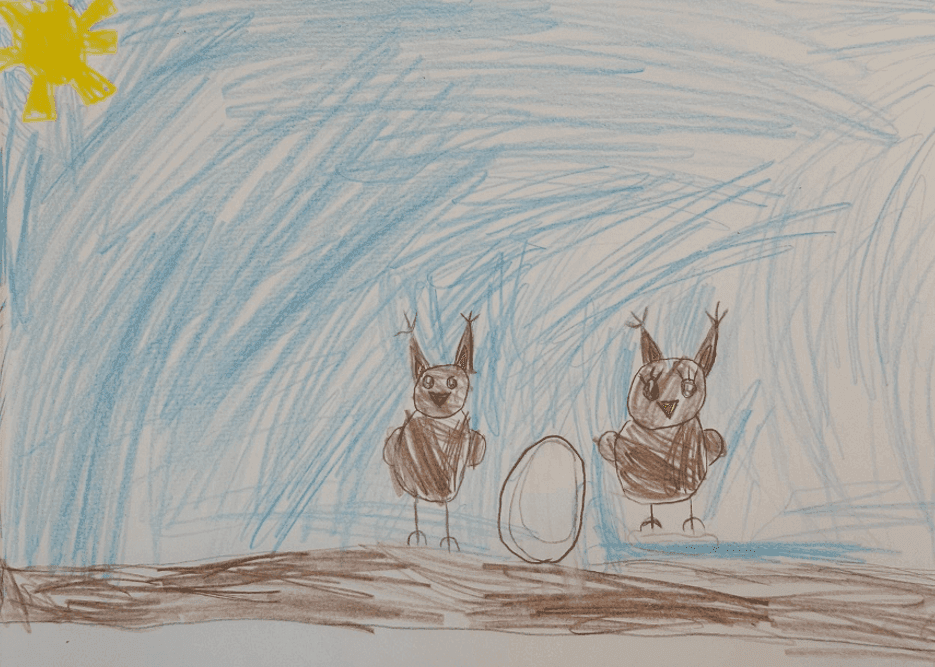
The Story of the Little Owl
Once upon a time there was a little owl. And he had a mother. And one day she flew in with an egg. And she said, "Soon we'll have a new little owl." "No," said the little owl, "no, no, and no! After all, I'm your little owl! Why do we need another one?" The mother said, "Indeed, but maybe it's a worm?" "No," said the little owl, "no, no, and no, they wriggle." And the mother thought and said, "But maybe it's a dinosaur?" "No, no, no, and no. It can't fly." "Indeed," said the mother. "But maybe it's some kind of flying sperm whale? We need to bring it some food quickly." "No, no, no, and no," replied the owlet, and then added, "But maybe it's a baby elephant?" "No," replied the mother, "no, think about our nest and the water, we could make some kind of waterfall there." "That's true," said the owlet, "but maybe it's a dragon? It can fly." "No," replied the mother. And then the owlet said, "That's true, maybe I'm your big owlet, and this one will be the new little one!"
This fairy tale is highly transparent: behind the little owl’s experiences and his difficult acceptance of a sibling, we can hear the child’s own worries and her relationship with a new member of the family. But what is especially interesting is that, in the story, the child’s worries are not merely reflected – they are transformed. Not only does acceptance of the new reality emerge and the emotional tone change (this is the transformative power of imagination), but an important step is also taken towards understanding the situation itself.
In construction and design
At first, the child creates an image of what is desired, without details – only a general idea. Then, through the work of thinking, the child invents ways of creating a stable construction.
Starting from lived emotional experience, imagination creates an expanded image, sometimes an entire world: the plot of a play episode, a story, or an artistic work. This is the point at which not only the object itself is discovered, but also its possibilities – something that borders on invention. This is the transformative power of imagination.
How to notice manifestations of children’s imagination: observe without interfering
Manifestations of imagination in children are often very fleeting.
They are easy to miss if the adult observes from a position of evaluation or instruction.
To observe imagination means changing one’s perspective.
1. Look not at the result, but at the transformation
Imagination lives not in what has been produced, but in how one thing becomes another.
Pay attention to:
A pencil becomes a thermometer, and then a magic wand.
This is the very moment when imagination is at work.
2. Listen to the speech accompanying play
Sometimes imagination “sounds” before it becomes visible.
Signs include:
Even if the play appears chaotic, speech maintains the integrity of the idea.
3. Notice emotional intensity
Imaginary images are almost always emotionally charged.
You may observe:
This is a sign that, through imagination, the child is living through something personally important.
4. Pay attention to transformations of objects
The development of imagination can be seen in how the child:
If the plot continues even without toys,
imagination has reached a new level of freedom.
5. Observe moments of “pause”
Sometimes the most important moment is silence.
The child may:
6. Do not rush to interpret
It is important not to translate what you see immediately into explanations:
It is better to leave space for meaning to remain open.
A simple rule for the observer
If you are unsure whether to intervene or not, ask yourself one question:
Am I helping imagination unfold – or am I trying to direct it?
Most often, it is enough simply to stay nearby, to notice, and to allow the child to invent.
Before using this checklist, it is important to remember: it is intended not for evaluating the child, but for observation. Children develop differently: each child has their own pace, interests, and ways of imagining. Imagination may appear vividly and immediately – or it may be quieter, subtler, more “internal”. This checklist is not a “norm” or a “development plan”, but a way of learning to notice: how the child transforms, invents, experiences, and makes sense of their own experience. Tick what you observe in your child – even if it does not happen all the time.
Transformations: how one thing becomes another
Imagination develops from dependence on the object towards greater freedom.
Plot and story
The child does not simply reproduce but re-invents the situation. Sometimes the differences from a familiar fairy tale or from yesterday’s story are small, but they are still very important.
Speech in play
Emotional involvement
This is a sign that, through imagination, the child is living through something important to them.
Drawing, construction, storytelling
The child is not simply making something, but expressing meaning and attitude.
Moments of “inner work”
At such moments, the inner unfolding of the image is taking place.
Children’s imagination is the ability to create new images, restructure reality, and move beyond the “here and now”.
But young children do this through reliance on objects: they need real things from which they can “push off”.
Therefore, the adult’s main task is not to teach “the right way”, but to create conditions in which imagination can unfold.
Time for free activity
It is in free activity that the following emerge:
If a child mainly acts “as shown”, imagination does not move beyond what is already familiar.
What is important to provide:
How to support this:
Interaction: supporting imagination in communication with the child
Imagination develops in situations where the adult:
Listen as though listening to a story, not to a “reproduction of facts”.
Do not correct (even if the plot seems strange).
Clarify in order to understand:
This helps the child unfold the image and add details (the very process of “objectification”).
Support the development of the plot.
For older preschoolers, another important process emerges – integration: when an entire plot appears rather than a single image.
Helpful questions include:
Express genuine amazement.
Imagination becomes stronger when the adult is sincerely involved:
What is best avoided:
Materials for inventing (with support from objects)
Boxes, fabrics, cushions, sticks, stones, natural materials, bottle tops, small objects, human and animal figures.
Such materials help the child “see the whole before the parts”: a piece of fabric may become part of many different wholes and turn into a tablecloth, a tent, or Superman’s cape.
Materials for creative activity
Imagination develops not only in play, but also in:
The child learns to embody images in visible form and to express feelings and attitudes through colour, shape, and movement.
For example:
How to support this:
Transformation of space
Imagination becomes stronger when the child can build “houses”, “worlds”, and “cities”, transforming space according to their own idea.
How to support this:
My child is constantly inventing things. Is this normal, or are they “escaping from reality”?
This is not only normal – it is important.
Imagination is a way of understanding reality, not escaping from it.
When a child “makes things up”, they are:
For example, playing with an “excavator made from a block” is not fantasy for fantasy’s sake, but a way of making sense of what the child has seen.
Should children be given models to copy (how to draw, build, or play)?
It is important to maintain a balance.
If a child mainly acts by copying a model, imagination:
But if you demonstrate a technique (for example, how to hold a paintbrush or draw eyes) while still encouraging the child to create their own idea, the child will be able to:
My child’s drawings are “messy” and “hard to understand”. Is this normal?
Very often, children’s drawings are not simply pictures but a form of play. Action unfolds directly on the sheet of paper. What may appear to an adult as untidy scribbles may in fact contain unfolding events.
Imagination appears:
Accuracy and technical skill come later.
My child repeats the same play scenario again and again. Is this normal?
Yes – this is a very important process.
Repetition means that the child is:
Here imagination does not merely reflect experience – it transforms it.
My child talks to themselves during play. Is this normal?
Yes – this is an important sign of development.
Speech in play:
Sometimes imagination first becomes audible and only later visible.
Does imagination need to be deliberately developed, or does it develop naturally?
Both are true.
Imagination develops spontaneously, but:
The adult’s role is to create situations in which the child:
Tick the statements that apply to you: