Introductory video for this article — we recommend watching before reading
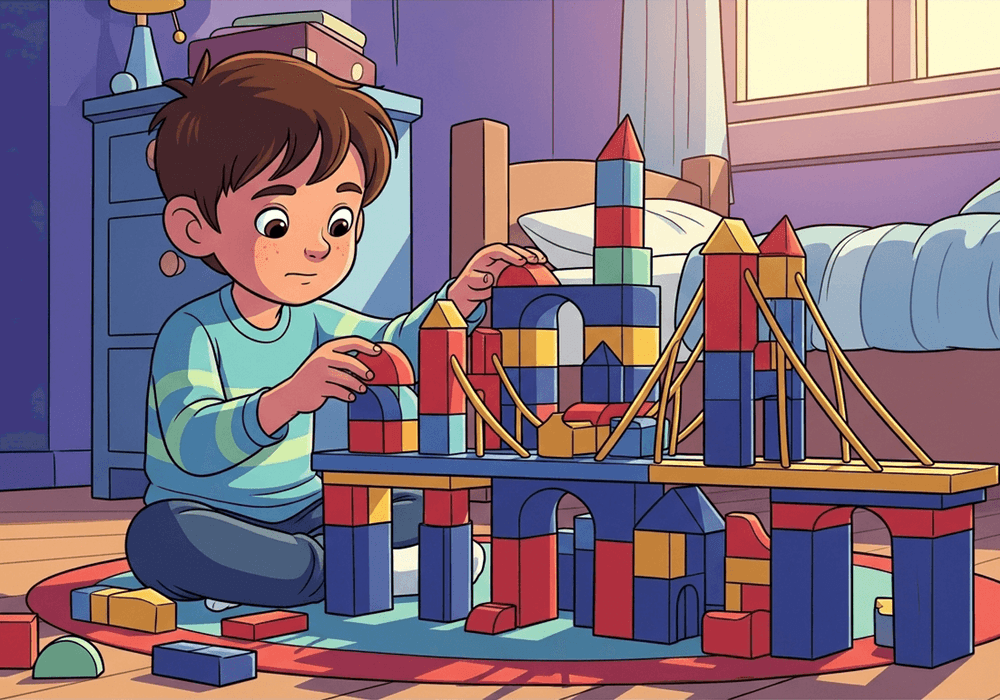
Construction is a special children’s activity in which a child creates a model-construction from a particular material.
It is a model because a child’s construction is always the building of something from the external world that the child reproduces using blocks or construction sets.
“Construction” means that, while building, the child must take into account the physical properties of the material; otherwise, the intention cannot be realised. The house will collapse, the car will not move, and so on.
Construction is connected with two other major children’s activities – play and experimentation. Most often, the desire to build something emerges precisely within a play situation: the child builds a house for a doll, a castle for a robot, or a zoo for animals. Having built it, the child may return to play – and begin “living in” the construction within the play world.
At the same time, construction has its own goals – to realise an intention – and gradually it may become a separate activity in its own right, when the main motive is no longer the play plot itself, but the construction.
For a child, construction is not preparation for the profession of engineer, but a special form of mastering culture. Through construction, the child becomes involved in a specifically human way of thinking – planning, relating intention and result, and transforming material.
An adult designer begins with an idea and a blueprint; a child initially begins with action, with trial and experiment. But both pass through the same path: from intention to realisation.
Through constructing, the child enters a cultural activity in which thought becomes action, and action becomes a way to understand and express thought.
This section will focus specifically on construction with blocks.
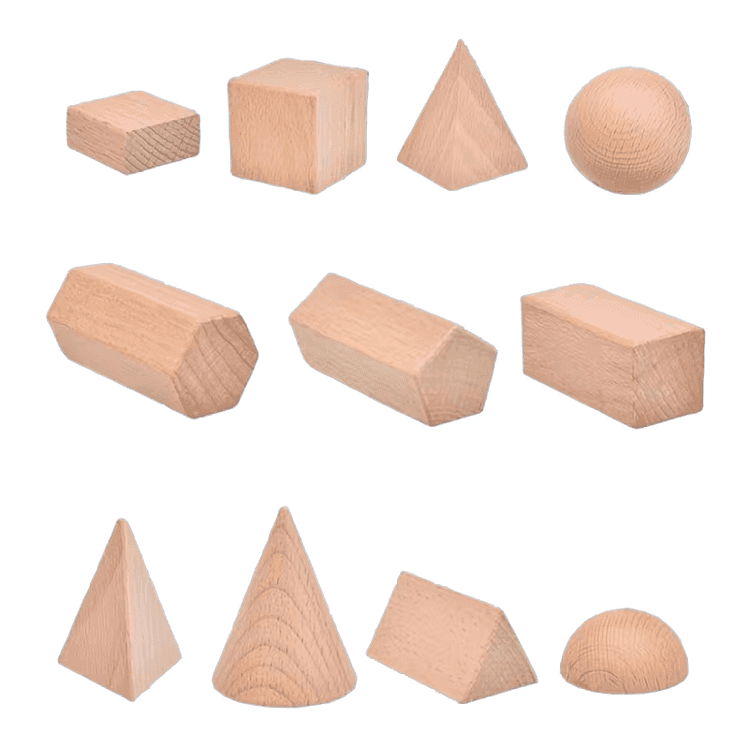
Blocks are a very special construction material. Unlike most construction sets, they consist of basic three-dimensional forms – cubes, parallelepipeds, prisms, cylinders, and so on.
These forms contain key proportional relationships, and this is precisely why building with them is so developmentally valuable.
These basic forms allow different ways of creating the same three-dimensional figure from different initial elements: for example, to build a cubic house, you may use one cube, or several parallelepipeds, or two prisms. And this is where the developmental potential of this construction material lies.
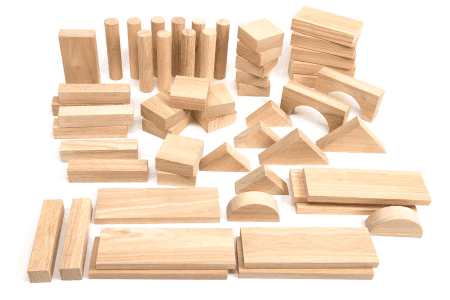
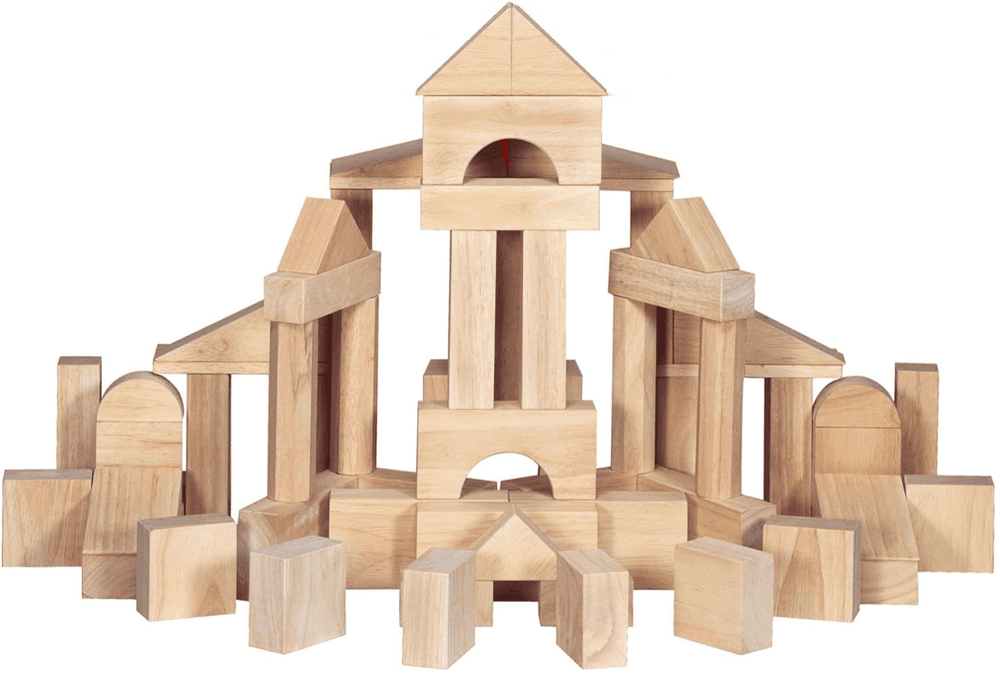
Below are examples of the kinds of elements that should ideally be included in a good construction set:
Supposedly, the main thing is the result: that the child should create complex constructions
In fact, in construction it is important not only what is built, but also the process itself. The child learns to think with their hands, to search for solutions, to make mistakes, and to correct them.
Supposedly, the main thing is to be able to build from a blueprint, “correctly,” while when a child builds according to their own intention, this is “just play”
In fact, this is not true. It is indeed important in construction to be able to use a blueprint, understand projections, and so on. However, these are all means, and they should be used precisely for the realisation of one’s own intention. Intention is no less important than skills.
Supposedly, construction is only for boys
In fact, this is not true. Both girls and boys equally need the experience of creating and transforming. Construction develops universal qualities – thinking, imagination, initiative – and these are important for everyone.
In construction, it is not simply “fine motor skills” or “attention” that develop. Through construction, the ability to mentally structure the world is formed – to perceive relationships, proportions, order, and patterns.
What exactly develops through construction?
Expression of Feelings
The expression of feelings through creating an intention is a prerequisite for an aesthetic relationship to the world.
Any intention reflects not only a person’s thoughts and ideas, but also their feelings. Any constructive activity is also the ability to embody one’s feelings through material.
One should not think that feelings, including children’s feelings, lie on the surface. In reality, it is often not so easy for a person to understand what mood they are currently in.
Construction can help children become aware of their feelings and embody them in material constructions.
Through construction, the child may discover that form can express character: a straight house is calm, a crooked one is fairy-tale-like, mysterious.
Self-Regulation (Voluntary Behaviour)
During construction, the child learns to select materials and sustain a task over time, building a sequence of actions.
As a result, the following abilities emerge:
Cognitive Abilities
Imagination: the ability to create an intention, an image of the future
Initially, the intention emerges at the end of the construction process or during it. The reason is that the ability to act purposefully – from intention to result – does not appear immediately in children.
At first, at the age of three, when asked, “What are you building?” a child answers, “I don’t know, I’ll build it and then you’ll see.”
During construction, the ability develops to create an intention in advance, internally.
It is precisely through creating an intention that imagination develops: the ability to imagine a new image before the details of its realisation – materials, physical parameters, and so on – are fully understood.
Mathematical abilities
Mathematical abilities are connected with spatial thinking, which develops through building with blocks.
Solving tasks that require holding several characteristics simultaneously. For example, height and balance.
Decentration
The ability to imagine an object from different perspectives.
Visual modelling
With a little support, construction can become the activity through which the child masters visual models (drowings and diagrams) already in the preschool years.
Aesthetic perception of reality
Through discovering symmetry and asymmetry.
Development of creative abilities — dialectical thinking
While thinking about how to build a bridge so that it does not collapse but can support the weight of a toy car, the child may arrive at unusual solutions.
Construction gives rise to a readiness to solve non-standard problems and to experiment with materials and constructions in order to do so.
Communicative Abilities
Children learn to coordinate points of view, negotiate, and help one another.
Can All of the Above Develop in Other Activities?
Yes. And this gives parents a great deal of freedom.
If there is absolutely no opportunity to create conditions for construction with blocks, all of the above will, to one degree or another, develop through other activities.
Is there something for which construction creates especially favourable conditions?
Yes: visual modelling and spatial thinking.
A checklist for observing children’s construction that will help you notice important aspects of children’s construction activity.
How the Child Acts
Does an Intention Appear?
How the Way of Acting Changes
Does Play Emerge Around the Construction?
Here the construction becomes not simply an object, but a space for imagination and action.
How the Child Relates to Failure
Do Transfer and Generalisation Appear?
Does Work with a Model Appear?
What Happens in Speech?
It is important to create opportunities at home for building with blocks – an attractive, “inviting” environment. It may immediately capture the child’s interest, or it may do so only after some time, or perhaps not at all – it is impossible to predict how things will develop.
But in any case: if the conditions are created, they will certainly influence the child’s development – sometimes in unexpected ways or at unexpected moments.
The construction set should be large enough to build a castle or a small town. It should contain a variety of forms: cubes, cones, prisms, parallelepipeds, arches. It is precisely this diversity that stimulates imagination.
There should be a place for constructions so that they do not have to be dismantled when toys are tidied away. This is important: only in this case is it possible to return to constructions and improve them.
It is important that there is a convenient surface for building on, so that constructions remain stable.
The construction area should contain small figures (cars, animals, etc.) in order to provoke play. It is precisely within play that the desire to build initially emerges (a house for a kitten, a garage for a dump truck). And often the opposite also happens: a construction is created for its own sake and then becomes incorporated into play.
The connection between play and construction is valuable both for play and for construction itself.
Time for free activity is a necessary treasure, because it is during this time that the child can engage in something – including construction – on their own initiative.
Yes, the child may not choose building with blocks during their free time. But if they do choose it, this will be initiative-based construction, and that has particular value.
It is important to use words connected with spatial relationships in speech: higher/lower, under/above, on top/below, farther/closer, balance, cube/square, and so on.
As research shows (see the “Learn More” section), this influences children’s spatial thinking.
This can be done both during construction and in everyday life.
If there is desire and opportunity, sometimes build together with the child or even alongside the child. Give freedom to your own inner child.
This may prove much more useful than didactic attempts to involve the child in construction through offering “tasks.”
An adult’s enthusiasm is an extremely important factor: sometimes children watch an enthusiastic adult for a long time before their own interest awakens.
This applies not only to construction.
Interest is not something that exists from the very beginning; it is something that awakens.
Photographs of architectural works displayed in the home or directly near the construction area greatly expand children’s repertoire and broaden their understanding of what is possible.
Of course, it is best if each photograph is discussed with children in some way: when it is possible to look together, notice details, wonder, and admire.
Such an experience of shared perception is invaluable.
Even if these cultural examples are not directly used in construction, they will influence children’s artistic taste and outlook. And if construction does become engaging, they will become a source of new ideas.
During travel and even ordinary walks around one’s own town, it is important to draw the child’s attention to different buildings, compare them, choose favourite constructions, and wonder and admire together.
Such experiences help the child begin to perceive the surrounding architectural environment as a source of aesthetic pleasure.
In construction, the child may master different positions:
If a play situation is created, partners in construction (an adult and a child, or several children) can take turns occupying different positions.
For example: “Now I draw the blueprint, you build, and Mum checks.”
Or the child creates the blueprint, Mum builds, and the child checks.
Again, it is important for adults to be able to make mistakes that help the child remain “alert” and thereby master visual modelling.
Sometimes adults unintentionally interfere with the development of construction. This happens when the adult:
The main thing to remember: the adult should not be a director; the adult should be a partner.
It is important for the child to feel that their idea is interesting and valuable. Only then does the child learn to think and act independently.
Better questions to ask:
Better not to say:
These phrases help avoid taking the child’s intention away from them.
It is not at all necessary to “teach” construction directly.
It is enough to be nearby, to be interested, and not to interfere.
What if the child is "not interested in construction"?
First of all, there is nothing wrong with that.
Just like adults, children have the right to be more interested in some things than in others.
Secondly, the adult’s task is to create a space of possibilities for trying things out and developing interest.
Interest is not something that exists from birth.
Interest is something that emerges through interaction with the world and with adults.
Moreover, children very often “catch” enthusiasm from adults who are genuinely interested in something.
Interest appears not before the process, but within the process itself.
So what matters is that the opportunity to construct exists. What happens next will develop naturally.
Is construction important for children who are not going to become engineers and are supposedly more "humanities-oriented"?
With preschool children, it is not worth speaking about “humanities-oriented” versus “technical-minded” children.
The preschool years – and those that follow – are a time for trying things out, understanding oneself, experimenting with the world, and allowing interests to emerge.
Any early “self-definition” or “career orientation” is inapplicable to preschool age.
(And, in parentheses, the opposition between “humanities-oriented” and “technical-minded” people has largely lost its relevance in the modern world – but that is a separate discussion.)
Why blocks, when there are so many construction kits?
Blocks possess important characteristics that support the development of spatial thinking: they can be represented and imagined from different projections.
The value of block construction in no way excludes building with construction kits – let there be a wide range of construction materials in the child’s environment.