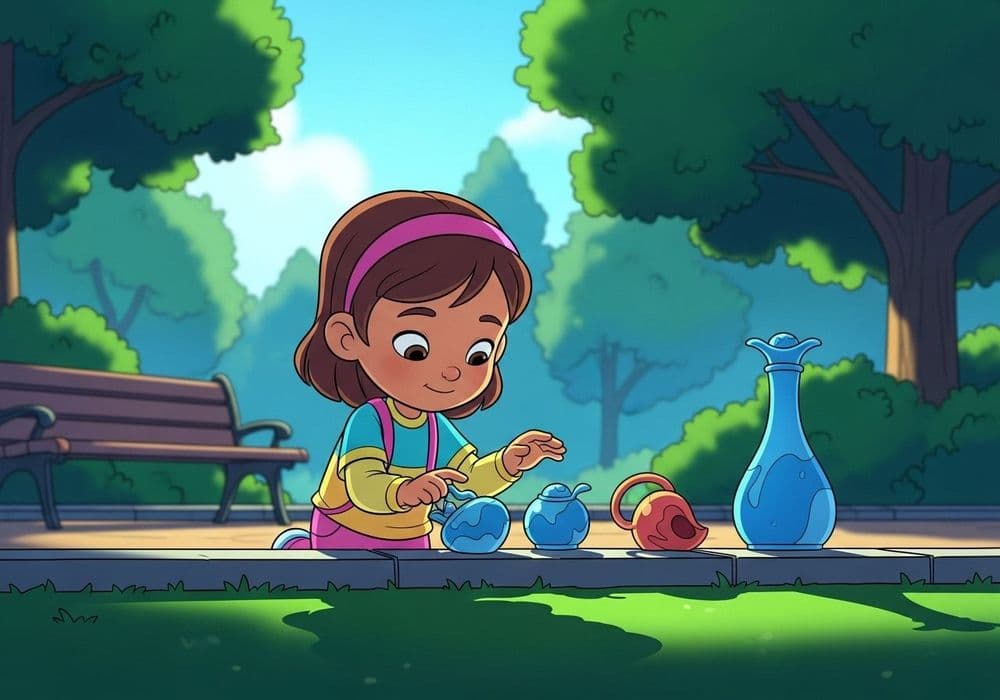
Introductory video for this article — we recommend watching before reading
You have often seen a child:
Are they playing, messing about, doing nothing?
No – they are experimenting:
Is this trial and error?
Yes. But it is important to understand that an error is actually a hypothesis that has not been confirmed. In other words, by experimenting, the child learns to put forward and test hypotheses.
“What if I try it like this? And like this? It doesn’t work. Right – what if I try this way? Oh, it worked!”
This is approximately how we act when a problem cannot be solved immediately. It is not simply a matter of trials, but of “joyful” trials, where a person imagines what else could be done and experiences not fear that it will fail, not irritation that it is not working, but excitement and interest.
The well-known American psychologist Alison Gopnik calls children “scientists in the crib,” because children explore the world in much the same way as real researchers.
…that children’s attempts are chaotic
A child turns objects around, connects and disconnects them, repeats the same action again and again.
In reality, research and observation show the opposite: in experimentation, the child does not act randomly, but builds their own logic of inquiry. The child tries simple options, notices effects, and gradually makes their actions more complex. The goal is not given in advance in words, but gradually emerges within the process itself.
Chaos is only the external impression; internally, the child is working to build cause-and-effect relations.
…that it is more effective to show “how it should be done” than to let the child try independently
Direct demonstration seems to adults like the shortest route to the result.
In reality, demonstration often interrupts the main developmental mechanism: exploratory activity. When the child is immediately shown the “correct way,” they begin either to copy, or to give up quickly if copying does not work.
In free experimentation, the child learns something much more important: to try, to withstand failure, to change strategy, and to find a solution independently. This takes more time here and now, but creates more stable abilities for the future.
When you support children’s experimentation, you immediately create conditions for the development of many different abilities:
Anyone who has observed preschool children knows that they are constantly trying things out. They perceive everything around them as a challenge and as a kind of training ground: “Can I manage this? What about this way? And this way?”
A preschool child will not simply walk properly along the pavement – they will certainly try walking along the kerb, just to check whether they can do it.
Through experimentation, the child learns:
Children’s experimentation rarely looks like a neat experiment with a clear goal.
More often, it looks like “fiddling about”: the child tries, repeats, changes, returns, gives up, and then takes it up again. To observe experimentation means to look not at the result, but at the course of the search.
Pay attention to how the child:
These are signs that the child is investigating, not simply playing randomly.
It is also important to notice pauses: moments when the child freezes, looks closely, and thinks. In these seconds, an internal rethinking of experience often takes place. It is better not to hurry or prompt – silence works more powerfully here than words.
Try to look at the child’s actions in a new way and see the early signs of inquiry activity.
The child presses all the buttons on a musical toy
The child pours water onto the ground and watches it disappear
The child watches a ball roll down a slope
Tick the things you often notice your child doing.
Repetition and Variation
This is about searching for patterns.
“What Will Happen If…?”
This is about forming hypotheses.
Observation and Pauses
This is about making sense of experience.
Increasing Complexity
This is about the development of thinking.
Transforming Materials
This is about creative and dialectical thinking.
Testing Their Own Abilities
This is about agency and self-regulation.
Experimentation in Language and Ideas
This is about linguistic and creative thinking.
Experiments in Communication
This is about social understanding.
The toys that stimulate experimentation least are those in which everything has already been decided for the child and where there is only one obvious way to play. Such toys leave little room for children to act in their own way.
The following toys and materials, however, leave room for freedom and encourage experimentation:
Multi-functional Materials
Sticks, pebbles, wire, fabrics, cardboard boxes.
Yes – these are exactly the things children so often love and adults so often dismiss: “just a stick.” Yet with a stick one can study the laws of floating and sinking, discover that it does not bend unlike wire, or notice that it makes very different holes in the sand from a spade.
Materials with Different Textures
Fabrics and paper of different densities, smoothness, or roughness; different surfaces.
Materials for Artistic Exploration
Paints, plasticine, clay.
First experimentation, then result.
Initially, children are fascinated by the traces that fingers, brushes, or rollers can leave behind. Gradually they begin to discover that colour or form can express mood. In this way, artistic creativity grows out of experimentation.
Toys and Materials That Allow Children to Discover Physical Laws Through Action
Natural and everyday materials: water, sand, pebbles, sticks, boxes.
What the child discovers: properties of objects: wet/dry, heavy/light, falls/does not fall.
What matters for the adult: do not limit repetitions; do not demand a result.
Materials with different textures: soft and hard fabrics, thin and thick paper, smooth and rough surfaces.
What the child discovers: differences in sensation; how actions depend on material.
What matters for the adult: allow touching, crumpling, comparing.
Materials for making “traces”: finger paints, water with brushes, soft plasticine.
What the child discovers: “if I do this → what happens?”, appearance of a trace.
What matters for the adult: do not require a “picture”; value the process.
Simple objects for action: blocks, balls, containers for pouring and transferring.
What the child discovers: basic cause-and-effect relations.
What matters for the adult: allow time for trials; do not rush to help.
Multi-functional materials: sticks, stones, wire, boxes, fabrics.
What the child discovers: different ways of using and transforming objects.
What matters for the adult: support the child’s ideas; do not impose one correct way.
Materials for comparison: different surfaces (sand, soil, asphalt), liquids, containers.
What the child discovers: comparison, first conclusions, patterns.
What matters for the adult: ask questions: “What changed?”
Artistic materials: paints, clay, plasticine.
What the child discovers: movement from experimentation to intention.
What matters for the adult: do not rush children to “draw properly.”
Simple scientific materials: spinning tops, balances, magnets, mirrors, lenses, torches, magnifying glasses, nesting dolls.
What the child discovers: physical regularities: rotation, equilibrium, reflection, etc.
What matters for the adult: discuss observations rather than explaining in advance.
Materials for combining: construction sets, everyday materials for inventions.
What the child discovers: creating new solutions; engineering thinking.
What matters for the adult: support exploration, even if the result is “imperfect.”
Useful Suggestions
Experimentation lives where we trust the child and what the child is doing. If a child feels that they are allowed to try, make mistakes, and return to an idea, their exploratory activity does not fade away, but gradually turns into the ability to set tasks and search for solutions.
Listen to Your Own Language
Better to Say:
Better Not to Say:
To support children’s experimentation, you do not need special lessons or materials. A few simple things that can easily become part of everyday life are enough.
1. Allow the Child to Try
Do not stop the child if they are exploring: pouring, mixing, repeating, checking. This is not “messing about,” but a way of understanding how the world works.
2. Do Not Rush to Show “the Right Way”
Even if you know the answer, let the child try first. Understanding is born in the search.
3. Ask a Question Instead of Explaining
“What do you think will happen if…?”
“What will change if…?”
This is already enough to set thinking in motion.
4. Give Time and Tolerate the Pause
Do not rush. It is important that the child has time to notice, think, and try again.
5. Stay Calm About Mistakes
If it did not work, this is not a problem, but the next step:
“It didn’t work… what could we try now?”
6. A “Rich” Environment for Experimentation Can Look Very Simple
Water, sand, stones, boxes, paints – this is enough for many discoveries. Let them be accessible both at home and outdoors.
Experimentation is supported not by special lessons, but by the adult creating an environment for experimentation, allowing the child to try, not rushing to explain, and showing interest in what the child is doing.
Evaluate yourself in 1 minute. Tick the statements that are most often true for you:
Why does the child do the same thing many times – isn’t it meaningless? Isn’t the child wasting time?
No – this is learning.
By repeating, the child changes conditions, notices differences, and “feels their way” towards a pattern. They are not wasting time, but building an understanding that cannot be given through explanation alone.
How can we distinguish experimentation from “chaos” and mess?
Look not at the outward appearance, but at the process.
If the child:
then this is inquiry, even if from the outside it looks like “fiddling about.”
How is this connected with school readiness and learning?
Directly.
Experimentation develops:
This is the foundation of successful learning – not only knowledge, but the ability to learn.
When should we show “how it should be done,” and when is it better to let the child try independently?
First – let the child try. Then – discuss.
If you show immediately, the child will copy.
If the child explores first, they understand rather than reproduce.
Should we correct the child if they are doing something “wrong”?
It is better not to correct directly.
It is more useful to ask: “What happened? How else could it be done?”
This way, the child discovers limits and possibilities independently.
How can we understand when it is time to help rather than wait for the child to succeed?
The guide is the child’s state.
It is worth helping if:
Do not rush if the child continues trying, even if it looks “inefficient.”
The main thing is not to deprive the child of the opportunity to search.
Can there be “too much” freedom?
Yes – if there are no boundaries or support at all.
The optimum is freedom of action + the presence of an interested adult
Not “do whatever you want,” but “I am here, and I am interested in what you are doing.”
Why does the child abandon what they started – is this normal? Should we insist that the child always brings things to a result?
Yes, this is normal.
Switching is part of the search: the child compares, returns, checks.
Not only the result matters, but the process itself.
The ability to complete things develops later – through interest, not pressure.
What should we do if the child fails and becomes upset?
Acknowledge the emotion and support the attempt: “Yes, it didn’t work… What could we try now?”
It is important to show:
Should we ask questions, or is it better not to interfere? Should we explain?
Better:
Good questions:
Explanation is useful after experience, not instead of it.
How can we support interest without turning it into a lesson?
Be a co-researcher, not a teacher:
Interest is supported by the adult’s attitude, not by assignments.
How can we allow experimentation and still keep order?
Separate:
For example:
“With water – in the bathroom or on a tray.”
Do not restrict experimentation itself; organise a space for it.
Why does the child sometimes smear paint instead of drawing “properly”?
Because the child is exploring the material.
They are studying:
Drawing appears later – out of these attempts.
The child “tests boundaries” in communication – is this also experimentation?
Yes. The child is exploring:
It is important not only to forbid, but also to discuss: “How do you think he reacted that way?”