![[EN] CHILD LAB](https://childlab.co.uk/wp-content/uploads/sites/4/2026/01/child-lab-logo.jpg)
What Is Play?
Over recent decades, the importance of play has been discussed so frequently that it can seem as though everyone fully understands why play is valuable for preschool children and why it deserves support. In reality, however, there are far more myths than genuine understanding.
Play is often seen as something important, yet still less valuable than organised activities. Many parents believe that it is structured activities that prepare a child for the future. Very often, play is understood as anything children do in their free time. Adults say, “Go and play,” assuming that play will naturally happen—although in practice, play does not always emerge in such situations.
So let us take a closer look at what play actually is.
Play: An Imaginary Situation and Initiative
Play is a special form of activity with several defining characteristics. If even one of them is missing, what is happening is most likely not play.
First, play involves an imaginary situation that allows the child to hold two spaces at once: the real, visible world that can be touched and manipulated, and a meaningful, invisible one. One space is “as if”, the other is “as it is”, and play arises at their intersection.
When a child picks up a stick, it may become a thermometer, a spyglass, a spoon, or a pencil—while at the same time remaining a stick. What is remarkable is that the child holds this duality with ease: they act with the stick as if it were a spoon, while fully knowing that it is a stick. As one psychologist put it:
A child quite seriously feeds a doll a sand pie, yet would be very surprised—and even frightened—if the doll opened its mouth and took a bite.
Holding these two spaces—the real and the imagined—is cognitively demanding, which is why play is considered a complex form of activity.
Second, play is characterised by initiative. In play, the child creates new twists in the storyline, introduces new events, and follows their own desires and experiences. When there is no initiative—when adults offer a ready-made script or tightly direct what should happen—the activity ceases to be play.
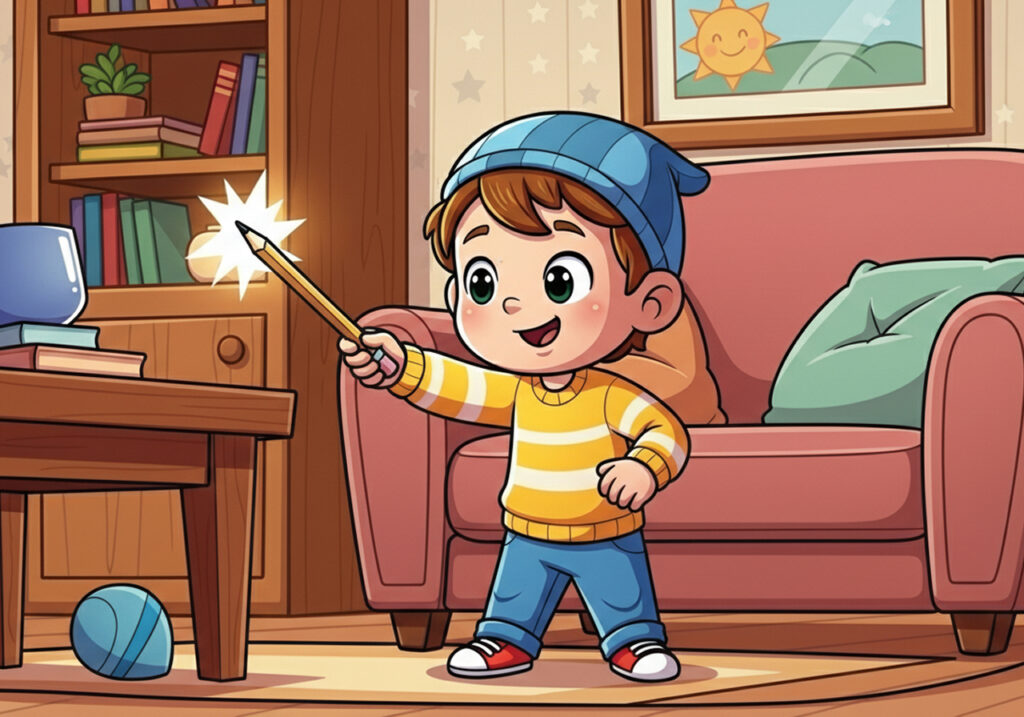
The presence of an imaginary situation and the child’s initiative are the two key features of play. Together, they make play a space of experimentation and joy, of freedom and rules at the same time.
Myths About Play
Myth 1. “Play is just entertainment, not a real activity.”
Play often looks unserious: the child pretends, fantasises, says odd things, and acts “as if”. Because of this, play may appear to be merely a break between “real” activities. In fact, it is in play that a child first becomes the author of their own activity: they create meaning, roles, rules, and the flow of events themselves.
Play is not a pause in development; it is the very form through which a child learns to act according to an idea, to regulate their behaviour, and to work with imagination. Without play, neither creativity nor independent thinking can fully develop.
Myth 2. “If a child plays a lot, they will be less prepared for school.”
This myth grows out of fear: what if play distracts from learning? Yet play and learning are not opposites. In play, children develop precisely the skills that make learning possible: the ability to hold a role, follow rules, and act meaningfully rather than impulsively.
If play is pushed aside too early, a child may know letters and numbers but struggle to learn: they may find it difficult to concentrate, set goals, or sustain effort. Play does not hinder learning—it lays its psychological foundation.
Myth 3. “Fantasy and play are lies that should be discouraged.”
Adults are often concerned when children “make things up”, “distort facts”, or insist on events that “didn’t really happen”. Yet fantasy in play is not deception; it is the work of imagination. Through play, children learn to distinguish reality from fiction and to manage images, meanings, and emotions.
When adults demand too early that children “tell only the truth” and “stop making things up”, they deprive them of one of the most powerful tools of development. The capacity to imagine is the foundation of creativity, thinking, and emotional resilience.
Types of Play
Director Play
Director play is a form of play in which the child acts with characters and for them. These may be small figurines, or everyday objects—buttons, blocks, pinecones—that become characters in the child’s hands.
A classic literary example can be found in Lev Kassil’s Conduit and Shvambrania, where an imaginary world emerges when chess pieces turn into characters. Director play appears very early: even two- and three-year-olds can act as “directors”.
At first, there may be no storyline. The child animates figures: they move, speak, and interact. Yet this is already genuine play, because it unfolds in the space of “as if”. Later, the first storylines begin to take shape.
Interestingly, director play reappears in older preschoolers at a new developmental level. Now the child is no longer simply reflecting isolated actions but is able to construct entire stories and worlds.
In developed director play we can observe:
- Above-situational thinking — the ability to create roles, space, scenery, and plot, which supports an authorial position;
- Story construction — an early form of storytelling;
- The beginnings of visual modelling, when space is organised as a stage for action, laying foundations for construction and design.
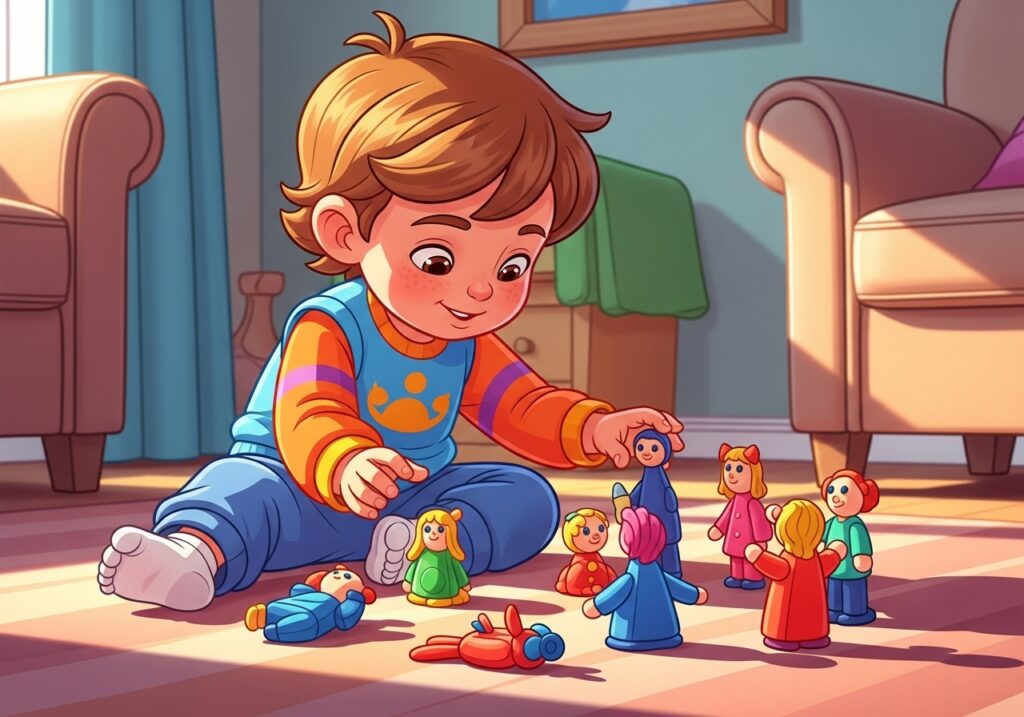
Director play may unfold with partners, but children can also play alone. It may involve ready-made toys—hence the popularity of small themed figurine sets—but it often develops even more richly with homemade toys.
Despite the growth of the toy industry, children never lose interest in toys they create themselves. A homemade toy can perfectly match a child’s idea and help bring it to life. This is why children still love making toys from clay, paper, or other simple materials.
Director play may also unfold in drawing. What adults see as “spoiling a picture” may in fact be play. For instance, a child may draw a beautiful house and then suddenly announce, “And then a storm began!” and scribble over it. For the child, the value lies not in the finished image but in the unfolding storyline. They are not ruining the drawing; they are continuing the plot.
Imaginative Role Play
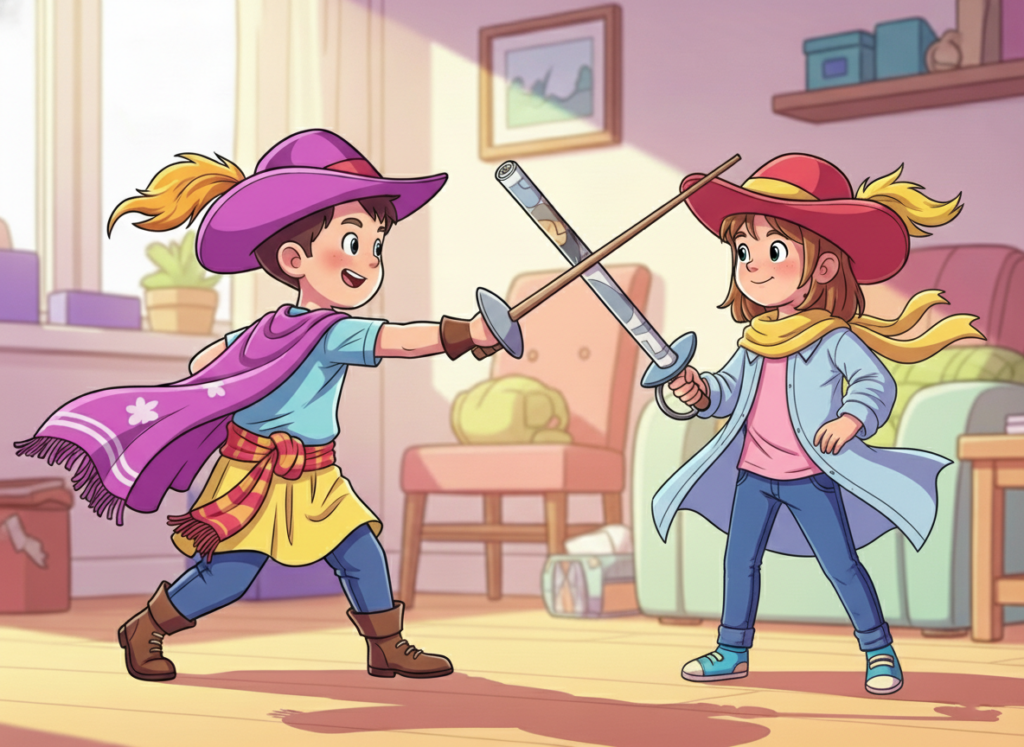
In imaginative role play, the main focus is on creating an image. The child becomes someone or something else, sometimes changing their walk or voice, sometimes using simple props. A child may turn into a kitten by putting on ears, or into a musketeer by wearing a cloak made from a parent’s scarf.
Here, the emphasis is on embodying the character—their movements, habits, and temperament—while a storyline may not yet be present. A child can remain in this “as if” space for a long time without losing interest.
Plot-Based Role Play
Plot-based role play includes both roles and a storyline and usually involves partners. Storylines may unfold over long periods, returning day after day. Even when plots are short or repetitive, such play is important for expressing and transforming children’s experiences.
Games with Rules
Games with rules are forms of play in which behaviour is constrained by agreed norms rather than by a free storyline. These games support the development of self-regulation and social interaction. Children learn to take others’ actions into account and to restrain impulses in order to follow shared rules.
What Develops Through Play?
It is now well established that play is essential for a child’s development.
Emotional development and agency
In play, children live through feelings in a symbolic space. Fears, desires, and conflicts can be transformed. A child afraid of doctors may become the doctor, treating sick toys and gaining a sense of control. Through play, children try out different positions—from vulnerability to agency—an invaluable experience for emotional growth.
Self-regulation
Play supports voluntary control: the ability to manage behaviour and follow rules. Children willingly endure challenges in play that would otherwise be difficult—sitting still, waiting, holding back impulses. Play is often described as the cradle of self-regulation.
Initiative
In play, children follow rules they have invented themselves. This unites initiative and self-control: proposing rules and choosing to follow them.
Communication
Shared play requires negotiation, coordination, and conflict resolution. Children learn to listen, persuade, and adjust their actions so that play can continue.
Creativity and dialectical thinking
Play is the creation of imaginary worlds. Over time, children move from reproducing everyday scenes to inventing dragons, distant lands, and complex contradictions that require flexible thinking.
For these reasons, play is considered the leading activity of the preschool years. Through joy and freedom, it fosters the psychological foundations needed for the next stage of development. Well-developed play is a key prerequisite for school readiness.
What Develops in Children’s Play?
Today it is well established that play is essential for a child’s development.
First, play supports emotional development and children’s agency. This means that, in play, children can live through their feelings in a symbolic space—that is, they create an imaginary world in which experiences are not only reflected but also transformed. If, in real life, a child is—for example—afraid of the doctor, then in play the child can become the doctor, treating sick cuddly toys—and in this way their fear can be experienced and worked through. In play, a child takes an active role: for instance, becoming a rescuer of those who need protection, or a fairy who brings gifts—trying out different positions. It is precisely in play that a child can move from feeling weak and unprotected to becoming someone who rescues others and makes decisions. This is an invaluable experience for emotional development and for the growth of agency.
Second, play develops self-control—the ability to manage one’s actions and follow rules. In play, a child can follow quite complex rules. For example, jumping while squatting is difficult, but if the child is playing a frog, they will willingly and joyfully overcome this difficulty. A child playing hide-and-seek may hold their breath and sit under a table for quite a long time, showing remarkable self-control, whereas in everyday life it may be hard for them to sit still even for five minutes. Self-control is fundamentally important for development and, in particular, for future school readiness, where managing impulsivity matters. Research shows that children are much better able to regulate themselves in play: play is often called the cradle of self-control.
Third, play is also a cradle of initiative. In play, children follow rules that they themselves have invented. In this way, self-control and initiative come together: the ability to propose rules and then choose to follow them.
Fourth, play develops communication. Plot-based role play and director play often unfold with partners, and shared play depends on agreement. Without coordinated action, play can stop altogether. Through play, children learn to negotiate, resolve conflicts, and coordinate actions so that play can continue.
Fifth, play supports creativity: imagination and dialectical thinking. Play is the creation of imaginary worlds; the more opportunities there are for this, the more boldly a child will create these worlds, without fear of interruption, producing new and unexpected reflections of their experience. Gradually, children move from copying everyday situations to battles with dragons, journeys to unknown lands, and encounters with invented characters. Play creates many situations in which partners must resolve inevitable contradictions—and this is where dialectical thinking becomes indispensable.
This is why play is considered the leading activity of the preschool years: children gain experience of joy and freedom, and at the same time—and precisely because of this—those new psychological capacities mature that are needed for the next stage of development. For this reason, well-developed play is a key prerequisite for school readiness.
How to Create Conditions That Support and Foster Play
Why Has Play Become at Risk?
Over the past decade, people have talked so much about the importance of play that it can seem like a truism. Yet in reality, play continues to be undervalued. Adults often prefer to enrol children in various structured activities, while time for play is left as an afterthought. The same picture can be seen in early years settings: children often have very little time for free play because so much time is taken up by organised activities.
This happens because of the illusion that a child develops only when an adult organises learning and the child sits at a table, studying under a teacher’s guidance. Adults continue to underestimate play as a space for the development of initiative and children’s abilities.
Meanwhile, play itself has become a risk area. There are at least two reasons for this:
- Children used to acquire experience of well-developed play from older children. This was possible when families had many siblings and neighbourhoods had mixed-age groups of children playing together. Today, when there is often only one child in a family and neighbourhood play groups are gradually disappearing, children simply have fewer opportunities to learn play from older children.
- Various enrichment activities leave little time for play.
What Can Be Done? How Can Play Be Supported and Developed?
Space for Play
For play, it is important to have a space where a child can create a secluded place—build a den or set up a stage for director play. It is also important that play can be hidden from view—by building a den or a tent—or, on the contrary, that a play set-up can be left in place and does not have to be cleared away immediately when play ends. If play can be continued later, there is a much greater chance that longer play with extended storylines will develop.
It is important that the child can arrange the space in accordance with their own play idea.
Time for Play
Research suggests that a child often needs at least twenty to twenty-five minutes simply to get into play, because play involves a storyline, roles, and a play space. Children therefore need regular time for play and, at least sometimes, the chance to play for longer stretches without interruption.
Materials for Play
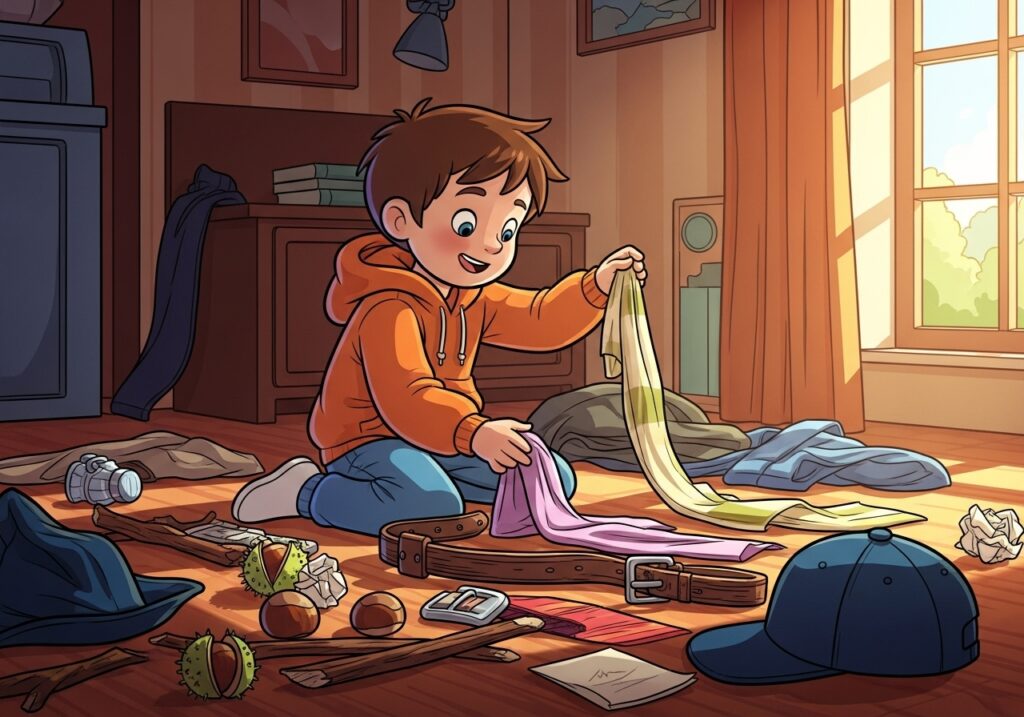
Fabrics, belts, old hats, and scarves are especially valuable, because they help a child create an image and transform into a character. Open-ended materials that can become anything are also very important: sticks, chestnuts, pinecones, foil, old wallpaper, and so on. All of this makes it possible to create scenery and costumes and to bring a child’s idea to life. If children try to make toys for play themselves, it is worth supporting them, because they are following their own intention.
Play Partners
For play—especially plot-based role play—partners are very important. These can be peers or children of different ages. Play in a mixed-age group is valuable for younger children, who gain play experience, and for older children, who gain opportunities for reflection—comparing themselves with younger children and becoming aware of their own growth. Both also gain an invaluable opportunity for decentration: the ability to look at a situation from another person’s perspective and to understand their feelings and intentions. In mixed-age play, everyone benefits.
Adult Participation in Play
First and foremost, it is important that adults do not undermine play. Here the principle “do no harm” applies—for example, through inappropriate questions or didactic interventions (“let’s count the dolls”). If an adult takes away the child’s initiative, play stops being play.
At the same time, adult participation can be very valuable. Sometimes it is enough simply to be present: even the calm presence of a friendly adult can support a child’s play. Notice how children glance at an adult during play, finding reassurance in their gaze and in the adult’s readiness to respond.
Adults can also enrich play by providing experiences that later become play material—for example, going for a walk together, visiting a swimming pool, or going to the theatre. New experiences become material for future play.
An adult can also help with materials or ideas: for example, how might the roof of a homemade den be fixed so it doesn’t fall down?
Shared reading is another enormous resource. It enriches a child’s understanding of the world and fuels imagination: literary characters may enter children’s play directly, or they may inspire the child to invent new characters and move beyond everyday reality.
An adult can also join play as a partner—taking on a role (or a character in director play) and helping the storyline unfold. What matters, however, is that initiative remains with the child. This means accepting the storyline the child has already begun. But when play seems to be stalling and risks running out of steam because the plot is no longer developing, an adult can add a small twist—for example, by introducing a problem and asking, “What if…?”
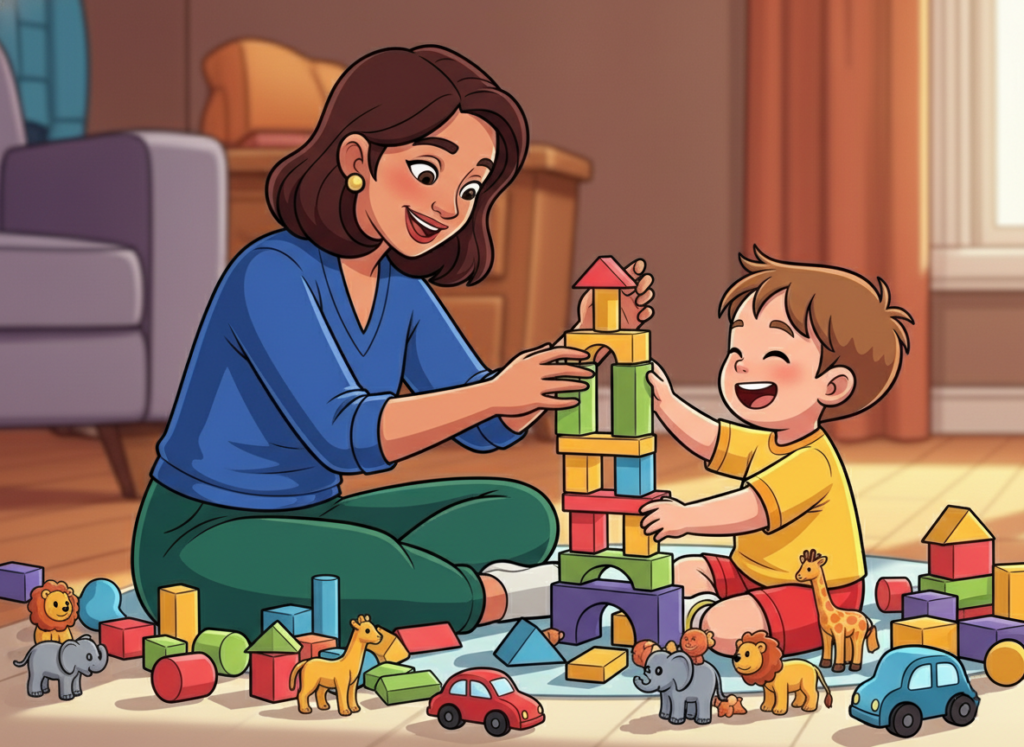
Direct participation in play is not essential if it feels difficult or simply not enjoyable for the adult. In that case, it is enough to make sure that the other conditions for play are in place—this already makes a significant difference. Shared activities can also take other forms, such as reading, construction, or storytelling.
Play in Adult Life
Play is the leading activity of the preschool years, but its value extends far beyond childhood. Playfulness—the capacity to play—turns out to be an essential condition for a fulfilling adult life, because it allows a person to relate to life in an exploratory, open, and interested way. Play is a way of engaging fully with life: when a person enjoys not only the outcome but also the process; when they are not afraid to try; when they treat attempts as interesting experiments and see failure not as defeat, but as a pathway towards new attempts. Play offers a way of relating to the world in which mistakes are not feared and everything can be re-imagined and tried again.
Most importantly, adults can nurture their own playfulness by joining in children’s play.
Reflecting on Your Role: How Do I Support Children’s Play?
What position do I take in relation to children’s play?
This is not a checklist of “good” or “bad” practice. It is a reflective tool that helps you notice which conditions for play you are already creating and what your next possible step might be.
Level 1
Minimal conditions for play are in place
(time, space, materials)
Consider whether the following statements sound like you:
- The child has regular time when their play is not hurried or interrupted.
- There is a place where play can happen, and there is no expectation that everything must be tidied away immediately when play ends.
- The child has access to materials for play, not only “educational” or task-based resources.
- I do not stop play even if it appears meaningless to me.
- I try not to replace play with activities chosen solely for their “usefulness”.
- I recognise the child’s right to play for its own sake.
If you identified with most of these statements, it means that basic opportunities for play are present. This is the foundation. Without it, play cannot develop.
Level 2
Conditions plus adult attention, observation, and a supportive attitude
Consider whether the following statements sound like you:
- I observe what and how the child is playing, without stepping in straight away.
- I try to understand the idea behind the play, even when it is not immediately clear to me.
- I do not rush to correct, direct, or show “the right way”.
- I accept the imaginary situation as the reality of the play.
- I can tolerate pauses, uncertainty, and moments of not knowing in play.
- I relate to play with warmth and interest, rather than seeing it as an obstacle.
If these statements describe you, play is beginning to deepen, and the child experiences their initiative as accepted. At this level, play gains stability and richness.
Level 3
All of the above, plus the adult’s readiness to join in as a play partner
Consider whether the following statements sound like you:
- I can enter the play without taking over or directing it.
- I accept the role the child offers me.
- I act from within the play narrative, rather than from a position of control.
- I can play alongside the child without turning play into instruction or teaching.
- I sense when it is better to participate and when it is better to observe.
- I am not afraid of “looking silly” in order to protect and sustain the play.
If these statements describe you, play becomes a genuinely shared activity. Within this shared space, the child can develop imagination, self-regulation, and thinking. This reflects a high level of attunement and involvement—though it is by no means an obligatory standard.
Levels Do Not Cancel Each Other Out
In everyday life, we are usually somewhere between levels. It is entirely possible to be at Level 2 in one situation and at Level 1 in another.
Reflecting on the question “What small step could make my position in play a little more supportive?” can help you move forward gradually and realistically.
What to Read?
- Brown, Stuart. Play: How It Shapes the Brain, Opens the Imagination, and Invigorates the Soul. New York: Avery, 2009.
- Fisher, Jane E. Play: A Polyphony of Research, Theories, and Issues. New York: Routledge, 2018.
(Accessible chaptered overview useful for informed parents.) - Ginsburg, Kenneth R. The Importance of Play in Promoting Healthy Child Development and Maintaining Strong Parent-Child Bonds. Pediatrics 119, no. 1 (2007).
(A widely cited clinical article — short and parent-readable.) - Gray, Peter. Free to Learn: Why Unleashing the Instinct to Play Will Make Our Children Happier, More Self-Reliable, and Better Students for Life. New York: Basic Books, 2013.
- Hirsh-Pasek, Kathy, and Roberta Michnick Golinkoff. Einstein Never Used Flashcards: How Our Children Really Learn — and Why They Need to Play More and Memorize Less. New York: Rodale, 2003.
- Hughes, Marilyn C. Pretend Play and Child Development. London: Jessica Kingsley Publishers, 2009.
- Miller, Esther A. The Power of Play: A Research Summary on Play and Learning. Minnesota Children’s Museum, 2007.
- Singer, Dorothy G., and Roberta Michnick Golinkoff. Play = Learning: How Play Motivates and Enhances Children’s Cognitive and Social-Emotional Growth. New York: Oxford University Press, 2008.
- Weinfield, Nancy S., and Allyssa McCarthy. Playful Parenting: An Activity Guide for Ages 0–7. Oakland, CA: New Harbinger Publications, 2017.
- Wood, Eileen, and Karen Attfield. Play, Learning and the Early Childhood Curriculum. Thousand Oaks, CA: SAGE Publications, 2019.