![[EN] CHILD LAB](https://childlab.co.uk/wp-content/uploads/sites/4/2026/01/child-lab-logo.jpg)
What Is Reasoning?
We often say that a child is “thinking”, but not all thinking is reasoning. A child may fantasise, repeat what they have heard, or speak impulsively—and all of this is entirely normal. Reasoning begins when a child tries to explain why they think the way they do, what they are relying on, and what follows from their idea. At this point, a thought becomes not just a statement, but something that can be discussed: it can be clarified, questioned, tested, and revised.
Calm, attentive questions from an adult support this process—not in order to correct the child, but to give them space to think out loud and to organise their own thinking.
What Is an Argument?
Imagine the following situation: a child says, “I want to wear the blue T-shirt.” This is their opinion, their preference. But if they add, “…because it has a dinosaur on it, and today we talked about dinosaurs at preschool,” this is already an argument.
An argument is not simply an explanation; it is a link between an idea and the reason for it.
An argument answers the question “why?” and makes a child’s thought understandable not only to themselves, but to others as well. It may be based on a fact (“because it’s raining today”), a rule (“because that’s what we agreed”), or a personal preference (“because it’s my favourite story”). In all cases, it adds clarity and meaning.

It is important to distinguish an argument from simple repetition or an emotional reaction. If a child says, “I won’t eat the soup because I won’t!”—this is not an argument, but a refusal. But if they say, “I won’t eat the soup because it’s too salty today,” this is already an attempt to justify their position.
Even if the reason seems insignificant to us, it is meaningful to the child—and it marks the beginning of the path towards conscious, reflective thinking.
Common Argumentation Difficulties in Young Children
Children are only just learning how to think and speak consistently, so their early arguments are often naïve, emotional, or logically unstable. This is completely normal. Our role is not to criticise these mistakes, but to notice them gently and help the child refine their thinking.
Below are some of the most common patterns seen in children’s early arguments:
- Repetition instead of explanation (tautology)
The child seems to repeat the same idea without adding meaning:
“I don’t want to go to bed because I don’t want to.”
There is no explanation here—only a restatement of the refusal. - Internal contradiction
The child contradicts themselves, often without realising it:
“I won’t eat porridge because I like it, but today I don’t want to.”
Two incompatible statements appear together—this is a good moment for a gentle clarifying question. - Incomplete argument
The child gives only part of the explanation:
“I won’t play with Petya because he’s bad.”
What does “bad” mean here? What actually happened? Without detail, the argument remains vague. - Undifferentiated argument
The reason given could apply to many choices and does not explain this one:
“I want to watch a cartoon about cars because it’s interesting.”
But many cartoons are interesting—why this one in particular? - Desire presented as an argument
An expression of wanting replaces explanation:
“Buy me this doll because I want it!”
This is an emotional request rather than an argument.

- Emotional argument without a clear basis
“I won’t wear these trousers because they’re horrible!”
There is a feeling behind this statement, but no articulated reason. Perhaps they itch or feel uncomfortable, but the child cannot yet put this into words.
What Do We Know from Research About Children’s Ability to Argue?
Children can argue
Research in developmental psychology clearly shows that preschool children are capable of basic logical justification. Studies indicate that children as young as two to four years old already demonstrate early forms of argumentation: they put forward simple claims and support them with reasons. These reasons may refer to rules (“You can’t, because Mum said no”) or to consequences (“I won’t wear it, because it will itch”).
Young children also show a striking sensitivity to context and to the status of their conversational partner. They argue differently with a peer, a sibling, or a parent. By around the age of three, children are already using different types of justification—from emotional reasons to references to social norms.
Argumentation Develops in Dialogue
Children’s argumentation is not a monologue; it is always dialogic in nature. It arises from differences of opinion, disagreement, or the need to negotiate. The quality and complexity of a child’s arguments depend directly on who they are talking to and in what situation.
In interactions with peers—especially during shared play—children’s arguments are often more confrontational, but also more creative. Through these exchanges, children learn to negotiate relationships, distribute roles, and defend their ideas.
In dialogue with an adult who asks open-ended questions and offers alternatives, children’s arguments tend to become more complex. They begin to use counterfactual reasoning (“What if…?”), put forward hypotheses, and even support their position non-verbally through gestures or actions.
Research shows that adults—often without realising it—are the primary providers of models of argumentation, which children then adopt, adapt, and make their own.
The Development of Children’s Argumentation Depends on Shared Reasoning with an Adult
A preschool child is not a passive listener, but an active participant in dialogue whose reasoning skills develop rapidly through social interaction. Children’s frequent use of “because” should not be interpreted as manipulation or stubbornness; it is practice in critical thinking.
The most effective way to support this development is to create everyday opportunities for shared reasoning. This does not require special lessons or formal teaching. It can happen naturally:
- at the dinner table, by discussing why vegetables are good for us;
- during shared reading, by asking what a character might do next and why;
- when helping children resolve a disagreement, by asking guiding questions such as
“How could we solve this?” or “Why do you think your idea might work?”
The adult’s role is not to assert authority, but to act as an attentive thinking partner—helping the child organise their thoughts, find stronger reasons, and take another person’s perspective into account. Research suggests that this is precisely how the foundations for future abilities to think clearly, persuade others, and negotiate are formed.
Myths About the Development of Argumentation in Children
Myth 1: Young children (under five to seven years old) are not capable of argumentation. It is too difficult for them.
Reality:
The capacity for basic argumentation appears much earlier than this—often in the second or third year of life. Children aged two to four make claims (“I won’t!”) and support them with reasons, even if these reasons are very simple. They may refer to rules (“You’re not allowed”), physical properties (“It’s hot”), or personal desires (“I want it this way”).
Research shows that even at this age children can sense the difference between stronger and weaker reasons. For example, they tend to prefer perceptual arguments (based on what they can see or feel) over circular ones (which simply repeat the original claim).
Myth 2: Children’s arguments are always negative—just conflict, stubbornness, or disobedience.
Reality:
For a child, arguing is a key learning context for the development of thinking. It is the encounter with differing viewpoints—not their absence—that activates reasoning. When children argue with peers or adults, they learn to articulate their own position, listen to others, look for counterarguments, and negotiate.
This is not chaos; it is a complex social and cognitive activity that plays an important role in development.
Myth 3: To argue well, a child needs to be taught formal logic or argument schemes (such as Stephen Toulmin’s model).
Reality:
Argumentation does not develop through learning formal schemes. It develops through lived experience of dialogue in everyday situations—during play, while discussing a story, or when making sense of daily decisions (“Why do we need to wear boots today?”).
Formal models of argument come much later. The foundation is laid in informal conversations where what matters is not the correctness of a structure, but the genuine attempt to explain and justify one’s thinking.
Myth 4: The main purpose of argumentation is to win and prove that you are right.
Reality:
Research shows that among children—especially in peer groups—argumentation often serves social and cooperative purposes. Through arguing, children establish and change the rules of a game, negotiate roles, build relationships, and co-create shared meanings.
Very often, “winning” does not mean defeating the other person, but finding a shared solution—or simply keeping an interaction going in an engaging way.
Myth 5: Children learn to argue only through interaction with adults, because adults are the main models.
Reality:
Although adults play a crucial role as providers of rich language models, interaction with peers is equally important. With peers, children are in a position of relative equality, where appeals to authority (“because I said so”) do not work.
In peer interactions, children must persuade, negotiate, and seek common ground. Arguments in these contexts are often more inventive and closely connected to children’s immediate interests and concerns.
Myth 6: Good argumentation is only verbal.
Reality:
For young children, argumentation is a multimodal process. They use gestures, intonation, facial expressions, and actions—such as demonstrating how something breaks or works—to support their position.
Ignoring this non-verbal dimension means missing an essential part of how children think and communicate.
Myth 7: If a child keeps repeating the same reason (“because I want to!”), it means they are not developing.
Reality:
Repetition is not always a sign of poor reasoning. In children’s argumentation, persistence and repetition often function as a strategic way of holding one’s position in dialogue—especially when linguistic resources are still limited.
With sensitive adult support, this early persistence gradually develops into a richer and more varied use of reasons.
Why Are These Myths Harmful?
These myths lead parents and educators to shut down forms of discussion that are entirely natural for children. They encourage adults to underestimate children’s cognitive potential and to miss key moments when critical thinking could be supported gently and effectively. When we understand what children are truly capable of, everyday “arguments” and endless “why?” questions stop feeling like a nuisance and begin to look like fertile ground for development.
How to Conduct a Dialogue That Stimulates Children’s Reasoning
A dialogue with a child is, first of all, the ability to ask questions that invite thinking. Secondly, it is the ability to respond in a way that keeps thinking alive. Adults often rush to explain or to offer a ready-made answer—and the conversation then comes to an abrupt end.
In a developmental dialogue, an answer can itself take the form of a question—not to test the child or put them on the spot, but to help them reflect on their own thinking. Responding questions such as “Why do you think that?”, “What do you mean?”, or “Is it always like that?” do not correct the child. Instead, they turn the child’s own response into something that can be examined, clarified, and developed.
This is the power of dialogue: it helps the child not only to speak, but to learn how to reason, to refine their ideas, and to change their point of view.
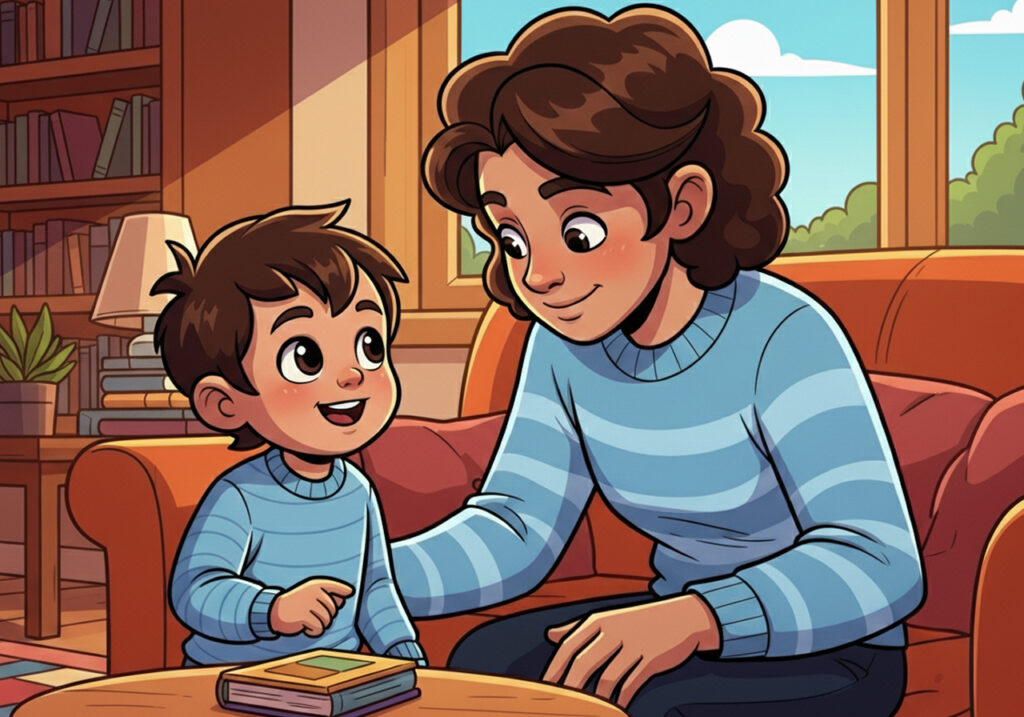
Dialogue can be compared to a game of table tennis: the person responding has to listen very carefully in order to keep the shared thinking going.
Rules for Conducting a Dialogue with a Child
Sensitivity to the Other Person’s Emotions
Reasoning is not always appropriate. If a child is very upset, angry, or frightened, a discussion about reasons and arguments will only increase tension. In such moments, what the child needs most is not questions, but emotional support: to be listened to, comforted, and accompanied.
Conversation and reflection become possible later, when the emotional intensity has settled.
Interest in the Problem — a Position of Equality
A developmental dialogue cannot arise from an “examining” or testing position. It emerges when the adult and the child explore a question together, without knowing the answer in advance.
A child’s curiosity is often contagious. If an adult allows themselves to be surprised, to doubt, and to be genuinely interested in a problem, the child readily joins in the thinking. The aim is not to lead the child to a predetermined conclusion, but to be a true co-thinker.
Interest in the Child’s Thinking
Dialogue requires real attention to another person’s thoughts. This means listening not in order to respond as quickly as possible, but in order to understand how the other person is thinking.
When an adult shows genuine interest in a child’s reasoning—by asking clarifying questions, checking understanding, and reflecting the child’s words back to them—the child learns that thinking itself, both their own and others’, is something valuable.
Types of Questions an Adult Can Ask a Preschool Child
Questions for Clarification and Orientation
Why they are needed:
They help the child notice and name what is already available to them. These questions do not require reasoning; they support attention and orientation in the situation.
What they sound like:
- “Who brought you to nursery today?”
- “What colour is your jacket?”
- “What are you holding in your hands?”
If the child finds it difficult, the adult can suggest a source:
- “We can look at the calendar.”
- “Try to remember who was there this morning.”
These questions help the child feel confident and involved. They do not develop reasoning—and that is perfectly fine; they serve a different purpose.
Questions About Cause-and-Effect Relationships
Why they are needed:
They help the child begin to notice hidden connections between events and phenomena.
What they sound like:
- “Why do we wear a warm coat in winter but not in summer?”
- “Why do chefs wear white clothes?”
- “Why do puddles appear after the rain?”
Here, the child starts thinking not just about what happens, but why it happens.
Questions That Ask the Child to Justify Their Own Position
Why they are needed:
They help the child explain the logic of their own thinking. This is not about how the world works in general, but about why they think or decide something.
What they sound like:
- “Why do you think that?”
- “How did you work out that it’s going to rain today?”
- “What did you like most at the celebration—and why?”
These are the questions that turn a conversation into genuine reasoning rather than a simple exchange of opinions.
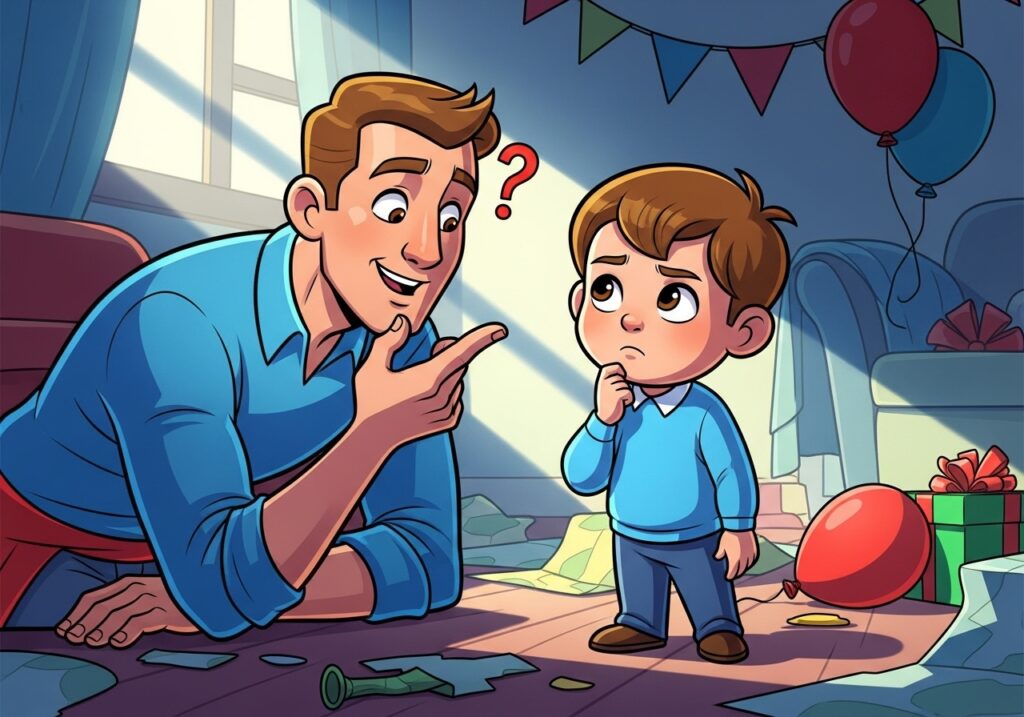
Questions That Invite Comparison with Another Viewpoint
Why they are needed:
They help the child learn to agree or disagree thoughtfully, rather than automatically.
What they sound like:
- “Do you agree with what Anna said?”
- “Why do you agree?”
- “Why don’t you agree?”
It is important that the adult does not signal which answer is “right.” Otherwise, the child will focus on pleasing the adult rather than on their own reasoning. These questions are particularly valuable in interactions between children.
Inventive (Creative) Questions
Why they are needed:
They help the child notice non-obvious possibilities in objects and situations.
What they sound like:
- “What could we call this?”
- “What could this turn into?”
- “How else could we use this box?”
Here, the child practises going beyond what is familiar.
Questions About What the Child Would Like to Learn
Why they are needed:
They support the child in formulating their own interests and questions.
What they sound like:
- “What would you like to learn more about?”
- “What caught your interest here?”
- “What question would you ask about this?”
These questions communicate an important message: the child’s curiosity matters.
Hypotheses (Questions-as-Assumptions)
Why they are needed:
They help the child learn to put forward assumptions and think about how these might be tested.
A hypothesis is a question phrased as a statement that may or may not be confirmed.
What they sound like:
- “Where do you think the ice will melt faster—inside or outside?”
- “What do you think will happen if…?”
It is important that the adult does not rush to give an answer, but instead helps the child to:
- suggest different possibilities,
- compare them,
- think about how they could be checked.
This is the foundation of research-oriented thinking.
Not all questions develop reasoning—and that is completely normal. What matters is that everyday conversations with a child include different kinds of questions, and that among them there is space for questions that help the child justify their ideas, consider other viewpoints, and put forward hypotheses.
Follow-up Questions
It is important not only to know what questions to ask, but also how to respond to a child’s remarks in a way that keeps thinking alive. Very often, when adults hear a child’s statement or question, they rush to explain, correct, or supply a ready-made answer.
In a developmental dialogue, a response can instead take the form of a follow-up question that does not close the topic but returns it to the child:
- “How do you understand this yourself?”
- “Why does this seem important to you?”
- “What do you think might follow from that?”
Such responses show the child that their thinking is taken seriously and is worth exploring further. They do not remove the difficulty, but create a space for reflection—in which the child learns to reason, clarify, and test their ideas.
Ask Questions That Invite Justification
Why do you think that?
Child:
“This character is mean.”
Questions:
- “Why do you think that?”
- “What did he do that made you call him mean?”
The child learns to take responsibility for their own thinking and to explain the grounds for their judgement.
Discuss Generalisations and Extreme Statements
Work with words such as “always,” “never,” “everyone,” and “no one.”
Child:
“He always lies.”
Questions:
- “What does ‘always’ mean here?”
- “Are there times when he doesn’t lie?”
The child begins to notice overgeneralisations and learns to avoid unjustified extremes.
Explore What Follows from a Statement
If a thought were true, what would follow from it?
Child:
“It’s better to be strong than kind.”
Questions:
- “If everyone were strong, what do you think would happen?”
- “Would kindness still be needed then?”
The child starts to grasp cause-and-effect relationships and the wider implications of ideas.
Contrast Instead of Directly Objecting
Rather than saying “No, that’s wrong,” try testing the idea by looking at its opposite.
Child:
“Making mistakes is bad.”
Questions:
- “Can making mistakes ever be useful?”
- “Are there situations where a mistake actually helps?”
The child learns to examine and test their own ideas rather than simply defend them.
Everyday Tips
To support the development of argumentation, there is no need to run “logic lessons.” It is enough to regularly use different types of questions that invite thinking.
- One Question That Asks for Justification
Helps the child explain why they think something, rather than simply stating an opinion.
Examples:
- “Why do you think that?”
- “What led you to that idea?”
- One Question About Cause and Effect
Helps the child notice connections between events.
Examples:
- “Why did this happen?”
- “What changed because of that?”
- One Inventive Question
Opens up space for alternatives, hypotheses, and imagination—an essential part of reasoning.
Examples:
- “How else could this be done?”
- “What would you suggest?”
These questions do not need to be asked all at once or in a single conversation. It is enough for them to appear naturally over the course of the day—in play, during reading, or in everyday situations.
If, during the day, a child has:
- explained why they think something,
- noticed the cause of an event,
- and suggested their own solution,
then reasoning has already been developing.
Developmental Effects of Dialogue
When an adult listens to a child’s answer until the end, without interrupting or correcting it immediately, the child’s sense of agency develops. The child feels that their thinking has value, even when it is still unclear or imprecise. As a result, they become more willing to speak, think aloud, and express ideas without fear of instant judgement.
When an adult asks questions that are aimed at reflection rather than at finding the “right answer,” thinking becomes meaningful for the child. Questions such as why the child thinks a certain way or what follows from an idea turn thinking into a living and engaging process. This supports intrinsic motivation and encourages the child to think independently.
When an adult discusses different viewpoints without imposing a single correct position, moral development is supported. The child learns that actions, opinions, and judgements have reasons. They begin to understand that these reasons can be compared, discussed, and reflected upon.
When an adult returns the conversation to grounds and consequences, the child’s theoretical thinking develops. Questions about what follows from an idea or whether it always works help the child move beyond the immediate situation. The child begins to generalise, notice patterns, and maintain a logical line of reasoning.
When an adult invites the child to justify a claim, compare arguments, or test an idea, the child develops critical engagement with information. This forms a habit of checking what statements are based on and learning to distinguish facts from opinions.
When an adult paraphrases the child’s words, clarifies them, and feeds the ideas back to the child, reflection develops. The child becomes more aware of how they think, notices contradictions, and learns to refine and clarify their own position.
Check Yourself: How Do You Create Conditions for Reasoning?
Which of the following statements are often true for you?
- We enjoy talking and reasoning together.
- I can tolerate a pause while my child is thinking.
- I allow my child to explain their choice, even when I disagree with the argument.
- I more often ask “Why do you think that?” than “Why did you do that?”
- From time to time, my child and I genuinely reason together and enjoy it.
- I accept that my child may disagree with me.
- During conversations, I sometimes ask questions that help my child think more deeply.
1–2 statements:
The child already has space for argumentation.
3–4 statements:
Argumentative dialogue is beginning to take shape.
5–7 statements:
You are actively creating an environment that supports the development of reasoning.
Instead of a Conclusion
The development of argumentation is not about using sophisticated language, and it is not about winning an argument.
It is about a child learning to explain themselves, to listen to others, to think aloud, and to feel safe in discussion. And the adult’s role is not to judge or instruct, but to be an attentive conversational partner—a partner in thinking.
What to Read
- Brenifier, Oscar. The Art of Philosophical Discussion. Paris: Nathan, 2012.
- Brenifier, Oscar. What Is Good and Evil? London: Bloomsbury, 2015.
- Brenifier, Oscar. What Is Happiness? London: Bloomsbury, 2015.
- Brenifier, Oscar. What Is Freedom? London: Bloomsbury, 2015.
- Brenifier, Oscar. What Is Life? London: Bloomsbury, 2016.
- Faber, Adele, and Elaine Mazlish. How to Talk So Kids Will Listen & Listen So Kids Will Talk. New York: Scribner, 2012.
- Gregory, Maughn, Joanna Haynes, and Karin Murris. The Routledge International Handbook of Philosophy for Children. London: Routledge, 2017.
- Lipman, Matthew. Thinking in Education. 2nd ed. Cambridge: Cambridge University Press, 2003.
- Matthews, Gareth B. The Philosophy of Childhood. Cambridge, MA: Harvard University Press, 1994.
- Worley, Peter. The If Machine: Philosophical Enquiry in the Classroom. London: Bloomsbury, 2011.
- Worley, Peter. 40 Lessons to Get Children Thinking. London: Bloomsbury, 2015.
- Worley, Peter. Once Upon an If: Thinking Through Stories. London: Bloomsbury, 2015.