![[EN] CHILD LAB](https://childlab.co.uk/wp-content/uploads/sites/4/2026/01/child-lab-logo.jpg)
What Is Children’s Free Experimentation?
A child is born with a “what is this?” reflex. This reflex exists in animals as well, and it allows for a quick response to unexpected situations.
From this reflex, children’s curiosity grows: an interest in new situations. The downsides of such curiosity (high distractibility, for example) often obscure something important for adults: it is this fascination with novelty that represents the first sprouts of exploratory activity—the ability to ask questions and to move from what is known to what is unknown. And the more opportunities a child has had for exploration driven by curiosity, the more likely it is that, at school, they will develop a genuinely exploratory attitude towards situations—when it matters not only to solve a practical task, but also to understand the principle behind the solution.
Children’s free experimentation is spontaneous activity that is not rigidly controlled by an adult and is aimed at learning about the properties of objects and phenomena in the surrounding world through practical action. The child acts according to the simple formula: “What will happen if…?”
The well-known psychologist Alison Gopnik calls children “scientists in the cradle,” because they explore the world in much the same way professional scientists do.
From a very early age, a child:
- puts forward hypotheses (“What will happen if…?”),
- tests them in action,
- notices what worked and what did not,
- and changes their ideas when experience contradicts them.
A child does not simply copy adults, nor do they try everything at random.
They experiment, compare options, and look for cause-and-effect relationships—
much as scientists do in a laboratory.
The main difference from an adult is this: a child has less ready-made knowledge, but far more openness and courage to try.
That is why childhood is not a time of “empty play,”
but a period of intensive exploration of the world,
in which free trials, mistakes, and questions are not obstacles, but the driving force of development.
Examples of Free Experimentation
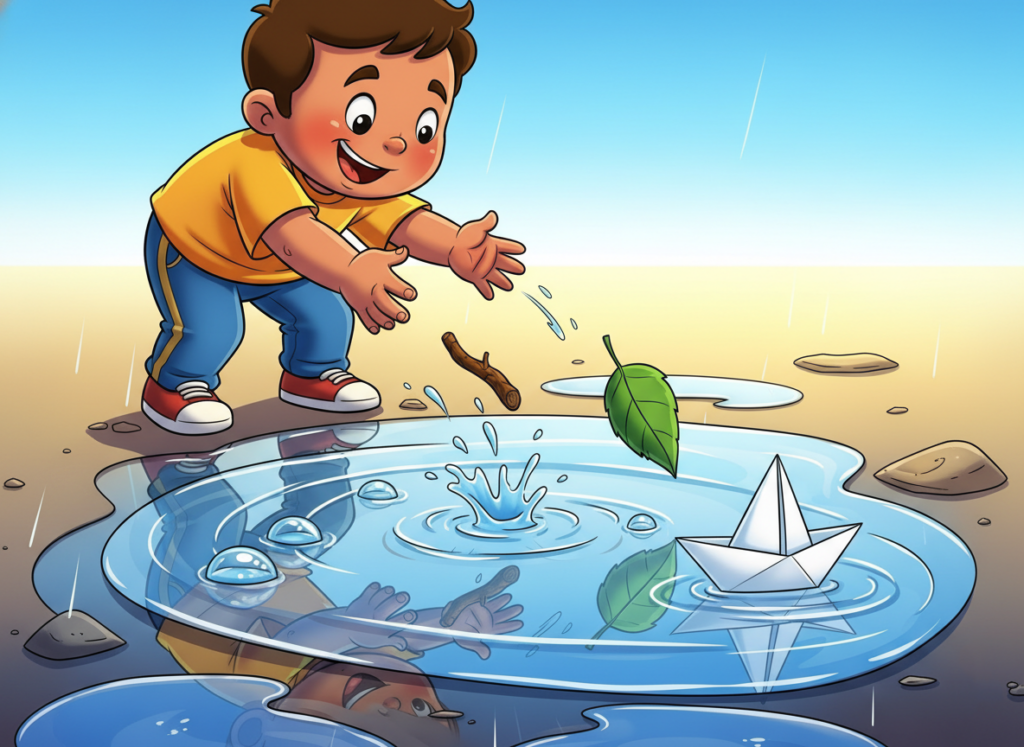
- A toddler throws pebbles into a puddle to watch the splashes.
- A child builds a tower of blocks until it collapses.
- They mix paints on a palette to create new colours.
- They pour water into sand and observe how its properties change.
Key Characteristics of Free Experimentation
- Motive: curiosity, interest here and now.
- Goal: there is no clear goal; the process is more important than the outcome.
- Plan: actions are impulsive, without a carefully thought-out plan.
- Reflection: the child may not yet be aware of the connection between action and result.
Why Do People Need Experimentation?
“What if I try it this way? And what if like this? That didn’t work. OK, what if I do it like this? Oh—it worked!”
This is roughly how people act when a problem does not yield to a ready-made solution. We are not talking simply about trial and error, but about playful experimentation—when a person wonders what else could be done and feels not fear of failure or frustration when something does not work, but excitement and interest.
In life, we often encounter problems that are difficult to solve and for which we do not have ready-made “keys.” This difficulty may arise because we are dealing with something new that operates according to rules unknown to us. It might be a technical device, a poem we have never encountered before, or unfamiliar building materials. An experimental way of acting is one in which a person is primarily interested in how something works and, most importantly, is not afraid to try different options.
Curiosity without immediate practical aims means being interested first and foremost in how something is structured, and only secondarily in obtaining a concrete result.
This way of relating to the new and the unclear is characteristic of professionals who are deeply engaged in their work. What matters is that a person makes attempts without fear of making mistakes—there is a playful attitude towards the situation, in which trying is not so much frightening as it is interesting.
It is precisely this kind of heuristic attitude towards reality that is laid down in childhood, through the activity known as free experimentation. It is important for a child to gain this experience early on, because it increases the likelihood that, as an adult, they will respond to difficulties not with fear, but with curiosity and excitement: What if I try it this way?
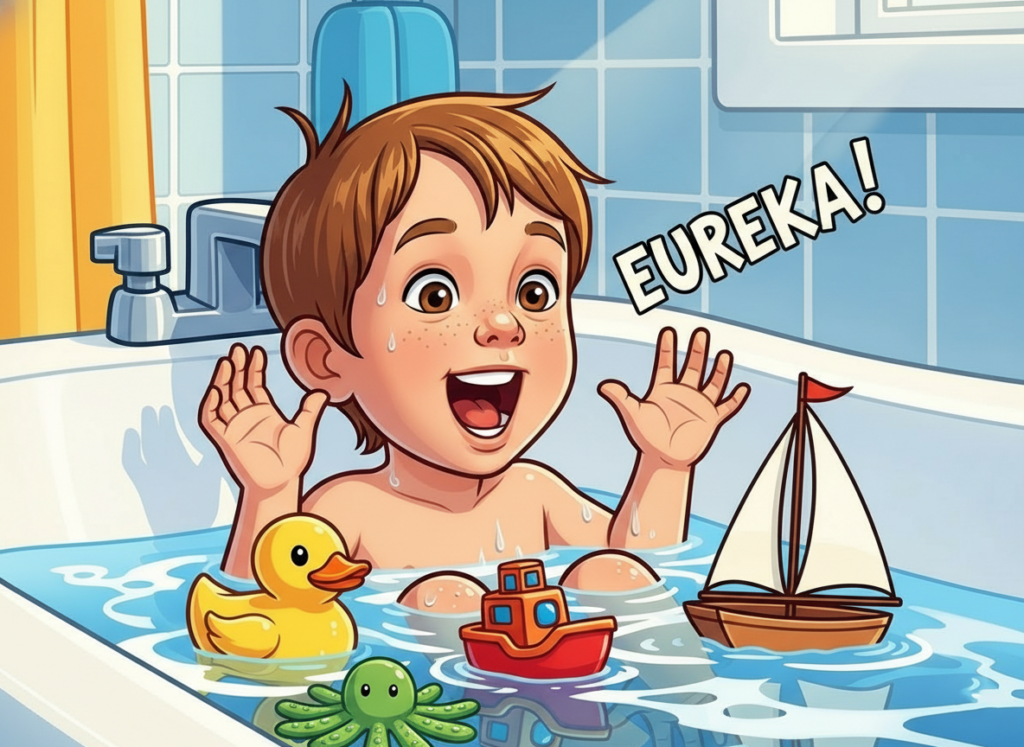
Moreover, adults themselves can learn from children this joy of encountering the unknown. For this to happen, conditions must be created in which children’s experimentation is possible.
To answer one’s own question, a person has to search for information, consult different sources, look for the right books, and sort things out. This search activity can evoke anxiety—or it can evoke joy and excitement.
The point is not only emotional, although the joy of searching is an important factor in success. It is also essential to know how to organise a search strategy: to act not at random, but systematically, to put forward hypotheses and test them. It is well known that many children quickly master new gadgets by figuring out how they work through trial and error. This is where a strategy of independent search comes into play—something that representatives of the older generation, who tend to rely on instructions, often lack.
However, most gadgets available to children offer only limited space for exploration: they are deliberately designed to be intuitive. But in order to work out how to find the right information, fix a malfunction, or improve a cooking recipe, one needs the ability to search properly.
A well-developed search strategy combines the ability to generate unexpected solutions with the ability to act logically and step by step.
Moreover, in some situations one must also be able to formulate the question itself—to see the problem. Very often, asking a good question is already half the solution.
What Is the Value of Experimentation for Child Development?
Jerome Bruner and Kathy Sylva offered children a task: they had to retrieve a toy from a box, but this could only be done with the help of a self-made tool.
The children were given sticks and clips—from which it was possible to build a kind of “grabbing tool”, but how exactly to do this had to be figured out.
The children were divided into two groups.
The first group was shown, before the task, how the sticks and clips could be connected. This was not a ready-made solution, but a significant hint.
The second group was given no explanation. They were simply given time to handle the materials, to experiment, to connect and disconnect them. From the outside, this looked like “messing about” or “aimless fiddling.”
And here is what proved unexpected:
the children from the second group—the ones who were allowed to experiment freely—performed better.
When the researchers looked more closely, they discovered something else that was important. These children:
- started with simple trials,
- gradually made their actions more complex,
- acted step by step.
In other words, they had a genuine search strategy.
The children who had been shown “how it should be done” often:
- immediately tried the most complex option,
- quickly gave up,
- acted on the principle of “it worked / it didn’t work.”
What Does This Mean for Us, as Adults?
Free experimentation is not chaos and not a waste of time. It is precisely through it that a child:
- learns to try,
- builds a strategy,
- is not afraid of mistakes,
- maintains exploratory motivation.
Sometimes direct demonstration seems like the shortest path. But in reality, it can deprive a child of the most valuable thing—the experience of searching. That is why time spent on free trials is not lost time, but an investment in a child’s thinking and confidence.
This study shows how complex the processes are that take place during free experimentation, when it may seem that children are acting at random. In fact, it is precisely in this process that a search strategy is formed.
It turns out that direct instruction only appears to be the shortest path to knowledge. In reality, one should never cut shorttime for free trials. This is an invaluable experience that sustains exploratory activity.
What Develops Through Children’s Experimentation
Agency
The child experiences themselves as the author of action: I try, I decide, I choose what to do next. In experimentation, the child acts not by imitation or instruction, but from their own initiative—and it is here that the sense of “I can” is formed.
Thinking
Through trials and changes, the child learns to see connections between action and result, to notice patterns, to compare options, and to change strategy. Thinking develops here not through explanation, but through action and search. An important aspect of thinking is forecasting—the ability to anticipate different, including opposite, possible courses of events.
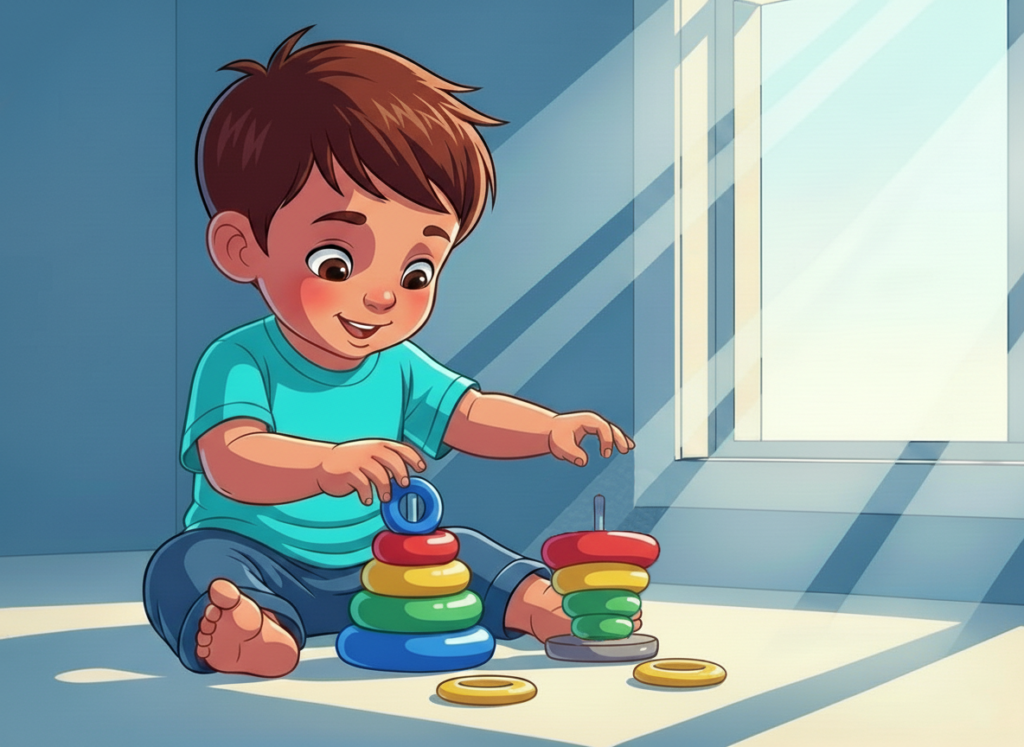
By observing, one can see how children’s trials become increasingly systematic. For example, when assembling a stacking toy, a child at first acts unsystematically, taking small rings, then large ones. Gradually, they begin to grasp the structure of the toy—a sequence in which each next element is larger than the previous one but smaller than the next (or vice versa). Then a logical order appears in the trials. This does not work in every case—some tasks require more complex constructions—but creating an environment for the development of thinking is one of the important possibilities of experimentation.
The Ability to Be Surprised
The ability to notice the unexpected and not to become distressed when expectations are not confirmed.
Cognitive Interest — a Playful, Exploratory Attitude Towards Activity
Experimentation forms an attitude that the world can be explored. The child becomes accustomed to approaching new tasks not with anxiety, but with interest—as an opportunity to try, test, and discover something new, first in play and later in any activity. This is where curiosity begins: the desire to learn, to ask questions, to seek answers, to try.
Intellectual Emotions: The Tension of Search and the Joy of Discovery
The joy of discovery is one of the treasures of human life. Exploratory activity includes two movements: the transition from not knowing to knowing—when we seek answers to questions and emerging problems; and the transition from knowing to not knowing—when we pose questions where everything once seemed clear. Experimentation consists precisely of these two abilities, both of which are fundamentally important.
The search itself may be difficult, but the moment of discovery—the “insight”—when a person finds a solution, brings a joy that is hard to compare with anything else. The questions each person faces are unique, and therefore experimentation and search are among the most important paths to the joy of discovery.
At the same time, it is very important which emotions a problematic situation evokes—anxiety or interest. Readiness to respond to situations of uncertainty and the unknown without fear is one of the possible gains of childhood—one that an adult can also cultivate in themselves.
An Aesthetic Attitude Towards Reality
By experimenting with materials, a child may unexpectedly discover the aesthetic dimension of life: realising that certain combinations of forms, colours, or sounds evoke emotions or allow one to express one’s own feelings. Artistic activity itself is, in essence, experimentation with the means of expressing feelings. A poet, artist, or musician searches for precisely those combinations of words, colours, or sounds that convey a state of mind. The beginnings of an aesthetic attitude towards reality are formed in children when, through experimentation with materials, they suddenly feel that something has turned out “beautiful”—that is, resonant with their feelings.
Self-Regulation
- Goal-setting and forming an intention
- Planning
- Evaluating one’s own actions (comparing the outcome with the intention)
- Working memory
- Cognitive flexibility
When a child is engaged in free experimentation, all components of self-regulation are activated: they decide what to explore, think about how to organise it, evaluate whether it worked, try to remember how the trial went, and switch to a new attempt if the initial question turns out not to be so important. Preschoolers’ attention is not very stable; however, if they are engaged in an exploration that is meaningful to them, they can stay with it for quite a long time.
Myths About Children’s Experimentation
Adults are often convinced that learning as an organised transfer of knowledge from teacher to student—from the one who knows to the one who does not—is the “royal road” (that is, the best and most optimal) path to understanding.
Without diminishing the importance of teaching, let us say that the ability to experiment and to search independently is no less important. Moreover, when teaching is well organised, it is precisely this that fosters independent search.
Myth 1. “Experimentation is chaotic fooling around with no purpose”
From the outside, children’s trials often look disordered: a child twists objects, connects and disconnects them, repeats the same action over and over. However, research and observation show the opposite: in experimentation, the child does not act at random, but builds their own logic of search. They try simple options, notice effects, and gradually make their actions more complex. The goal is not verbally defined in advance, but is gradually formed within the process itself. Chaos is only an external impression; inside, there is active work on constructing cause-and-effect relationships.
Myth 2. “If you don’t show the correct way, the child will learn more slowly”
Direct demonstration often seems to adults like the shortest path to a result. But it frequently interrupts the main mechanism of development—exploratory activity. When a child is immediately shown the “right way,” they either begin to copy or quickly give up if copying does not work. In free experimentation, the child learns something far more important: to try, to tolerate failure, to change strategy, and to find a solution independently. This takes more time in the moment, but it yields durable skills for the future.
Myth 3. “Experimentation is only a preparatory stage; later it is no longer needed”
It sometimes seems that experimentation is important only in early childhood, and that later it should be replaced by “proper” activities—learning, creativity, problem-solving. In reality, experimentation does not disappear; it is transformed. Artistic activity, construction, storytelling, and scientific thinking all grow out of it. Where a child had the right to try and make mistakes in childhood, the ability later emerges to set tasks, formulate hypotheses, and seek non-standard solutions. Experimentation is not a temporary pastime, but the foundation of many complex forms of thinking.
Experimentation in a Child’s Life: How It Appears in Other Activities
Free experimentation, in which a child figures out how the world works—tries, wonders, makes mistakes, and discovers—is one of the most important experiences of preschool childhood.
At the same time, experimentation can unfold in many different domains: in mastering speech, in construction, in working with materials for artistic creation—which include colours, sounds, and movements.
A distinctive feature of free experimentation is that the task is born “along the way.” In adult experimentation, everything begins with a problem situation; in free experimentation, everything may begin with interest in the materials, when a child tries to combine them in different ways and sometimes apparently “by chance” discovers new effects. We put “by chance” in quotation marks because there is logic in the child’s actions: they always anticipate some effect and test their expectations, even if this is not obvious to the observing adult.
In free experimentation, the child acts “without an externally assigned task”: they are genuinely interested in figuring out how something works. And here lies another essential feature of free experimentation: since there is no task imposed from outside, making mistakes is not frightening. The cost of error is very low: If it didn’t work this way, I’ll try another.Errors are even interesting, because they violate expectations: Oh, so that’s how it turned out. This attitude is natural for children, but here the role of the adult is crucial: it is important not to undermine the joy of such trials, not to introduce fear of mistakes or regretful remarks like “Oh, what have you done?”
Free Experimentation and Play
Experimentation strongly resembles play with materials; what unites them is this joyful attitude towards trying things out. Unlike play, experimentation may not involve an imaginary situation in which the child acts “as if.” For example, one can build something or bake a pie without playing, remaining in the real world. In play, the process itself is most important; in experimentation, interest in the result begins to take shape: Will my expectations be confirmed?
At the same time, play and experimentation can flow into one another. In play, a child may suddenly become absorbed in materials and temporarily forget about the plot, turning to construction. Conversely, in the process of building a castle, an imaginary situation may arise if it becomes a castle for a monster or a princess.
Free Experimentation and the Emergence of Artistic Activity
A child’s artistic activity almost never begins with a clear intention such as “what I want to depict.” It begins with trials: a brushstroke, a line, a spot, a combination of colours, an unexpected effect. The child experiments with the material—observing how it behaves, what is possible and what emerges. Only gradually, within these trials, does intention begin to take shape: something to preserve, repeat, or intensify.
The idea is born from interaction with the material, not prior to it. If an adult demands too early that the child “draw a specific object” or “make it look nice,” this path from exploration to expression is cut short. Free experimentation is the ground from which artistic activity grows as a way of expressing experience through form.
Free Experimentation and Children’s Storytelling
Children’s storytelling also begins not with a fully formed plot, but with experimentation: with words, intonation, rhythm, images. The child tries telling—repeats, jumps around, adds strange details, plays with sounds and meanings. This is not yet a coherent story, but a searching movement in which the child tests how words can be combined and what they are capable of expressing.
Gradually, if the adult is ready to listen and does not rush to correct, an intention emerges: to tell something as a whole, to hold the thread, to return to the beginning and bring it to an end. Thus, from free trials, storytelling arises as an activity—with an authorial position and interest in the result. But this path always begins with experimentation, not with the assignment “make up a story.”
Free Experimentation and the Formation of Research Activity
The connection between children’s free experimentation and the emergence of the first signs of research activity is a direct cause-and-effect relationship. One might say that free experimentation is the practical ground in which the “shoots” of research activity take root.
What Are “Shoots of Research Activity”?
This is a higher level of cognition, where spontaneous actions begin to acquire features of a scientific approach. It is a precursor of future learning and research activity.
For example:
- A child does not simply throw different objects into a puddle, but deliberately selects them—a light leaf, a heavy stone, a stick—to understand what sinks and what does not.
- They do not simply knock down a tower, but deliberately build it with a narrow and a wide base to check which will be more stable.
- They intentionally mix yellow and blue paint to get green because they want to draw grass.
Key Characteristics of Research Activity
- Motive: cognitive interest, the desire to find an answer to a specific question.
- Goal: a clearly understood goal (to test a hypothesis, to solve a problem).
- Plan: an approximate plan of action takes shape.
- Reflection: the child analyses the result and draws conclusions (even if very simple ones).
How Logically Structured Experimentation Differs from Spontaneous Experimentation
In an experiment by Lucia Bertsfaï, eight-year-old children were asked to solve a task in which they had to move a figurine from one corner of a chessboard to another using levers. The children were not told how the levers worked.
It turned out that some participants immediately began trying to solve the task by randomly moving different levers. Others, after a few attempts, set aside the immediate goal of moving the figurine and began to explore how the levers worked. It was these children who managed to cope with the task more effectively.
This logic of experimentation, which can emerge in eight-year-olds, matures in the free experimentation of preschoolers who learn to develop trial-and-error strategies.
This kind of attitude is important because it lies at the foundation of theoretical thinking—the ability to identify a general principle that will work in different situations and thus provide far greater freedom of action.
How Does Free Experimentation Turn into Research?

Which rods does it make sense to compare pairwise in order to find out which characteristics (length, colour/material, or cross-sectional shape) influence flexibility?
This well-known task by psychologist Jean Piaget tests the ability to build a search strategy. Effective strategies typically emerge by adolescence, but the path towards them begins precisely in children’s free experimentation.
The first shoots of research activity appear already in the preschool years. This process can be described through the following sequence:
- From spontaneous action to purposeful action
- Experimentation: A child randomly presses all the buttons on a musical toy.
- A shoot of research: The child notices that one button turns on the light and another produces a sound. They begin pressing them one by one to establish a connection: “This button is for light, and this one is for music.” Here a hypothesis is formed (“perhaps each button has its own function”) and tested.
- From perceiving the result to analysing it
- Experimentation: A child pours water onto the ground and sees that it disappears.
- A shoot of research: The child pours water onto asphalt (it forms a puddle), onto sand (it disappears), and onto clay (it is absorbed slowly). They begin to compare the results and draw a conclusion: “Water disappears differently—it depends on the ground.”
- From a single question to searching for a principle
- Experimentation: “I wonder if this ball will roll down the slope?”
- A shoot of research: “Will a cube roll down? What about a toy car? Which rolls faster?” The child builds a series of trials in order to answer a more complex question.
Thus, free experimentation is the starting point, the engine, and the foundation of research activity.
- In experimentation, the child accumulates raw experience and bodily knowledge.
- In research activity, they learn to systematise this experience, analyse it, and draw conscious conclusions from it.
Without the first, the second is impossible. By giving a child the opportunity to experiment freely, we enable them to be a scientist in their own laboratory—the world around them. And from this, quite naturally, the first shoots of serious research thinking grow.
How Can an Adult Observe Children’s Experimentation Without Interfering?
Children’s experimentation rarely looks like a neat experiment with a clear goal.
More often, it looks like “busy exploration”: the child tries, repeats, changes, returns, abandons something, and then takes it up again. To observe experimentation means to look not at the result, but at the process of searching.
Pay attention to how the child:
- repeats the same action with small variations;
- checks “what will happen if…”;
- makes the trials more complex step by step;
- lingers over unexpected results.
These are signs that the child is investigating, not just playing at random.
It is also important to notice pauses—the moments when the child freezes, looks closely, and reflects. In these seconds, an internal reworking of experience often takes place. It is better not to rush or prompt—the silence here often does more work than words.
Adult support begins with the language of observation.
Instead of “you did it right,” say:
- “you’re trying different ways,”
- “you’re checking what will happen,”
- “it’s interesting how this has changed.”
Such words do not direct the child, but help them stay with their own search.
The main thing to remember is this: experimentation thrives where the adult trusts the child and the child’s activity. If a child feels that they are allowed to try, make mistakes, and return to an idea, their research activity does not fade away, but gradually develops into the ability to set tasks and search for solutions.
How to Support Children’s Experimentation
What Happens “Naturally” in Childhood When Adults “Do Not Interfere”
What is characteristic of preschoolers?
- Trials with the external world: Children are interested in everything new. If something unfamiliar comes into their hands, they try to understand how it works and what can be done with it. Importantly, children try different methods, including unconventional ones, whereas adults are more often focused solely on “the correct way.”
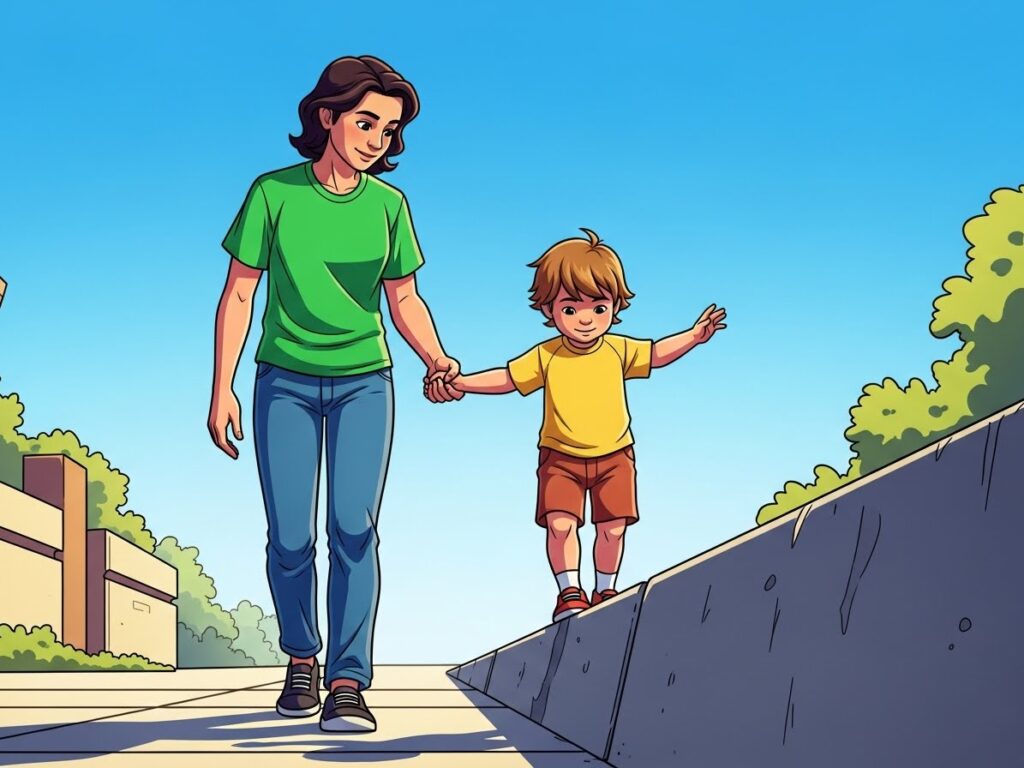
- Trials with oneself: Anyone who has observed preschoolers knows that they are constantly testing themselves. Everything around them is perceived as a challenge and as a kind of training device: “Can I manage this? This way? Or that way?” A preschooler will not walk calmly along the pavement—they will almost certainly try walking along the curb, simply to see whether they can do it.
- Curiosity: Around the ages of four to five, the “why?” phase begins—children ask questions that sometimes amaze with their depth and sometimes leave adults at a loss because they are difficult to answer.
All of this may appear to be an inherent feature of the preschool years, but this is not always the case. These qualities can be supported by adults—or, conversely, suppressed.
What Can an Adult Do to Stimulate Children’s Experimentation?
The role of the adult in supporting children’s experimentation is extremely important. An adult can:
- Create a rich environment: provide materials for experiments (sand, water, grains, magnets, magnifying glasses, objects of different shapes and textures).
- Ask open-ended questions that stimulate thinking: “Why do you think it turned out this way?” “What could be done differently?” “How could we check this?”
- Normalise mistakes: show that an unsuccessful experiment is not a failure, but a valuable experience that narrows and clarifies the field of search.
Practical Advice
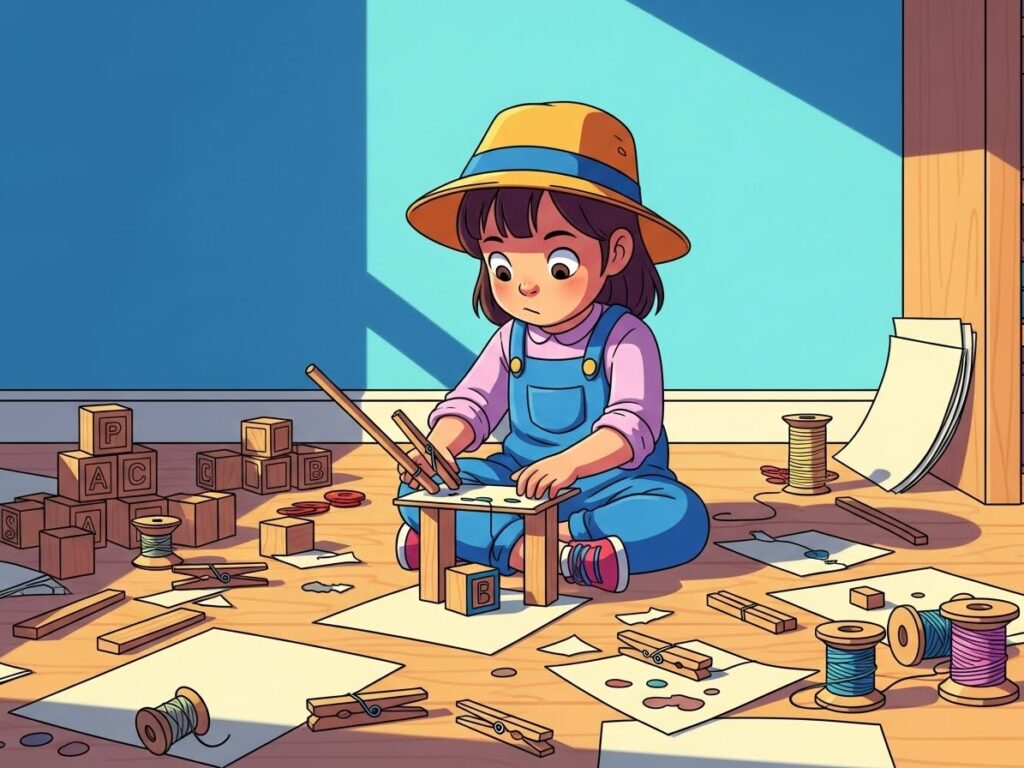
- Make a wide range of materials accessible for experimentation. These do not have to be special “young scientist”kits. Objects that are not usually considered valuable in everyday life are often ideal. They are sometimes called “junk materials,” but this term is rather dismissive—it reflects an adult perspective that has lost the ability to imagine what can be done with objects that have no obvious purpose. A more accurate term is “open-ended materials”—things that acquire structure and meaning only in the course of experimentation. These might include sticks and cardboard tubes, spools and boxes. A basin of water and a tin of buttons, a roll of foil and a handful of pegs can become sources of countless experiments.
- Support attempts to act not only according to rules, but in new ways. Adults often set up a kind of internal “filter,” paying attention only to whether a child is acting correctly and letting experimental trials pass as background noise. While learning rules is important, most real-life problems allow for multiple solutions. It is essential to learn to notice trials and unexpected solutions—not only in children, but also in ourselves—and to value them.
- Avoid turning children’s failures into drama. Making mistakes should not feel frightening. This applies to any shared activity, from cooking to fishing together. The adult’s example is crucial here: children observe how we respond to our own mistakes. To support experimentation, it is important to try new things ourselves and to share this experience with children: “That didn’t work—what else could we try?” The ability not to despair and to build a new route is a key condition for experimentation.
- Meet children’s curiosity halfway. Listen attentively to children’s questions and respond to them. Adults do not always have the time or energy for this, and it is not suggested that this should happen constantly. However, the experience of a child’s question genuinely surprising an adult and launching a shared search for an answer is deeply valuable and strongly supports cognitive development.
- Do not hide the fact that you do not know everything. Be willing to look for answers together—in books or online. Adults often fear that this undermines authority, but the opposite is true (as Socrates’ “I know that I know nothing” reminds us). It is important for a child to see that not knowing can be met with curiosity and exploration.
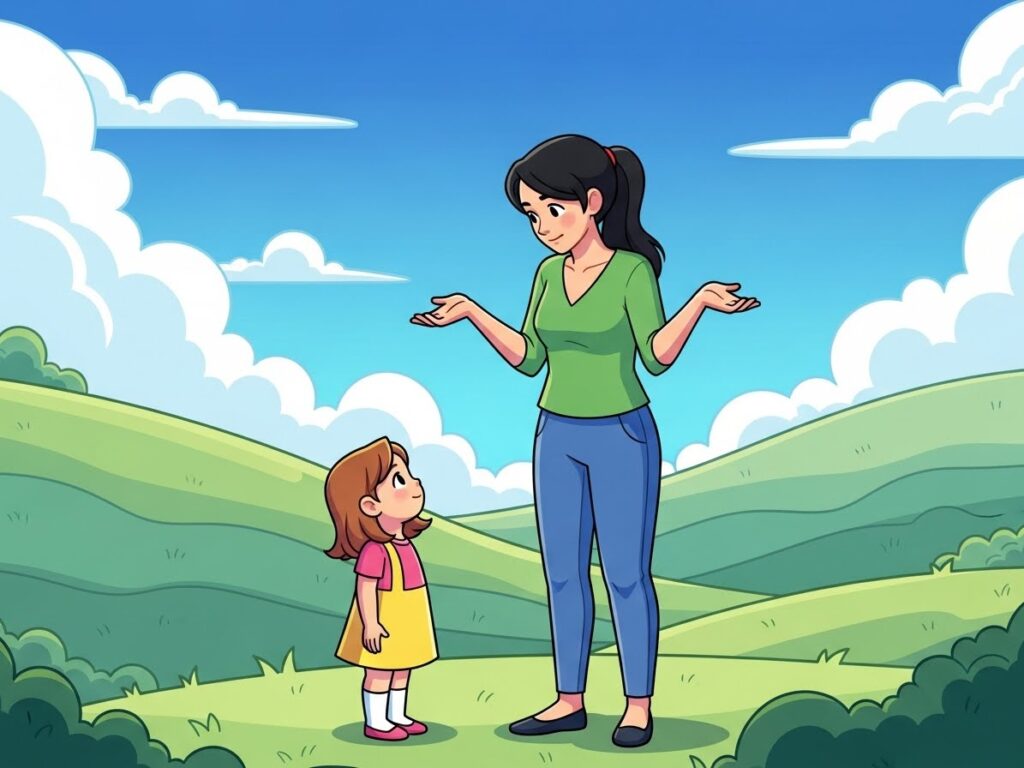
- Allow yourself to be surprised—and draw children’s attention to what is surprising. Surprise is a cultural emotion: it involves noticing the unexpected and taking pleasure in it. Children learn to experience surprise as joy in the unknown through adults.
- Capture the results: help the child draw, describe, or talk through what they have discovered as a result of their experiments.
How to Support Children’s Experiments with Language
It may seem that a child acquires their native language simply by imitating adults: if everyone around speaks the same language, the child just starts repeating it. This is not quite the case—mastering language and speech is a creative process. Children experiment with grammatical forms (hence attempts like “I’ll cut it with the scissors” in unusual constructions), with word meanings (“I macarooned myself”), and with the plots of familiar fairy tales (“And then Little Red Riding Hood went and ate the wolf”).
What can be done?
- Pay attention to children’s linguistic experiments—the invention of new words or the reworking of familiar fairy tales—and do not dismiss them as “just messing about”; share the child’s sense of surprise and amusement.
- Read with children books by authors who deliberately play with language: poems by Daniil Kharms, Edward Lear, and Lyudmila Petrushevskaya.
- Support children’s storytelling.
How to Support Children’s Experiments in Communication
Communication is also a space for experimentation. A child enters a world of highly complex social norms: one speaks differently with peers than with adults, with familiar adults differently than with strangers, and with relatives differently than with other adults. Although some rules are repeatedly communicated to the child (“you must say hello,” “you must not fight”), a vast number of rules have to be worked out in practice—guessed, tested, and revised. This is especially true because real life is always richer than any set of rules.
Experiments in communication involve testing hypotheses through observation (“Will my expectations be confirmed?”) and through active trials (“What will happen if I do it this way?”).
What a child explores experimentally in relationships with others:
- What helps to defuse (and sometimes escalate) a conflict?
- What is this person like? How will they react if I behave in different ways?
- What can I do, and what can’t I do yet? (This applies to intellectual and physical abilities alike; children are constantly testing themselves: “Can I jump from this height? And from that one?”)
Here is an example of how a child tests a hypothesis (from N. N. Poddyakov’s book Psychic Development and Self-Development of the Preschool Child).
Kolya B., aged five, went with his mother to a children’s concert. During the performance, a man of very small stature, with a wrinkled face and a bouncing gait, appeared several times. The boy had never seen a little person before and was struck by this man’s appearance, which reminded him of a finely made doll with a complex mechanism. A problem arose for the child: was this a living person or a doll? Kolya stopped paying attention to the concert programme and focused entirely on solving this question. A thought occurred to him: this could be tested—by sticking out his tongue at the little man. If it was a person, it would be unpleasant; if it was a doll, it would not care what was happening in the hall. Kolya waited for the right moment and, when the little man turned towards him, stuck out his tongue, then made a long “nose” with his hands and stared intently at his face. At that moment, however, the mother—shocked by her son’s behaviour—shook him, forcing the child to stop his ingeniously conceived experiment. Children aged five to six conduct even subtler and more complex social experiments, exploring a wide range of life situations at nursery and at home.
What Can Be Done?
Experimentation in communication is closely connected with the ability to understand another person’s position—to look at a situation through someone else’s eyes. Psychologists refer to this ability as decentration.
It is important for adults to discuss relationships with others with the child—why someone reacted in a particular way. In any situation, there may be many possible ways of acting, and there is rarely a single “correct” answer. That is precisely why it is especially important to try to understand the other person’s perspective and to anticipate their reaction:
“What might happen if I act this way? And if I act that way?”
“Why did they react like that?”
“How would I feel if I were in their place?”
“What else could be done in this situation?”
Conversations of this kind, when they take place in an atmosphere of trust, do not evoke guilt in the child—and this is key to helping the child approach communicative challenges with interest rather than fear.
Everyday Tips
- Pause
Before helping, wait 10–20 seconds.
Sometimes the solution emerges precisely in this pause.
- Allow “it didn’t work”
The phrase “It’s interesting what didn’t work here” supports exploration better than advice.
- Notice the strategy
Say not “Good job,” but “You tried it one way first, and then another.”
Listen to your own language
Better to say:
- “What are you checking at the moment?”
- “What might happen if you try it differently?”
- “Why did you decide to do it this way?”
- “It’s interesting what turned out to be unexpected here.”
Better not to say:
- “Let me show you.”
- “No, that’s not right.”
- “You should have thought first.”
- “I told you so.”
Three Common Mistakes—and What to Do Instead
Mistake 1: Helping too soon
✔ Instead: allow time for independent trial and error
Mistake 2: Focusing only on the outcome
✔ Instead: pay attention to the process of searching
Mistake 3: Anxiety about mistakes
✔ Instead: treat mistakes as information
A 7-Day Experimentation Challenge
- Day 1: Allow the child to try without prompts or hints
- Day 2: Ask one question instead of giving an explanation
- Day 3: Refrain from correcting anything during the process
- Day 4: Share delight in an unexpected result
- Day 5: Offer a new material with no instructions
- Day 6: Tell the child about one of your own attempts that didn’t work
- Day 7: Discuss together: “What was the most interesting part?”
Check Yourself: How Do I Support Free Experimentation?
Where am I now, and what could be improved?
Level 1. I don’t interfere
- I allow the child to try.
- Sometimes I feel anxious, but I try not to step in straight away.
Level 2. I observe
- I notice what the child is doing and how they go about it.
- I can tolerate pauses and resist the urge to prompt.
Level 3. I support the search
- I ask questions that stimulate thinking.
- I remain calm about mistakes and unexpected outcomes.
Level 4. I create conditions
- The child has materials, time, and permission to experiment.
- Experimentation becomes part of everyday life.
“Assess Yourself in One Minute”
Tick the statements that most often apply to you:
- I don’t rush to show the “correct” way.
- I can tolerate children’s trials without stepping in.
- I remain calm about failures and “unusual” outcomes.
- I ask questions instead of giving explanations.
- I notice attempts, not only successes.
- I allow myself to try new things.
0–2 items: “I don’t interfere”
3–4 items: “I observe”
5–6 items: “I support and create conditions”
How Can an Adult Awaken the Experimenter Within?
Experimentation is not only the professional domain of researchers or test engineers. It is a stance—an attitude towards uncertainty, which is always present in real life. There is even a term, “heuristic personality”: a way of relating to life in which a person allows themselves to try, allows themselves to make mistakes, accepts unconfirmed hypotheses and unsuccessful attempts with kindness, and is ready to venture new ones. This is not about irresponsibility, but about giving oneself permission to explore different strategies.
This is an invaluable experience for a child: being alongside an adult who is not afraid to try—and to fail.
How to awaken the experimenter who lives in every adult, but is sometimes barely noticeable because they are not given a “voice”:
- Try new things: a new recipe, new places, new ways of doing familiar things.
- Pay attention to how you react to your own mistakes. If you reproach yourself harshly, it is worth asking whose voice you are hearing at that moment. Perhaps it is time to answer it—and to defend your right to try and to look for new paths.
Instead of a Conclusion
Free experimentation is not chaos or disorder, but thinking in action, in its living form.
And if you are learning:
- not to rush,
- not to replace searching with ready-made answers,
- not to fear mistakes,
then you are already a highly competent adult in this area—for the child, and for yourself.
What to read?
- Beaty, A., & Roberts, D. (2013). Iggy Peck, architect. Abrams Books for Young Readers.
- Beaty, A., & Roberts, D. (2013). Rosie Revere, engineer. Abrams Books for Young Readers.
- Beaty, A., & Roberts, D. (2016). Ada Twist, scientist. Abrams Books for Young Readers.
- Cole, J., & Degen, B. (1985–). The magic school bus (book series). Scholastic.
- Citro, A. (2015). The curious kid’s science book: 100+ creative hands-on activities for ages 4–8. Innovation Press.
- Gallagher, S. (2013). Experimenting with babies: 50 amazing science projects you can perform on your kid. Perigee.
- Gopnik, A., Meltzoff, A. N., & Kuhl, P. K. (1999). The scientist in the crib: Minds, brains, and how children learn. William Morrow & Co.
https://www.alisongopnik.com/TheScientistInTheCrib.htm - Montessori, M. (1967). The discovery of the child. Ballantine Books. (Original work published 1948)
- Plaid, W., Mernit, J., & Crowley, M. (2012). Unbored: The essential field guide to serious fun. Bloomsbury.
- Tulley, G., & Spiegler, J. (2009). Fifty dangerous things (you should let your children do). Plume.