![[EN] CHILD LAB](https://childlab.co.uk/wp-content/uploads/sites/4/2026/01/child-lab-logo.jpg)
What Is Children’s Storycrafting?
A story is a very special form of text, built according to certain rules. A classical story has an introduction, an inciting incident, the development of action, a climax, a resolution, and an ending. Stories are a particular cultural phenomenon. They are not only literary works. They are a form through which people comprehend their own lives. Creating stories is a way of making sense of what is happening. That is precisely why storycrafting—the telling of stories—is used by teachers, psychotherapists, and those who build teams and projects.
Storycrafting—the creation of fairy-tale stories—is a special form of children’s activity. This may come as a surprise: unlike play, storycrafting is not talked about very often.
On the one hand, parents and other relatives, starting from when a child is two or three years old, notice that children tell many stories—enthusiastically and with complete absorption—often without even worrying whether the listener is actually listening. On the other hand, such storycrafting is difficult to distinguish from play, and later, by senior preschool age—precisely when children begin learning to write—it seems to disappear altogether. And when children at school master the technical side of literacy and begin writing their first texts, these texts appear completely unrelated to the inspired oral stories of early childhood.
However, if adults invite children to draw and record their stories and create conditions in which the child wants to do this, children can dictate stories with great enthusiasm and experience joy in their own authorship.
The Similarity Between Storycrafting, Play, and Experimentation
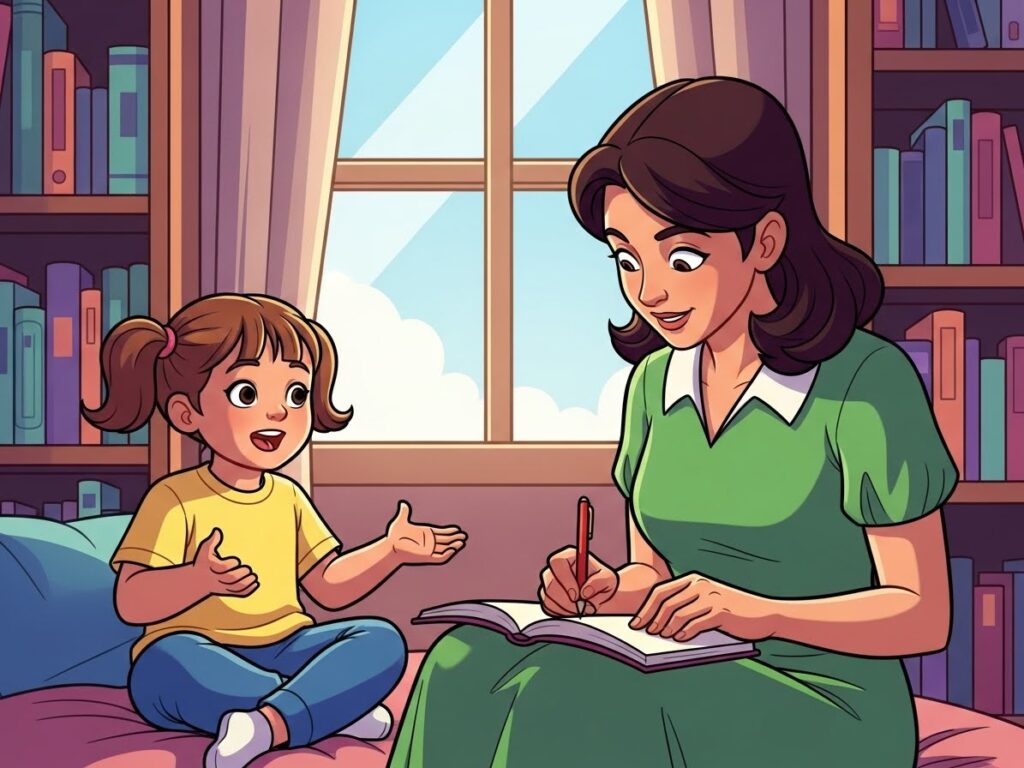
Children’s storycrafting is a special kind of activity; it is not identical to adult writing. It contains elements of play and experimentation, including experimentation with words. What storycrafting shares with play is that it is a way of expressing one’s experiences through images—and even transforming those experiences: after all, in a story you can try out different versions of how events might unfold. What it shares with experimentation is the opportunity to try out different ways of creating meaning, where the material for experimentation is not objects, but words.
How Storycrafting Differs from Play and Experimentation
However, unlike play and experimentation, storycrafting results in a text, in relation to which the child can experience themselves as an author. In play, the process itself is primary; in storycrafting, an interest in the result—the work—awakens. This means that in storycrafting, children’s subjectivity not only manifests and develops, but does so within the space of written text. And that text emerges thanks to the presence of a listener, a conversational partner. It is precisely this orientation toward another person that transforms play into the creation of a story.
The Conditions Under Which Storycrafting Emerges
Storycrafting fully manifests in situations where adults are willing to listen to and write down children’s stories. There is abundant evidence that when adults say to a child, “What an interesting story! Shall I write it down?”, children react as if they immediately understand what is being proposed. This confirms how organic this activity is for children. However, if adults do not say this, children create stories unnoticed—within play—and storycrafting fades away along with play.
Storycrafting is a remarkable phenomenon, similar to the old transfer pictures: if the conditions are right, the image appears and becomes vivid; if not, it remains almost invisible.
In this sense, storycrafting resembles other children’s activities—play and experimentation.
Why Do People Need Storycrafting?
Indeed: why would a child need storycrafting if they are not going to become a writer?
Writing is not a motor skill, but the ability to translate one’s thoughts from unformed reflections into words and to express them in a way that is understandable to another person. The motor component is important, but it is essentially auxiliary (it is no coincidence that different cultures place very different demands on neat handwriting—some consider it mandatory, others do not).
By contrast, expressing one’s experiences through text—especially through a literary text—is a significant cultural capacity that gives a person new possibilities. This step—from emotional reactions to a text in which these reactions are transformed and embodied—is one that children take with ease. Adults, however, take it with great difficulty if this activity was not supported earlier. Storycrafting is the first step toward future writing in the full sense of the word—as a cultural practice of self-expression through words and stories.
But it is not only about writing. Sometimes, by early primary school age, storycrafting seems to dry up—just as play sometimes fades. It dries up only because new activities and new ways of expressing oneself emerge. However, this does not mean that everything was “in vain”: the shoots that began to grow through storycrafting will manifest themselves in other children’s activities, primarily because storycrafting forms children’s subjectivity—an authorial position, a readiness to speak, and the courage to express oneself.
What Is the Value of Storycrafting for Children’s Development?
Practices of children’s storycrafting—where educators write down stories and organise shared readings or dramatisations—exist in different countries. While over the past fifty years much has been said about the importance of supporting play, the importance of supporting children’s storycrafting is discussed far less often. Nevertheless, over recent decades many studies have been conducted showing that children’s engagement in storycrafting is important for a wide range of developmental domains.
Subjectivity
Composing a story is a child’s first attempt at authorial action—that is, a sprout of subjectivity.
Through storycrafting, a child can re-think and re-experience their own experiences, take an active position, and cope with fear.
Play and Imagination
The plots of children’s play become more elaborate.
Imagination develops—the capacity to create new, unprecedented images.
Communication
Readiness to address another person with one’s idea.
Readiness to share one’s experiences with another.
Self-Regulation
Volitional control develops: the ability to create an intention and carry it through.
Speech Development and the Foundations of Literacy
Stories become more structured and coherent—they acquire a beginning, a middle, and an end.
Speech becomes more vivid and rich in adjectives and adverbs.
Interest in writing and reading increases.
Skills of “emergent literacy”—the technical side of reading and writing—improve.
In addition, researchers have identified an interesting pattern: it is precisely the creation of one’s own stories that enhances children’s reading competence. This pattern has been formulated as follows: “From a small writer to a great reader.”
At the same time, one must take into account the rule discovered by researchers studying play. Developmental potential lies primarily in a developed activity. In other words, if a child plays little, rarely, and in a simple way, one should not expect self-regulation—the ability to control impulses—to develop through play. But if a child plays often and extensively, and their play plots are elaborate and diverse, then a developmental effect of play can be expected.
The same can be said of storycrafting: developmental potential lies precisely in a developed activity—when a child composes stories with enthusiasm and when conditions for this are present.
Three Myths About Children’s Storycrafting — and What Really Lies Behind Them
Myth 1: “The most important thing in writing is motor skills: holding a pen, forming letters.”
What is important to understand:
Motor skills are only a tool, not the essence of writing. A child learns to write not when they perfectly form letters, but when they have something to say and someone to say it to. Storycrafting is precisely what creates this inner motivation: the child begins to see writing as a way of expressing meaning, rather than merely an exercise for the hand.
When there is an intention, motor skills catch up more easily.
Myth 2: “Writing is needed for transmitting information, not for made-up stories.”
What is important to understand:
The transmission of information is only one of the functions of writing.
Historically and culturally, writing emerged to:
- make sense of experience,
- express feelings,
- fix meaning,
- tell a story.
For a child, inventing fictional stories is a way of learning to think through text, not empty fantasy. Through imagined stories, the child masters real meanings.
Myth 3: “If adults hardly do this, it means it is not important.”
What is important to understand:
Many important adult capacities have childhood roots, but do not remain in their original form.
We rarely:
- play narrative games,
- build towers out of blocks,
- make up fairy tales aloud,
yet it is precisely in these activities that the following are formed:
- an authorial position,
- the courage to express oneself,
- the ability to transform experience.
Storycrafting does not disappear—it transforms. Children’s storycrafting is important not because a child will become a writer, but because they become the author of their own thought, learn to speak, to be heard, and to transform experience into meaning. And this is what truly “comes in useful in life.”
How Can Conditions for Children’s Storycrafting Be Created?
Children’s storycrafting does not require literary talent from an adult. It requires a special position—that of a listener and a witness to authorship. This position can be gradually learned.
Let us immediately note that a child may not become interested in storycrafting at all. In general, children have a full right to be more interested in some things and less in others. The task of an adult is not to force something to happen, but to create opportunities. Play and experimentation are leading activities of preschool age—that is, no child will bypass them. But construction, storycrafting, or artistic activity may attract children to a greater or lesser degree.
However, a child will never know whether they like an activity until they try it. Moreover, interest may arise with delay: a seed that falls into the soil may sprout later and unexpectedly. It is precisely opportunities for trying things out that an adult should create.
How to “Catch” Stories
Why do stories need to be “caught”?
At early stages, stories are very closely connected to play. They are born in that magical “as if” space that arises at the child’s will. This means that, unlike at later ages—when one can invite a child to a writing group and suggest writing stories—with preschoolers, stories must be anticipated. If you have the habit of listening attentively to a child, you may notice that from time to time they begin telling stories, doing so with complete absorption, often without even caring how attentively they are being listened to.
This is the moment to “cast the line” and ask:
“Would you like me to write your story down? Then we’ll have a little book!
Sometimes stories arise around a drawing, which itself is drawn not so much for representation as for play. And if the child is ready to enthusiastically comment on the drawing and unfold a story around it, one can also ask:
“Would you like me to write down your story, and you’ll have a book with a picture?”
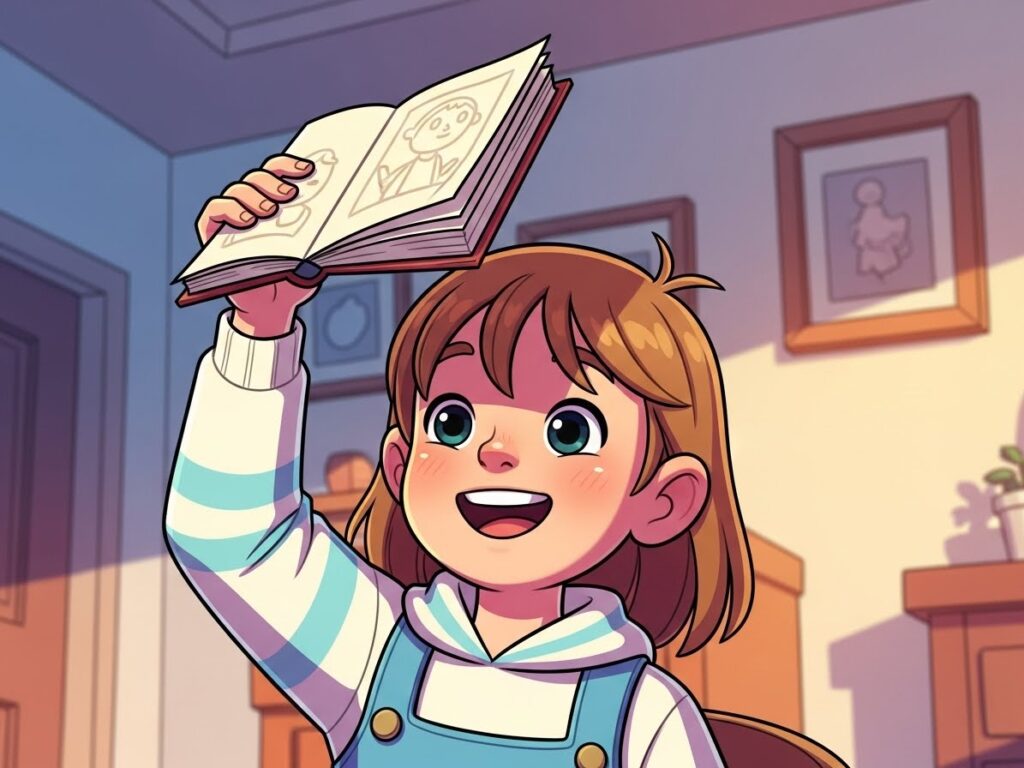
After that, one needs to see whether the proposal resonates. If not, the child has every right to refuse—and this means either that you might try again at another moment, or that storycrafting has not, for some reason, captivated the child (and perhaps will do so later).
An Important Reminder
It is essential to keep in mind that a preschooler is a person for whom it is important to learn “according to their own programme.” If storycrafting is organised as a lesson or an obligation, it will cease to be the activity in which children’s meanings emerge and are transformed.
How to Write Down Children’s Stories
There is no single algorithm suitable for all children, but some guidance can be offered, and in interaction with a child one can try out what “works”.
One can suggest that the child invent and draw a story and then dictate it to an adult. If the child is ready to invent “on the spot” and refuses to draw, this is also a possible option. For drawing and subsequent recording, one can make a separate notebook containing both stories and drawings, or one can make a separate little “book” for each story—using minimal means, such as a sheet of paper folded in half and a stapler.
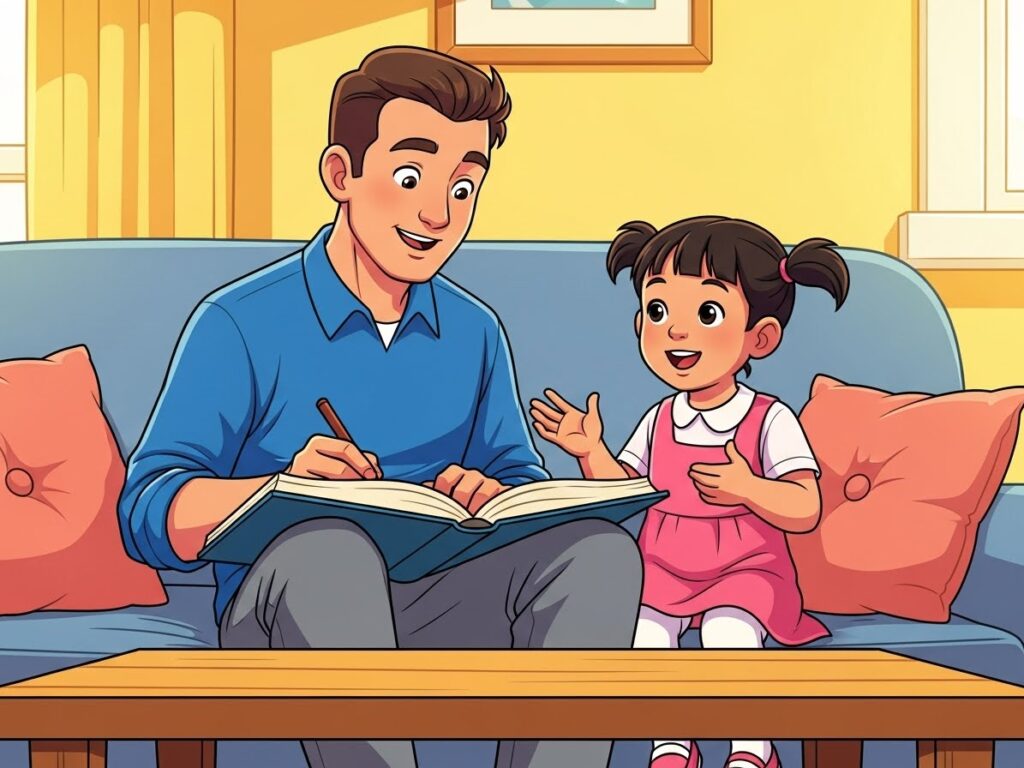
The recording of the story is done literally under the child’s dictation. Oral children’s speech can be fast and disjointed; to write down a dictated story, the adult will have to stop the child at times, ask them to repeat themselves, or ask them to dictate more slowly. Inevitably, the child will have to speak a little more slowly and formulate on the go—and that is exactly how it should be. One of the ideas behind this kind of dictation is that, in the process, the child learns to formulate their thoughts more clearly.
The Importance of Moments of Misunderstanding
It is precisely moments of misunderstanding that create the need for clarification. In everyday life, we begin to improve our formulations when we want to be better understood. In the process of writing down stories, an adult has every right to ask clarifying questions—if the story seems completely confusing—but these questions must be sincere and interested, not didactic or evaluative. It is important to hold in mind that the child is the author here, and the adult is only their helper. Only under this condition can one expect the child to continue composing and willingly dictating their stories.
The Adult’s Position
It is extremely important that the adult does not approach the story as a school composition—that is, does not expect “correctness”, “structure”, or “seriousness”. The value of children’s stories lies precisely in the fact that children’s experiences live there, and they live there in symbolic, fairy-tale images.
What Can Be Found in Children’s Stories?
At times, the content of children’s stories may seem unexpected to an adult. But in fact, stories are a window into the child’s inner world, through which one can glimpse their experiences. Therefore, one should not be frightened by the unexpected but rather be glad that the window is open and that you can empathise with the child and experience the events of their inner world together with them.
- Dramatic stories, in which frightening or even tragic events occur. This is how children’s experiences find a voice: through stories, children can live through sadness or fear and transform them.
- Comic stories, inversions, where “everything is the other way round”. This is how children explore the world—through trial.
- Stories with new, child-invented words. This is how children experiment with language, with its texture: sound, rhythm, rhyme.
Can Clarifying Questions Be Asked
Yes—but only in order to clarify places that are truly confusing. It is essential, however, that in all cases the adult relates to the young author with respect and interest, not from the position of a strict controller. The position of a strict controller immediately places the child in the position of a pupil—and storycrafting becomes impossible.
What to Do with the Story Afterwards?
A story comes into being literally in the space between the author and the listener. This means that it is important to create in the child a sense of being heard. Knowing that one’s story will be read—and even better, enacted—miraculously adds inspiration.
Stories can be:
- Read together. Through intonation, an adult can add emotion where the child lacked expressive vocabulary. In this case, the story begins to come alive even for its author.
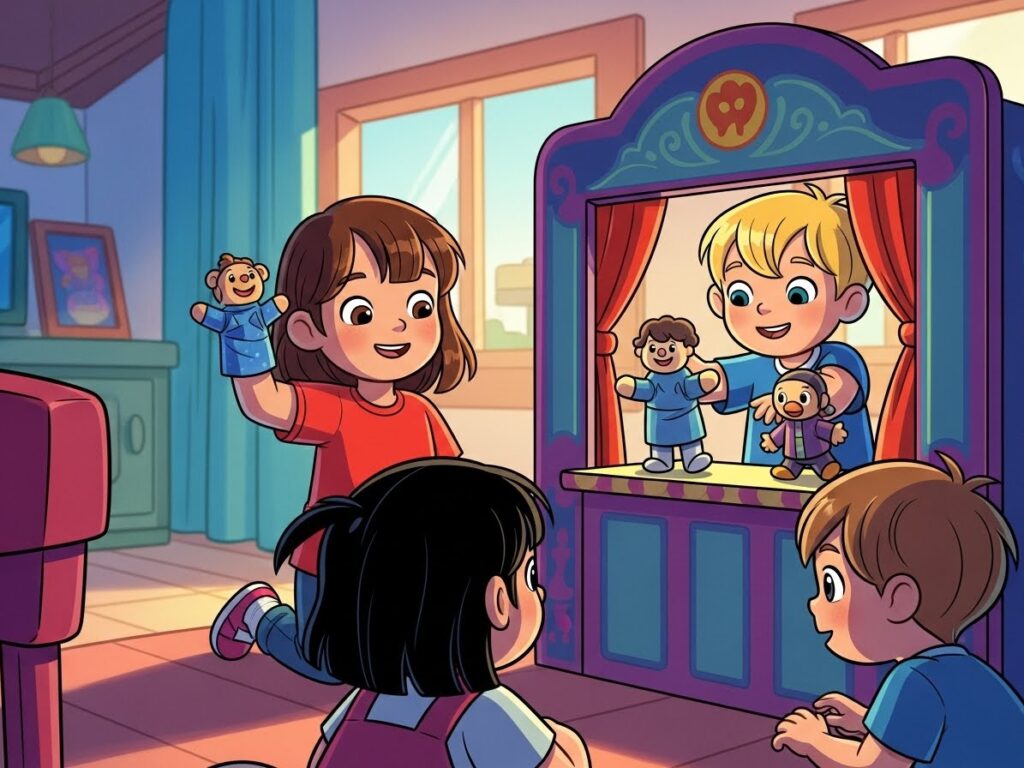
- Played out as puppet theatre. The puppet theatre can be very simple—for example, figures cut out of paper and glued onto sticks. What matters is that words turn into images—and this becomes a stimulus for further storycrafting.
- Acted out. For this, one can also use the most accessible materials—cardboard boxes and pieces of fabric. The very process of inventing costumes for the characters helps the child’s imagination make the story images more complex and multi-dimensional.
How to Establish a Storycrafting Tradition
Micro-Steps: Three Actions You Can Take Tomorrow
- Catch the moment
When a child begins telling something “on their own”, do not put it off for later—this is storycrafting.
- Offer recording, not an assignment
The phrase “Shall I write your story down?” opens up an authorial position without imposing it.
- Preserve a trace
Let stories remain in a notebook, a “book”, a folder. This gives storycrafting value in the eyes of the child themselves.
Prompts: How It Is Better to Speak
Say this:
- “What an interesting story. Would you like me to write it down?”
- “I didn’t quite understand—could you tell it again?”
- “And what happens next?”
- “This is your story—I’m just helping to write it down.”
Better not to say:
- “That’s not how you say it.”
- “Let’s make it shorter.”
- “Where’s the beginning?”
- “That’s wrong / illogical.”
The 7-Day Storycrafting Challenge
Day 1: Simply listen to the story all the way to the end
Day 2: Offer to write the story down
Day 3: Make a “book” out of a single sheet of paper
Day 4: Read the story aloud to the child
Day 5: Suggest acting it out
Day 6: Ask: “Would you like a continuation?”
Day 7: Re-read all the stories together
How Can You Assess Your Actions in Supporting Children’s Storycrafting?
What Level Are You at Now?
Level 1. I hear
— I notice that the child tells stories, fantasises, “chatters”.
— Often this seems like play or background noise.
Level 2. I listen
— I let the child finish telling their story.
— I show interest without evaluating or correcting.
Level 3. I record
— I offer to write down or preserve the story.
— I treat the narration as a text, and the child as an author.
Level 4. I create conditions
— I know how to “catch” stories.
— The child has experience of their stories being heard, written down, read, and acted out.
Mastery is not guidance in composing,
but the ability to be the adult thanks to whom a story appears.
Mini-Diagnostic: “Assess Yourself in One Minute”
Mark the statements that most often apply to you:
- I do not interrupt children’s stories, even if they are disjointed
- I do not correct the plot or language “on the go”
- I can offer to write down a story, not only to listen to it
- I treat the child’s narration as an authorial text
- I do not expect “correctness” or logic
- I am ready to be a helper, not a controller
0–2 points → Level “I hear”
3–4 points → Level “I listen”
5–6 points → Level “I support and create conditions”
Treat this “diagnostic” as a map of your growth: now you know which steps are worth taking.
Three Common Mistakes — and What to Do Instead
Mistake 1: Correcting language and plot
✔ Instead: clarifying only if something is genuinely unclear
Mistake 2: Turning storycrafting into a lesson
✔ Instead: catching it within play and spontaneity
Mistake 3: Evaluating the result
✔ Instead: valuing the very fact of authorship
Important: these are not mistakes of personality, but very habitual adult reactions.
What Parents Say
“I always thought it was just chatter.
When I wrote it down, I realised it was a real story.”
“I was afraid I would spoil things if I interfered.
It turned out it was enough simply to listen and write.”
“The most surprising thing is that my child began to feel proud of being an author.”
Can Adults Remember How to Make Up Stories?
Storycrafting can become a breath of freedom for an adult as well, if they dare to play at it together with a child. To play means not trying to make something foundational, beautiful, or super-valuable. To play means to enjoy the process itself, in which there is silliness and the joy of experimenting with words and plot. This is worth doing only if such play brings pleasure to you yourself. But whether it does or not can only be discovered by trying.
In addition to allowing, you to feel like a child again—playing and rejoicing—this can give you and your child a priceless experience of togetherness: mutual understanding and acceptance, where there is no need to strive to do something “correctly”.
At one time, many such games were proposed by the Italian writer Gianni Rodari in his book The Grammar of Fantasy.
What Can Be Done
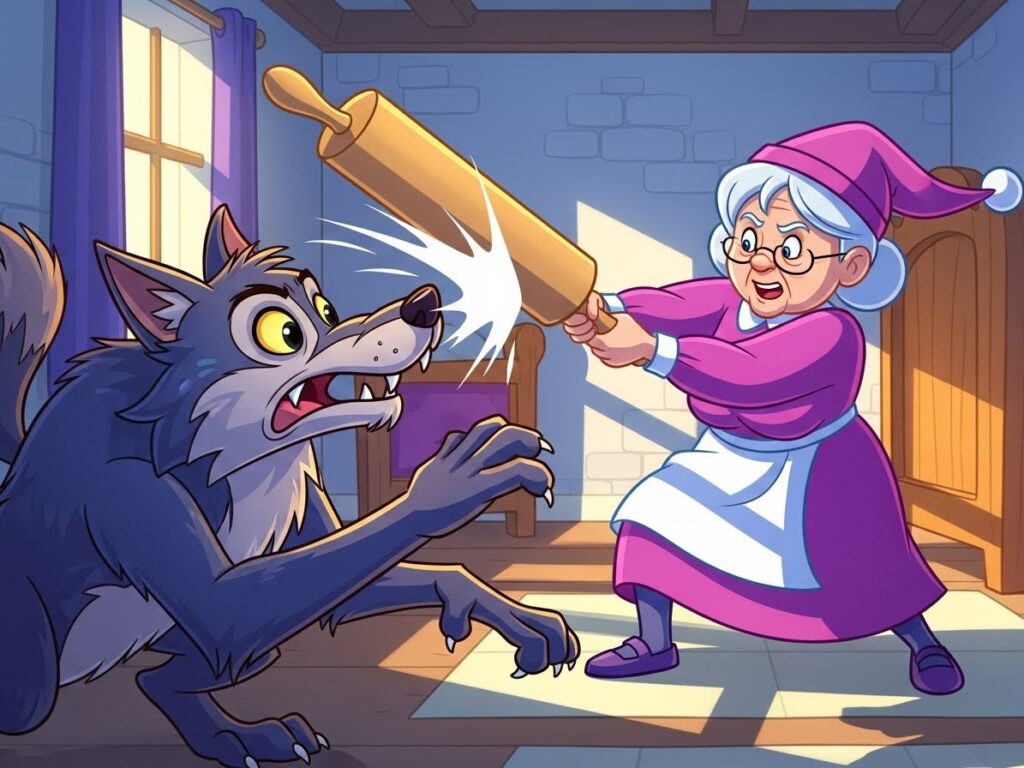
An “upside-down fairy tale” — a fairy tale in which a story familiar to both you and the child is turned on its head. For example, in Little Red Riding Hood upside down, the grandmother might eat the wolf! Inventing such a story is not easy at all.
The “binomial of fantasy” — two words are chosen at random—most likely from different semantic fields, for example the words “scissors”and “scooter”—and one then tries to invent a story in which they are brought together.
“Cards on the table.” This game consists of using elements of magic fairy tales.
There are thirty-one of them in total:
- the departure of one of the family members
- a prohibition addressed to the hero
- the violation of the prohibition
- reconnaissance
- delivery
- trickery
- complicity
- villainy (or lack)
- mediation
- the beginning of counteraction
- the hero leaves home
- the donor tests the hero
- the hero’s reaction to the actions of the future donor
- the receipt of a magical agent
- the hero is transferred, delivered, or led to the location of the object of the quest
- the hero and the antagonist engage in struggle
- the hero is branded or marked
- the antagonist is defeated
- the initial misfortune or lack is resolved
- the hero returns
- the hero is pursued
- the hero is rescued from pursuit
- the hero arrives home or in another country unrecognised
- a false hero presents unfounded claims
- a difficult task is proposed to the hero
- the task is accomplished
- the hero is recognised
- the false hero or antagonist is exposed
- the hero is given a new appearance
- the enemy is punished
- the hero marries
With children, one can use several of the simplest and most vivid elements (the prohibition, the difficult task, the return). With older children, a wide variety of combinations of elements can be used.
The elements can be depicted as symbols on cards—then all this turns into a cheerful card game.
Instead of a Conclusion
Children’s storycrafting arises between the child and the adult. If there is a listener, a story appears. If there is a story, an author appears. And if you notice and support this, you are already a very competent parent.
Reading suggestions
- Lee, T. (2015) Princesses, Dragons and Helicopter Stories: Storycrafting and story acting in the early years. London: Routledge.
- Lee, Trisha (2022) The Growth of a Storyteller: Helicopter Stories in Action. Routledge.
- Paley, V. G. (1990) The boy who would be a helicopter. Cambridge, MA: Harvard University Press.
- Paley, V. G. (2004) A Child’s Work: The Importance of Fantasy Play. Chicago: The University of Chicago Press
- Rodari Gianni (1996) The Grammar of Fantasy, An Introduction to the Art of Inventing Stories