![[EN] CHILD LAB](https://childlab.co.uk/wp-content/uploads/sites/4/2026/01/child-lab-logo.jpg)
Children of the so-called “why age” ask up to 300 questions a day. But by the time they reach school age, this stream dries up sharply. Why does this happen? Often because adults simply do not know how to respond to these questions properly, and children’s natural curiosity therefore receives no support.
The famous physicist Isaac Newton claimed that he owed his discoveries “not so much to intellect as to the ability to patiently ask questions.” His childhood “Why does the apple fall downward?” changed world science. Every child’s “why” a potential for discovery is — big or small.
Why does humanity need this — and your child?
A question is a point of wonder: a step from the known to the unknown.
If a person receives answers before questions have arisen, those answers have no value.
Any inquiry begins with the formulation of a question — not only scientific research, but also any attempt to make sense of a life situation.
Why is this important for the future?
The drive to ask questions is not merely a childhood habit. It is a foundation for critically important skills of adult life:
A child who knows how to ask (the world, a book, themselves) will always find a path to knowledge.
The ability to listen to others and to ask questions that reveal the essence is not only a key quality of an engaging conversationalist, but also an essential skill for teamwork.
The ability to ask a question and to notice a contradiction is the foundation for analysis and for building cause-and-effect relationships.
Thus, by supporting children’s questioning, we are “investing” in mental flexibility and the ability to navigate a changing world.
Myths about questioning
- Questions are (supposedly) easy to ask; it is much harder to search for answers to them.
- Questioning is (supposedly) a feature only of the preschool “why age,” and later it is no longer needed.
- (Adult myth.) A question is (supposedly) asked by someone who “does not know,” and therefore it is better not to ask, so as not to appear ignorant.
Such myths hinder both children and adults. In reality, asking deep, precise questions is a complex skill that everyone needs — always.

How is curiosity — the ability to ask questions — connected with other aspects of development?
The ability to ask questions is connected with:
- cognitive activity, curiosity, interest in the new;
- thinking, the ability to see contradictions and cause-and-effect relationships — the questions “why?” and “for what purpose?”;
- imagination: the ability to imagine possible and impossible transformations — the question “what if?”
Contexts in which the ability to ask questions can develop:
- shared reading;
- experimentation;
- travel and walking excursions.
What questions do children ask?
This small classification will help to “sharpen the ear” and better notice and support children’s questions.
Questions “for clarification and explanation”
These are questions about facts and ways of acting, which become more frequent toward the end of the preschool period:
“How do you start the toy car?”
“Where are we going in the summer?”
Questions about cause-and-effect relationships and purposes
These questions begin with “why” and “what for.”
They are questions about searching for connections: children want to build a coherent picture of the world, and the number of such questions increases toward the end of the preschool age.
“Why is he crying?”
“Why can’t you eat two ice creams?”
“And what do we need a spine for?”
From each such question, a large and interesting conversation about how the world works can grow, or even a whole joint investigation.
Sometimes a child builds a cause-and-effect connection themselves and wants to check with an adult whether their guess is correct:
“The hare turns white because the snow falls?”
And here is something interesting: children’s “whys” are often connected with the child’s attempt to extend already discovered regularities to new domains. Behind such a question lies an enormous amount of mental work. The question “And how does milk get into a cow?” is based on the child’s attempt to extend an already known regularity (which, incidentally, was not discovered immediately either — this is the law of conservation of matter, stating that material objects do not appear out of nowhere and do not disappear into nowhere) to living organisms.
Children demand consistency and logic from reality.

Questions about contradictions
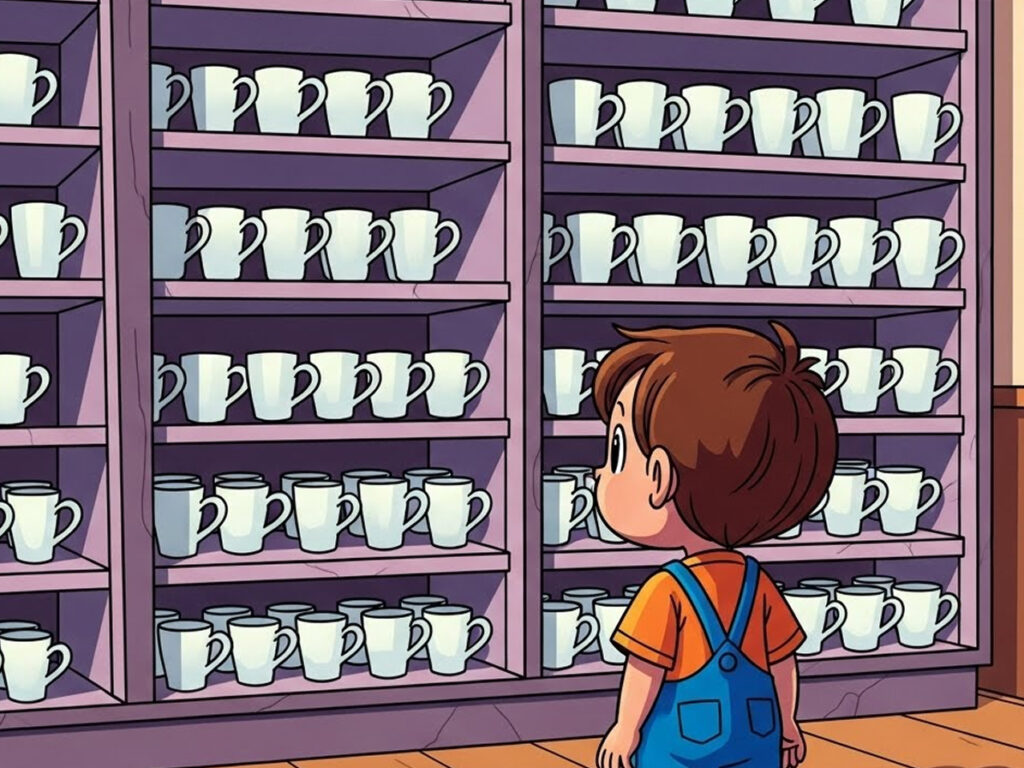
Sometimes a child directly notices that what they see contradicts the ideas they have already formed. Often behind such a question lies enormous mental work aimed at making sense of the situation — especially when it is not merely about the external appearance of objects (“Why are all the cups the same here?” — a question in a dining car), but about more complex matters.
The question “Why is it that the smaller the child is, the more their mother kisses them, and the bigger the child is, the less their mother kisses them?” reveals how complex the patterns are that the child is trying to discern in relationships with close people.
“Linguistic questions”
A special group of contradictions to which children are sensitive are linguistic contradictions. Korney Chukovsky wrote in his book From Two to Five that “starting from the age of two, every child becomes, for a short time, a brilliant linguist.”
Indeed, children “hear” not only the conventional but also the literal meaning of words and ask questions about the contradictions they notice, demanding logical consistency from language. Hence such questions arise as:
“Why is it called ‘breakfast’ if we eat it today?”
“If someone who writes is a writer, and someone who writes poems is a poet, why isn’t it ‘poemer’?”
“Why is cauliflower white?”
In fact, such sensitivity to different layers of meaning in a word is a property of poets. It is important to support this childhood ability so that it does not fade with age.
Questions about the possible and the impossible
These are hypothetical questions beginning with “What if?” For example:
“If a tree grew in the middle of a lake, what would it do?”
“But it isn’t there.”
“I know very well that it isn’t there, but what if? Well, what if it did grow there and stayed for a year?”
Behind such questions stands an awakening imagination, and the child seems to be inviting the adult to join in the joint construction of an image of possible events.
But how often adults brush such questions aside, believing that the supposed event has not yet happened and perhaps will never happen, and therefore does not deserve attention. Yet in reality it is precisely from such questions that hypotheses will grow — especially if adults do not let them pass unnoticed but suggest thinking together or looking for an answer in books.
Questions of “pre-causality”
Some children’s questions beginning with “why?” and “what for?” leave adults perplexed:
“Why don’t trees talk?”
“What do clouds hurry so fast for?”
These questions concern the goals and intentions of inanimate objects and phenomena. This is not surprising: it is well known that preschool children animate the world, attributing intentions to everything and everyone. This is what is called “pre-causality”: the belief that all things and phenomena act meaningfully, and that intentions can be discovered behind their actions.
Therefore, the question “Why is the cloud moving so fast?” may mean: “What made it decide to move so fast?” From the child’s point of view, everything was created by someone — hence the questions “Who made this tree?”
Gradually, there will be fewer such questions: children begin to distinguish between what happens according to intention and what does not; who is capable of having intentions and who is not. And yet this stage of child development has its own value. While the whole world is animated for children, they perceive it like poets and create stories that are only one step away from artistic creativity (“Once upon a time there lived a little house, and one day it decided to invite its friends…”).
If thinking and imagination develop organically, children will acquire a distinction between “living” and “non-living,” while at the same time the poetic view of the world will not disappear — the view that makes it possible to create magical stories expressing human experiences.

If an adult manages to unfold a discussion around any one of such questions, it will result in a most interesting conversation initiated by the child themselves.
The “emotional side” of a question
In human life, emotions and thinking do not “sit on separate shelves”: every question has an emotional side, and it is important for an adult to sense and understand it. Sometimes it is cognitive interest — the child is keenly interested in figuring something out. But sometimes, alongside interest, a question may contain anxiety, concern about whether the child is accepted, about what lies ahead, about whether they will be left alone, a request for support, and so on.
The question “Why are we driving for so long?” may mean anxiety about whether we will be late for the plane.
The question “What is this for?” (about shiny instruments in a doctor’s office) most likely means concern about whether it will hurt.
“Why does Mum go to work?”
Anxiety dulls cognitive interest. Behind the mask of “why?” and “what for?” there may be another question: “Will everything still be okay, even if everything is so unexpected?” This note of anxiety is important to recognize in order to respond first and foremost to it — for example, by answering and hugging the child, or in some other way giving a signal: “Everything is fine. We will sort everything out.”
How to observe children’s curiosity
Children’s relationship with questions resembles the well-known phrase “the tail wags the dog,” because indeed the question controls the child more than the child controls the question: children’s questions most often arise spontaneously and accidentally.
Learning to ask a question purposefully, consciously, appropriately, and to the very addressee one intends — means gaining experience of managing a situation, feeling more independent, more grown-up, and more confident.
Levels of development of questioning
Starting level: the child rarely asks questions.
Level 1: the child perceives the external form of a question as a speech act — asks formal, ritual questions that do not lead into an open situation. Says, “I have a question,” although what follows is not a question but a statement (“I have a question: Misha is throwing toys”).
Level 2: asks questions spontaneously or in a situation where an adult invites questions.
Level 3: in discussion or in spontaneous activity, the child, on their own initiative, asks a question that allows a transition from knowledge to not-knowing. The child takes the addressee into account, asking different questions to different interlocutors (“And I want to ask you a question”).
Evaluate yourself: how do you support curiosity?
Do you support children’s curiosity?
Try to answer for yourself what is characteristic of your communication with your child:
- I try to give an accurate and quick answer to most questions.
- I often answer: “Because it has to be that way” or “You’ll understand when you grow up.”
- Sometimes I say: “That’s an interesting question! Let’s think together.”
- At home we have a place (a board, a notebook) where we write down interesting questions.
- I myself ask questions out loud and am surprised by ordinary things.
What level are you at in supporting children’s questions?
Assess how often you act in the ways described. Choose one option for each item:
- Often / almost always
- Sometimes
- Rarely / never
- When I hear a question, I try to give an accurate and correct answer immediately.
- Before answering, I ask the child: “What do you think yourself?”
- I try to catch not only the essence of the question, but also the emotion behind it (curiosity, anxiety, surprise).
- I myself create situations that can surprise the child and provoke questions (I show an experiment, draw attention to something unusual).
- I write down or otherwise record the most interesting and unexpected questions of my child.
Key for calculating results and determining the level
Scoring: for each answer “A” give yourself 2 points, for “B” — 1 point, for “C” — 0 points.
Interpretation:
0–3 points: “Reactive” level.
You conscientiously answer questions, but interaction mostly goes in one direction: from you to the child. Your strength is that you provide knowledge.
Growth zone: try more often to return the question to the child (item 2) and observe their emotions (item 3).
4–7 points: “Supportive” level.
You are no longer just a source of answers, but a helper in the search. You involve the child in thinking and hear their feelings. This is an excellent foundation.
Growth zone: begin not only to react, but also proactively create “food for questions” (item 4) and value children’s questions enough to collect them (item 5).
8–10 points: “Environment-creating” level.
You consciously cultivate curiosity. You do not wait for questions but provoke wonder and turn questions into a family value. Your task is to continue in the same spirit and share your approach with others.
How to use the result?
This test is not an evaluation, but a map of possibilities. Identify your level and look at the items that scored fewer points — these are your next simple steps for growth. Even one small change (for example, starting to ask the counter-question “What do you think?”) already raises you to a new level of interaction with your child.
Age dynamics (what happens “by itself”)
No matter how young a child is, they already have their own ideas about the world and how it works, and these ideas are often confirmed: a toddler knows what will happen if a ball is thrown on the floor, knows where their pram is kept. And if the ball does not bounce as usual, or the pram today stands in an unfamiliar place, this causes surprise. With older children, questions arise as well: why is it like this?
This moment of unconfirmed expectations is the most precious one for cognition: the emerging conflict demands resolution. This is how cognitive interest is born, and it is precisely here that a question arises. A question gives energy: if it has arisen for you, it is interesting to search for an answer to it.
For an adult, a child’s question is a real window into the child’s world: from the question one can reconstruct what the child considers habitual and what — unexpected. The task of adults is to support this question-asking so that it does not fade away and moves to a new turn: from the curiosity of a preschooler to the inquiring curiosity of a schoolchild.
And in order to support it, it is important to listen attentively to children’s questions — because they are different.
What can an adult do to support and develop curiosity?
Notice and be surprised!
The task of adults is to support this question-asking so that it does not fade away and moves to a new turn: from the curiosity of a preschooler to the inquiring curiosity of a schoolchild. And to support it, it is important to listen attentively to children’s questions — because they are different, and one needs to respond to them differently.
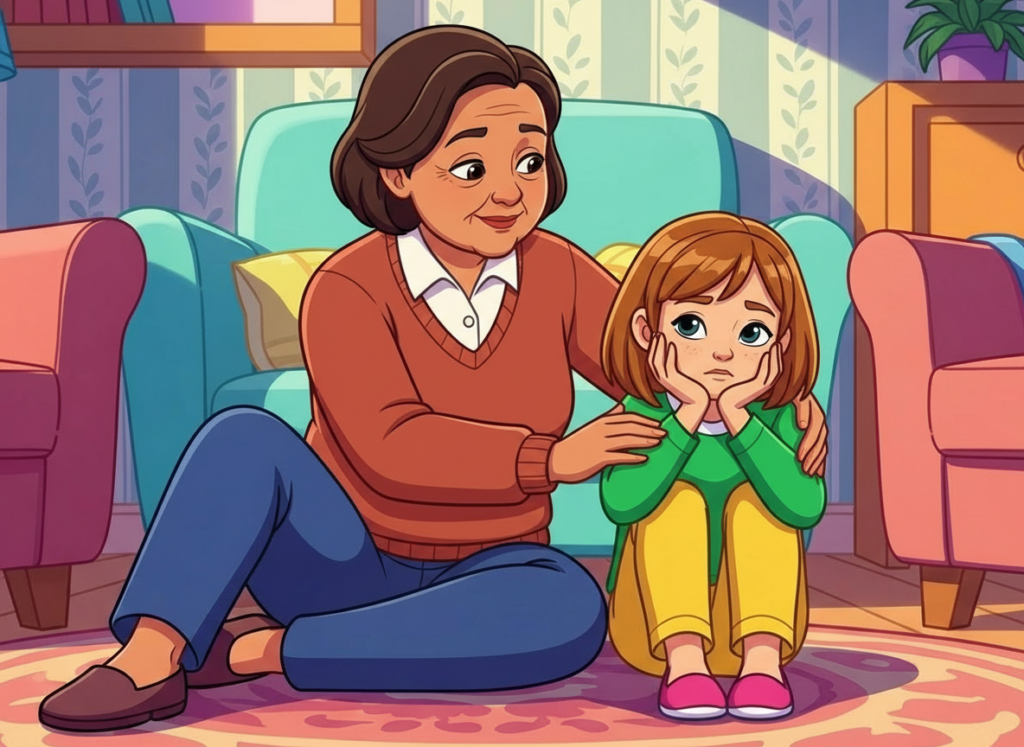
And most importantly — to respond to the emotion that stands behind the question, especially if it is an emotion of anxiety or fear. It is important to show the child that you understand what they are feeling. The question “Why are we driving for so long?” may mean “Are we going to be late?”. It is important first to respond to the feeling (“I see that you are worried. Everything is fine, we are on time”).
Sometimes it is enough simply to hug the child and, with your whole manner, show that you share their feelings and that they are not alone.
Respond!
Support questioning. Asking questions is a real skill that can either develop or fade away. One can make a “wall of questions” or a “book of questions” where children’s questions will be written down.
If adults show how wonderful it is not to know the answer and to begin a search or a discussion, if children’s questions grow into topics for joint searching or heartfelt conversations, there will be more questions.
Create points of wonder: ask questions yourself. Children catch such complex emotions as wonder from adults. Events and experiences that contradict children’s ordinary experience are important. Such experience may appear during travel or walks, but also during the most everyday activities — if one pays attention to expectations that are not being confirmed.
Help the child take a step from a question to information seeking. Children rather quickly begin to understand that they can get an instant answer to a question from an adult or from AI. For a preschooler, the very fact of knowing about such a “cultural helper” is already valuable. At the same time, it is important to search for the necessary information together with the child, so that the child can see that you do this with interest, are ready to look for information in different sources, to check it, and so on.
Help the child “discover” their own question. In cases where the child has already made their own conclusion, an adult can try to reconstruct the unasked question — and then the possibility of new answers appears. Thus, when a child says that “hares are white in winter because snow has fallen,” an adult can voice the unasked question: “And it really is interesting why hares turn white in winter, isn’t it?” In this way, we not only support the child’s thinking, but also help open new paths of movement of thought.
When a child asks a question, an adult usually considers themselves obliged to answer — after all, they are an adult, experienced and knowledgeable. Feeling the confidence and support of an adult is important for a child. But here it is important to maintain balance — because to many questions a child can find the answer independently, with a little help from an adult, or by thinking together with an adult, or by turning together with them to AI (since children’s questions often go beyond the competence of the adult who happens to be nearby).
Do not rush to give answers!
What should not be done — and what to do instead
One should not brush aside a “silly” or fantasising question.
Instead: value the very course of thought.
“How interesting you came up with this! Let’s imagine what would happen if this were true.”
One should not give an immediate, detailed lecture-style answer, interrupting the thinking process.
Instead: give a hint and involve the child in the search.
“This has to do with physics. Would you like me to show you an experiment that explains something similar?”
One should not ignore the emotional subtext, answering only the factual aspect.
Instead: “I see that this question worries you. Let’s hug first and then figure it out. Everything is fine.”
Instead of: “I don’t know.”
Better: “Let’s think about it together.”
Instead of: “Stop asking questions.”
Better: “How wonderful that you noticed this!”
If the child is anxious:
“I understand, this can be worrying. I’m with you. Let’s sort it out together.”
Practical advice
“Micro-steps” you can take already tomorrow
Three everyday tips:
- Pause for 5 seconds before answering and ask: “What do you think?”
- Ask your own question: “I wonder why…?”
- Write down one of your child’s questions in a “question diary.”
Weekly challenge: “The Question Factory”
Day 1: Write down the most unexpected question your child asked today.
Day 2: On a walk, ask them: “What is the most surprising thing here?”
Day 3: Respond to a child’s question with a counter-question: “What do you think yourself?”
Day 4: Together, invent three “what if…” ideas about any object at home.
Day 5: Consciously say: “I don’t know the answer, but let’s find out.”
Day 6: Create a “wall of wonder” — stick a picture or a question on the fridge.
Day 7: Together, find an answer to one of the old questions.
Games for developing the ability to formulate questions
- Game “What’s in the box?” (Magic bag)
How to play:
You place an object in an opaque box or bag. The children’s task is to guess what is inside by asking only questions that can be answered with “Yes,” “No,” or “Partly.”
What it develops:
- Formulating precise rather than vague questions.
- Building a logical chain by eliminating incorrect directions.
- Working with constraints (only closed questions).
Variation: use unusual objects (a pinecone, a magnet, a construction-set figure) to stimulate deeper questions.
- Game “Guess who / what I’m thinking of”
How to play:
One player (adult or child) thinks of an animal, character, or object within a shared category (for example, “animals of hot countries”). The others ask guiding questions, as in the “box” game.
What it develops:
- Categorising and systematising knowledge (“Is it a predator?”, “Does it live in the forest?”).
- Narrowing the search field by elimination.
- Game “Why-asker” (the other way round)
How to play:
An adult shows the children a picture with a surprising phenomenon (for example, a snail crawling on glass) or demonstrates a simple experiment (a coin does not pass through a heated opening). The children’s task is to come up with as many questions as possible beginning with:
Why…?
How…?
What will happen if…?
What for…?

What it develops:
- Seeing a problem and being surprised.
- Translating surprise into research questions.
- Looking at a phenomenon from different angles.
- Game “Yes-no riddles” with a puzzle
How to play:
This is a more complex version of “Guessing.” The adult thinks not of an object, but of a situation or a riddle. For example: “A person leaves a room, sees an umbrella on the table, and starts crying. Why?” Children ask questions in order to reconstruct the context.

What it develops:
- Asking questions not only about properties, but also about actions, causes, and emotions.
- Building complex cause-and-effect chains.
- Training “The three most important questions”
How to play:
Show the children an image of an unfamiliar, fantastic object or creature (for example, a Dyson sphere, an unusual fish such as a deep-sea anglerfish, or an alien). Their task is to come up with “only three, but the most important questions” about this object. Afterwards, you can discuss why they chose exactly these questions.

What it develops:
- Quality over quantity. Filtering out the secondary and extracting the essence.
- Determining what is most important for understanding an object.
- Game “Interview with a hero”
How to play:
One child (or an adult) takes on the role of a hero (for example, a scientist, a traveller, a book character). The others conduct an “interview” with them. To prevent the game from becoming purely formal, agree in advance that clarifying questions should be asked (“And what did you feel when…?”, “And how did you manage to do that?”).
What it develops:
- Conducting a dialogue, listening to answers, and asking questions based on them.
- Digging deeper, showing empathy and curiosity toward another person.
- Research quest “Find the answer”
How to play:
Create several “stations” in a room or outdoors with different objects (a magnifying glass and leaves; magnets and various materials; containers with water and objects to test buoyancy). At each station, there is one main question:
“Why are some leaves smooth and others rough?”
“Are all metals attracted to a magnet?”
The children’s task is not merely to answer, but to come up with their own additional questions about the object and try to find answers to them through observation and a simple experiment.
What it develops:
- Linking questions with practical investigation.
- Understanding that one question leads to another.
Key principles for all games
- Praise the question itself.
Phrases like “What an interesting question!” or “I’ve never thought about that myself!” are the best motivation.
- Do not give the answer right away.
Answer a question with a question: “What do you think yourself?”, “How could we check this?”
- Write questions down.
This shows that children’s questions are valuable. You can start a “Why-askers’ Journal.”
- Set an example.
Ask your own “silly” and surprising questions about the world around you.
“Spaces for questioning” at home
- “Question diary” (or “Why-askers’ Journal”).
A shared notebook where every family member can write down their question, a version of an answer, or a discovered fact. This materialises the value of curiosity.
- “Wall of wonder.”
Set aside a place on the fridge or a cork board. Let children’s question-drawings, your photos with “puzzles,” magazine cut-outs, and sticky notes with thoughts like “Why…?” appear there. This creates an environment that provokes reflection.

How an adult can “pump up” their own love of asking questions
The ability to ask questions is very valuable for adults as well.
The ability to discover the unknown within the known makes life more exciting and interesting. At the same time, it is well known that asking questions is not so easy — it is no accident that after even an interesting lecture, when the speaker invites questions, the response is often “no questions, everything is clear.” This is precisely what shows that asking a question is difficult: one must be able to doubt and to see a problem from another angle.
The ability to ask questions can be awakened in oneself by asking questions of an artistic work or a text — popular, scientific, or literary.
For example, the questions might be:
What in this work (text) is
- the main thing?
- unclear?
- controversial?
- something I agree with?
- surprising?
- pleasing?
- meaningful for my life?
- reminiscent of events in my life?
- raising questions?
Questioning can be turned into a game with friends.
How do we know that we are moving forward?
- A) Changes in you, the adult
- Less autopilot.
You catch yourself not saying the habitual “Don’t touch!”, “Don’t go there!”, “Let me do it!”, but first watching what exactly the child is doing.
- Curiosity instead of irritation.
A strange action or question from the child first arouses interest (“Hmm, what is he up to?”) rather than the desire to immediately stop it.
- Comfort with not knowing.
You calmly say: “I don’t know, but let’s find out together” — and this does not feel like a defeat.
- Joy of co-participation.
You take pleasure not in the perfect result, but in the process of joint searching and creativity with the child.
- B) Changes in the child (the most vivid signs)
- “I’ll do it myself!” sounds different.
It is not a capricious refusal, but calm confidence: “I want to try; help me get started.”
- Plans appear.
The child begins to talk not only about what was, but also about what will be:
“Tomorrow I’ll build a ship out of chairs!”,
“Let’s make a theatre this evening!”
- A mistake is not the end.
The child throws fewer tantrums when something does not work out. They may say:
“Oops, it broke… Oh well, I’ll try another way,”
or ask: “Why didn’t it work?”
- Questions become deeper.
Instead of endless “why” about everything, hypothesis-questions may appear:
“If we mix this paint with that one, will it turn purple?”
or reflective questions:
“Mum, what is it like to be sad?”
- The child offers help and solutions.
They may say: “Let me figure out how to fix this myself,”
or “Let me help you — I know how.”
The main indicator for both
Communication increasingly resembles a dialogue between two co-authors rather than an instruction of a subordinate. You are not simply walking side by side — you are looking in the same direction together, and the child feels that their voice matters for the shared “journey.”
Start small. Today — simply write down one child’s question. Tomorrow — ask your own. The day after tomorrow — look for an answer together. You are not merely answering your child. Together with them, you are unravelling the greatest mystery — the mystery of how the world works.
And the best guide in this journey is the inquisitive mind of your child, confident in your support. May there be more of their questions.
What to read
- Chukovsky, K. I. From Two to Five. St Petersburg: Limbus Press, 2000. 463 pp.
https://www.litres.ru/book/korney-chukovskiy/ot-dvuh-do-pyati-65104897/ - All of Oscar Brenifier’s books for parents
- Harris, P. L. (2012). Trusting What You’re Told: How Children Learn from Others. Harvard University Press.
- Leslie, I. (2015). Curious: The Desire to Know and Why Your Future Depends on It. New York, NY: Basic Books.
- Berger, W. (2016). A More Beautiful Question: The Power of Inquiry to Spark Breakthrough Ideas. Bloomsbury Publishing.
https://www.bloomsbury.com/uk/more-beautiful-question-9781632861054/ - Berger, W. (2018). The Book of Beautiful Questions: The Powerful Questions That Will Help You Decide, Create, Connect, and Lead. Bloomsbury Publishing.
https://www.bloomsbury.com/uk/book-of-beautiful-questions-9781632869586/