![[EN] CHILD LAB](https://childlab.co.uk/wp-content/uploads/sites/4/2026/01/child-lab-logo.jpg)
What Is Construction?
Construction as a Children’s Activity
Construction is a special type of children’s activity in which a child creates a model–structure from a particular material.
It is a model because a child’s building is always a representation of something from the outside world that the child recreates using blocks or construction sets.
It is a structure because, when building, the physical properties of the material must be taken into account. Otherwise, the child’s idea cannot be realised: the house will collapse, the car will not move, and so on.
Construction is closely connected with two other major children’s activities – play and experimentation. Most often, the desire to build arises within a play situation: a child builds a house for a doll, a castle for a robot, or a zoo for animals. After building, the child may return to play and begin to “inhabit” the construction.
At the same time, construction has its own tasks – to realise an idea, and gradually it can become a separate activity in its own right, when the main motive is no longer the storyline of the play, but the construction itself.
“What if my child is not interested in construction?”
First of all, that is absolutely fine. Just like adults, children have the right to be more interested in some activities than in others.
Secondly, the adult’s task is to create a space of possibilities for trying and for the growth of interest.
Interest is not something we are born with. Interest emerges in the process of interaction with the world and with other people. Very often, children “catch” interest from adults who are genuinely enthusiastic about something. At the same time, skilfully designed materials can also spark interest. A well-known example is LEGO, which has inspired millions of children to enjoy building, even if their parents were not particularly engaged in construction themselves.
Interest does not arise before the process – it arises in the process. That is why it is important simply to make construction possible. And then we see how it goes.
“Is construction important for children who are not going to be engineers and who may grow up to be ‘humanities-minded’?”
With preschool children, it makes little sense to talk about “humanities-minded” versus “technical” types. The preschool years (and the years that follow) are a time of exploration, self-discovery, and experimenting with the world – a time for interests to begin to show themselves. Any early “self-definition” or “career orientation” is inappropriate for this age.
(And in parentheses, it is worth noting that, more generally, the opposition between “humanities-minded” and “technical” people has largely lost its relevance in today’s world – but that is a separate conversation.)
Why Unit Blocks?
Yes, in this section we will be talking specifically about construction play with unit blocks.
“But why?” any modern parent might ask. Indeed – why? Haven’t blocks been left somewhere in a distant “pre-LEGO” past? After all, there are so many modern construction toys available today!
First, because unit blocks are a unique type of open-ended construction material. Unlike most modern construction sets, they consist of basic three-dimensional geometric forms – cubes, rectangular prisms, triangular prisms, cylinders, and so on. These shapes embody fundamental proportional relationships, and this is precisely why building with them is so powerful for children’s development.
These basic forms allow for multiple ways of creating the same structure. For example, to build a cubic house, a child may use one cube, or several rectangular blocks, or two triangular prisms. It is exactly this openness and variability that gives unit blocks their exceptional developmental potential.
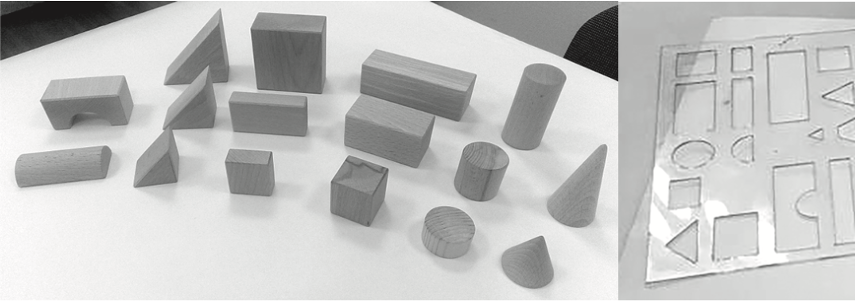
Here are the kinds of pieces that should be included in a good set of unit blocks:
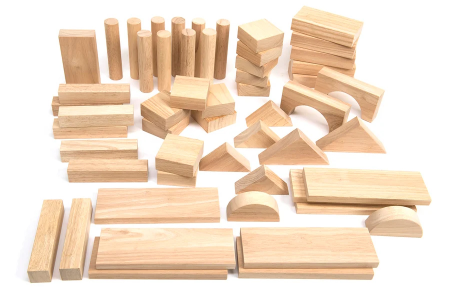
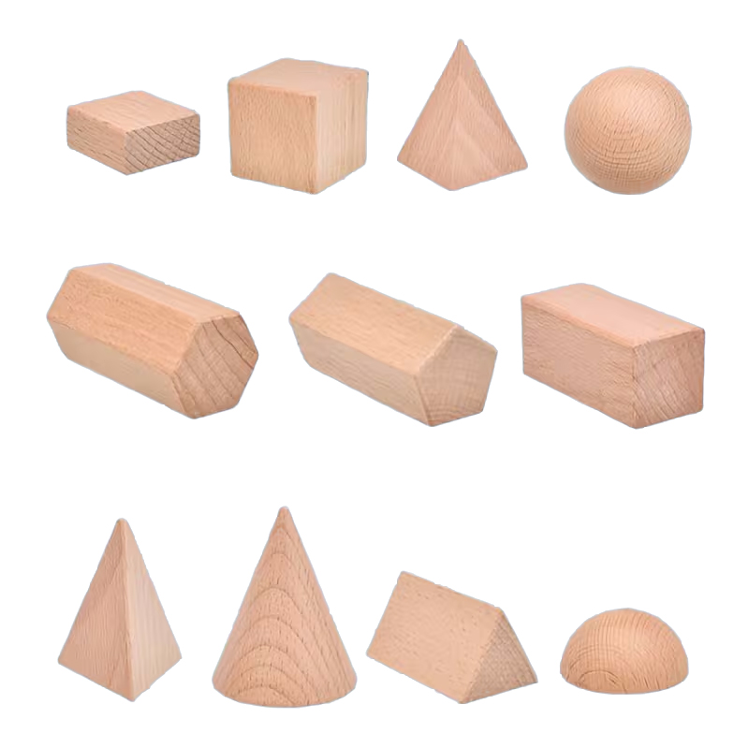
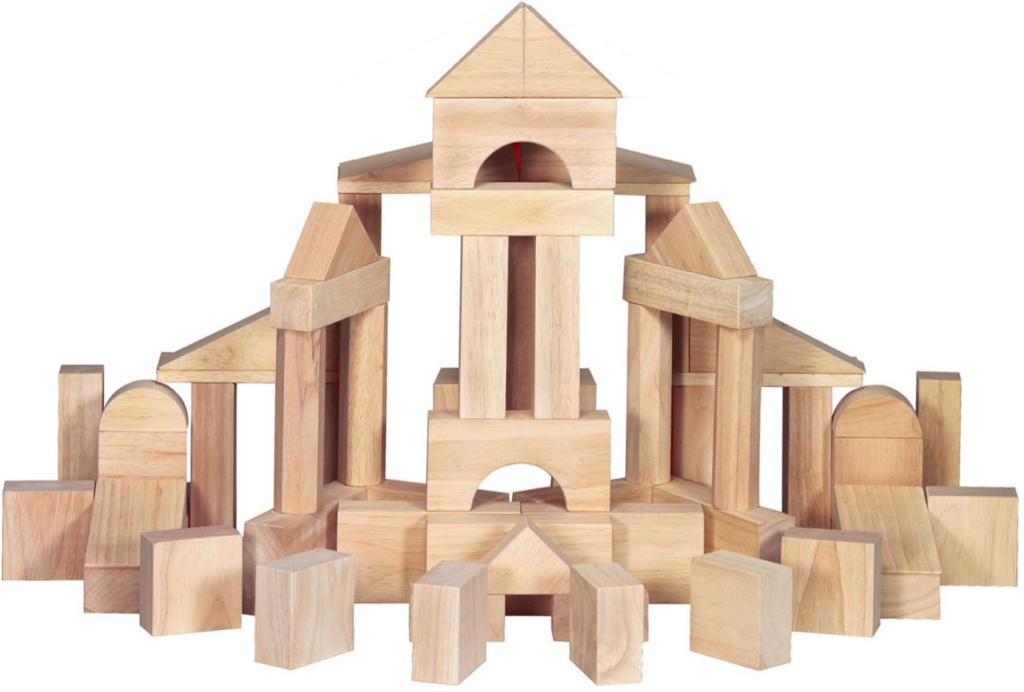
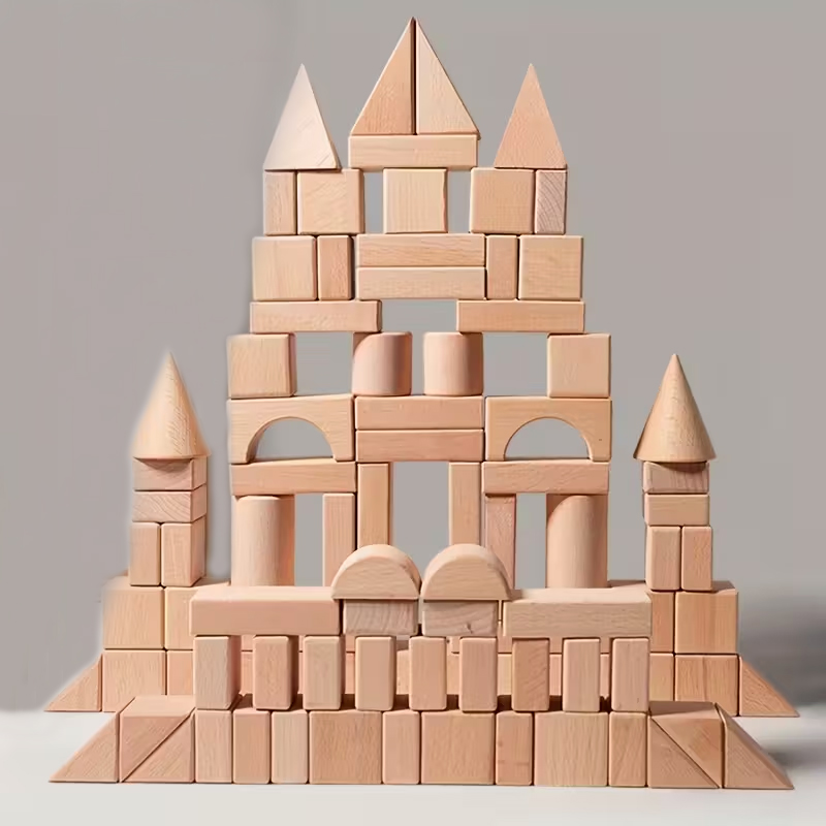
Second, most children today already have access to various construction toys, and there is no need to convince parents of their value. At the same time
Myths About Construction Play
Myth 1. Construction play is for boys.
Girls and boys equally need experiences of creating and transforming. Construction play develops universal capacities – thinking, imagination, and initiative.
Myth 2. The main thing is the result.
In construction play, it is not the finished object that matters most, but the process. The child learns to think with their hands, to search for solutions, to make mistakes and to correct them.
Myth 3. A construction set must be complex and expensive.
Sometimes simple blocks or wooden planks offer more freedom and meaning than a plastic set with fixed instructions.
Myth 4. You have to build “the right way.”
There are no wrong constructions in children’s play. There are explorations of form that lead to understanding.
Construction in the Adult World: What Kind of Activity Is It?
In the adult world, construction appears in forms such as designing, architecture, engineering, and design.
A designer or architect:
- creates an idea or intention;
- plans actions;
- searches for materials;
- realises the idea;
- checks whether everything has turned out as intended;
- makes changes if something does not work or if the idea itself has changed.
How Children’s Construction Differs
For a child, construction is not a “preparation for a profession,” but a special way of entering culture. Through construction play, the child becomes familiar with a specifically human way of thinking – planning, relating an intention to a result, and transforming material.
An adult designer usually begins with an idea and a drawing. A child, at first, begins with action – with trying things out. But both follow the same fundamental path: from intention to realisation.
By constructing, the child enters a cultural activity in which thought becomes action, and action becomes a way of understanding and expressing thought.
What Develops Through Children’s Construction Play
Construction play does not develop only “fine motor skills” or “attention.” Through construction, a capacity is formed to mentally build the world – to see relationships, proportions, order, and patterns.
What exactly develops through construction play?
The Ability to Create an Intention
At first, an intention is born at the end of building or in the course of it. The ability to act purposefully – from intention to result – does not appear immediately in children.
At around three years of age, when asked, “What are you building?”, a child often answers, “I don’t know – I’ll build it and then you’ll see.”
Through construction play, the ability gradually develops to form an intention in advance, on an inner, mental level.
It is precisely in the process of forming an intention that imagination develops – the capacity to envision a new image before the details of its realisation are clear: the materials, physical properties, and other constraints.
Expressing Feelings Through Creating an Intention
Expressing Feelings Through Creating an Intention is the foundations of an aesthetic relationship with the world.
Any intention expresses not only thoughts and ideas, but also a person’s feelings. Every form of constructive activity is therefore also a way of embodying feelings through material.
It is important not to assume that feelings – including children’s feelings – are always obvious. In reality, people often find it difficult to understand what they are feeling at a given moment. Construction play can help a child become more aware of their feelings and express them in material form.
Through construction, a child may discover that form can express character:
a straight, regular house can feel calm;
a crooked or uneven one can feel fairy-tale-like or mysterious.
Self-Regulation
Through construction play, children learn to select materials and to hold a task in mind over an extended period, building a sequence of actions.
- Planning and maintaining an intention.
- Evaluating: did it turn out as I planned?
Cognitive Development
- Spatial thinking and decentration– the ability to imagine an object from different viewpoints
- Solving material problems– relating goals to conditions, searching for new ways to achieve a goal, and solving tasks
- Solving material problems– relating goals to conditions, searching for new ways to achieve a goal, and solving tasks that require holding several characteristics in mind at the same time (for example, height and balance).
- Visual modelling– with gentle adult support, construction play can become the activity in which a child begins to master visual models (simple drawings, plans, and diagrams) already in the preschool years.
- Imagination– the ability to picture a whole image of a future construction.
- Aesthetic perception of reality– through discovering symmetry and asymmetry.
Development of Creative Abilities
- The creation of new and unexpected solutions.
Communication Skills
The ability to act together when several children are constructing. Children learn to coordinate viewpoints, negotiate, and help one another.
Can All of This Develop in Other Activities?
Yes. And this gives parents a great deal of freedom.
If it is not possible to create conditions specifically for construction with blocks, many of these abilities will still develop – to a greater or lesser extent – in other kinds of activity.
Is There Anything That Construction Play Is Especially Good For?
Yes: visual modelling and spatial thinking.
What Can Be Done: How to Create Conditions for the Development of Construction Play
Tools of Construction: Visual Model, Plan, and Template
What Is “Visual Modelling”?
We have already said that every construction is a model: for example, a model of a house, a car, or a bridge. This means that, when a child “plays” with blocks or a building set, they are learning to create a model of the world.
But the word model also has a second, more specific meaning: a drawing or plan.
Visual modelling is the ability to use drawings or simple plans to create an idea for a construction or to think about and analyse a structure that has been built.
A natural question may arise: isn’t this too difficult for young children? After all, at school children usually encounter technical drawing or map work much later.
First, research led by Leonid Wenger has shown that preschool children are quite capable of using visual models. They learn to work with them with great interest, especially when adults introduce them gradually and with genuine engagement.
Second, learning to use drawings and simple plans is valuable not mainly for future drawing or building skills. These “tools” are important because they support the development of thinking in general.
What Is a Plan (Drawing)?
A plan is a representation of a construction that shows its main relationships while leaving out secondary details.
For a plan, colour or decoration is not important. What matters are the relationships between sizes and parts. That is exactly why working with plans is so powerful for thinking: a plan helps a child learn to distinguish what is essential from what is secondary.
How Can Children Use Plans?
- To understand an existing construction
From a finished structure, a child can create a plan – and even make several views of it. - To create an intention
A child can express an intention in a plan (also in one or several views) and then use it as a basis for building the construction.
What Kinds of Plans Are There?
A plan can show all the parts from which a construction is made – in this case it is a detailed (component) plan.
But a plan can also be more complex: it may show only the main proportions and the overall outline of the construction. In this case, the child has to work out for themselves which pieces and how many of them are needed to realise the idea.
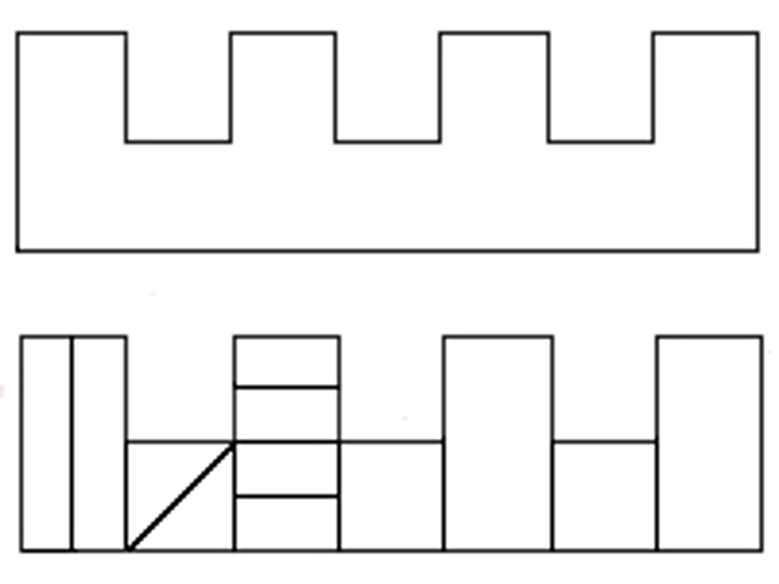
However, even if a drawing is component-based, it is not always easy to work out which specific pieces it is made from when we have only one projection. By the age of six to seven, children are quite capable of mastering two and even three projections of the same construction.
What Is a Template?
A template is an object with cut-out openings that correspond to geometric shapes.
Such a template does not interfere with creativity when it is used as a tool for learning about form. On the contrary, it helps children learn how to make drawings.
One of the difficulties of creating a drawing is that children’s fine motor skills are not yet fully developed. A template helps to compensate for this difficulty, making it easier for children to represent shapes accurately and focus on the relationships between parts rather than on the precision of their hand movements.
What Conditions Can Be Created to Support Children’s Construction
Step 1. Creating a Cultural Environment and a Positive Atmosphere
Set up a construction corner in your child’s room. It should include blocks and small figurines (cars, animals, people, etc.) so that both construction and play are naturally invited.
The block set should be large enough to allow a child to build a castle or a small town. It should contain a variety of shapes: cubes, cones, prisms, rectangular blocks (cuboids), arches. It is precisely this variety that awakens imagination.
It is important to have a comfortable mat or rug for building so that constructions are stable. It is also essential that the child has time for free activity. (You can read about why this matters here.)
Cultural experience.
When travelling, and even when walking around your own city, draw the child’s attention to different buildings: compare them, choose favourites, notice unusual details, wonder and admire together. Such experiences help the child see the architectural environment as a source of aesthetic pleasure.
Cultural tools: maps and drawings.
In everyday life we often use maps, plans, and simple drawings. In some situations you can involve your child: try to orient yourselves together-what is closer on the map, what is further away, which way we need to go.
This supports symbolic thinking and helps the child relate reality to its model (a map or a drawing). As a result, spatial thinking develops: the ability to imagine where to move in real space if an arrow on a map points in a certain direction.
Children usually join such shared thinking with great interest, especially if they are invited to explore together. In the long run, this helps them learn to use cultural tools independently.
Cultural examples.
Photographs of architectural works placed at home or near the construction corner greatly expand children’s ideas about what is possible.
It is especially valuable if these images are occasionally discussed: looking together, noticing details, wondering, admiring. Shared perception of this kind is priceless.
Even if these examples are not directly used in construction, they influence children’s aesthetic taste and outlook. And if construction becomes a strong interest, they can become a source of new ideas.
Step 2. Riddles: Models and Shapes
At this step, children become familiar with the block set and with modelling itself.
You can play games that help the child build a bridge between real three-dimensional blocks and their images. Even if your shared construction activities stop at this stage, you will already have done a great deal for your child’s development.
Children can learn to move from a three-dimensional shape to its flat image (model), and from a flat image (model) back to the three-dimensional shape it represents.
Distinguishing between three-dimensional and flat shapes strongly supports spatial thinking.
You may agree to call a flat model a “portrait” if the child likes this idea. The sense of mystery comes from the fact that the same three-dimensional shape has different sides-so it looks different from different viewpoints and can therefore have several different “portraits”.
The simplest three-dimensional shape is a cube: it looks the same from every side, and its portrait is always a square.
A cuboid (rectangular block) is more complex: from three different sides it looks like three different rectangles.
At this step, models are drawings of flat geometric shapes. They can be made freehand or with the help of a stencil.
Let us agree on names:
Drawings:
cube → square
triangular prism → triangle
How shapes look from different sides:
- Cube
- Triangular prism
- Cone
- Cuboid (rectangular block)
- Arch
- Half-cylinder
- Cylinder
Riddles
From Models to Solids
- Guess the model (a drawing in one view = a “portrait” of one side) : can you work out which solid shapes I might have in mind?
- Guess the model (a drawing in two views = “portraits” of two sides of the shape) : can you work out which solid shapes I might have in mind?
- Guess the model (a drawing in three views = “portraits” from three sides) : can you work out which shape I have in mind?
- The trickiest version for the most curious children: we draw three different sets of three-view drawings – and then work out which solid shape is being described. and guess which figure is guessed.
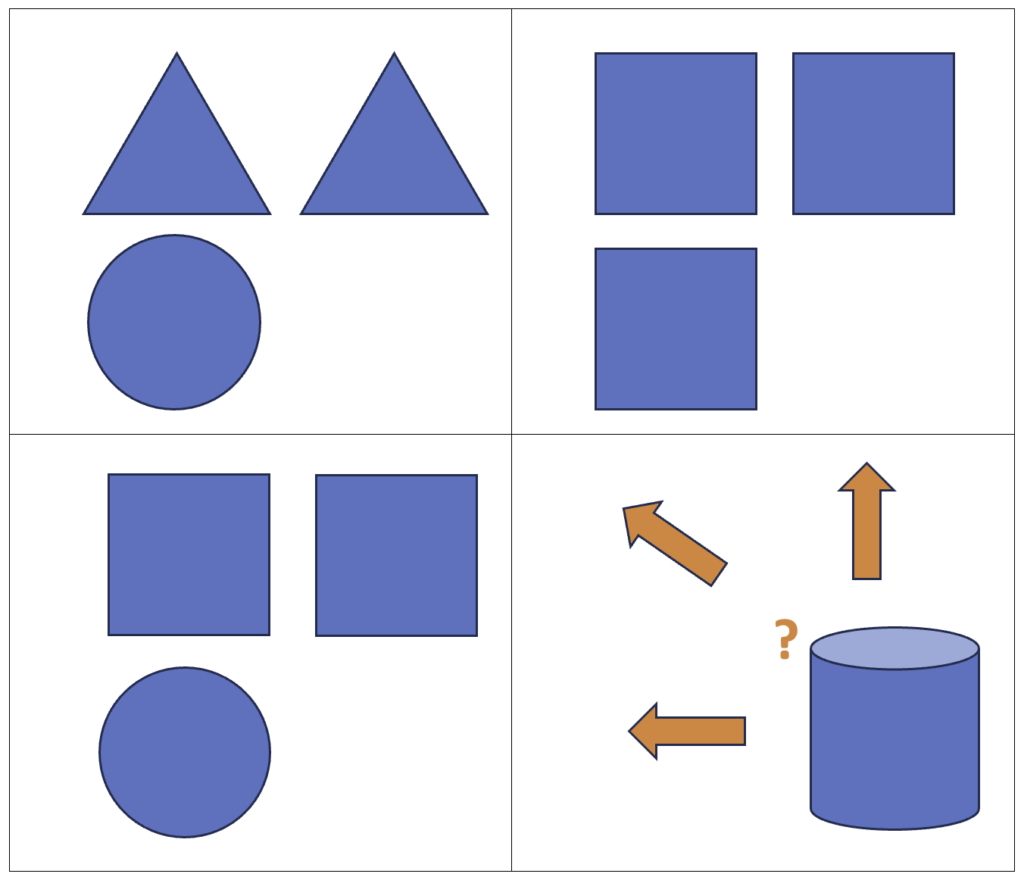
From solid shapes to Model (to Models)
- Take a figure from the building set (a flat shape), and ask the child to guess what a view (a “portrait”) from one side might look like, what views from two sides, and from three sides might be.
These guessing games can work both ways: for example, you start by setting a challenge for the child to solve, and then switch roles. If the adult makes deliberate mistakes that the child gets to correct, it will be even more fun!
Step 3. Collaborative Constructing.
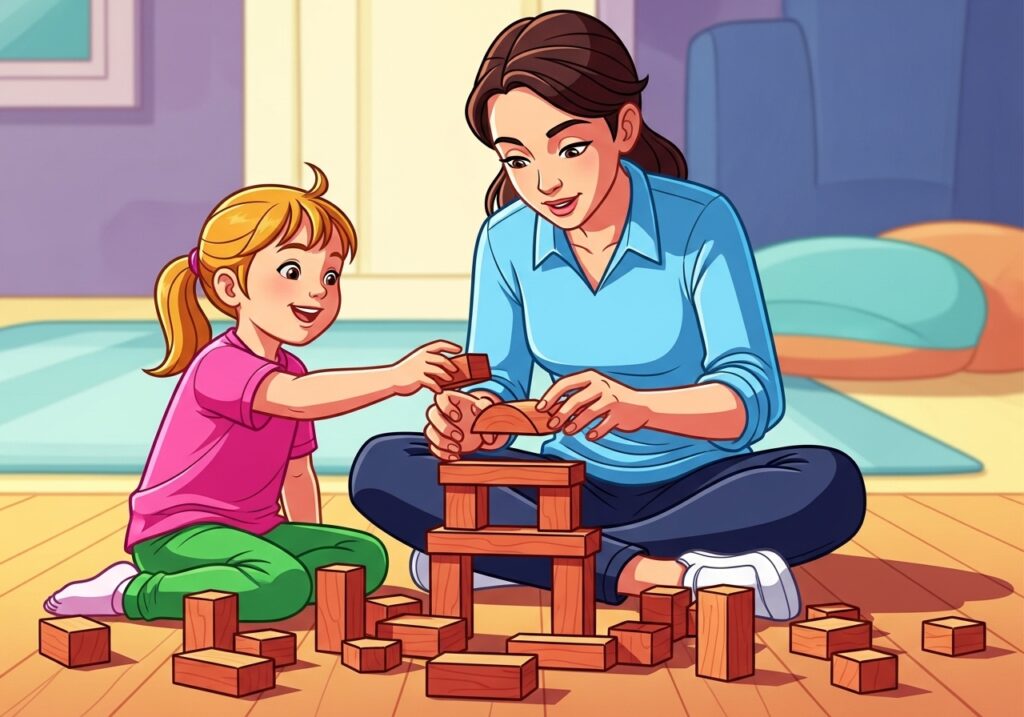
At this stage, you can build together with your child using visual models-that is, construction plans or drawings. Here, it’s important to tailor the activities to the child’s age, individual characteristics, and interests. We will suggest approximate tasks by age, but in practice, it’s best to use a trial-and-error approach to see what works and sparks their interest.
Roles in Constructing
While constructing, a child can explore different roles:
- The Architect:I create the plan.
- The Constructor:I bring it to life.
- The Inspector:I check the work.
By setting up a playful scenario, the construction partners (an adult and child, or several children) can take turns in these different roles. For example: “Right now, I’ll draw the plan, you build it, and Mum will be the inspector.” Or the child creates the plan, Mum builds, and the child inspects. Again, it’s valuable for adults to be able to make deliberate mistakes, which helps the child stay alert and, in doing so, master the skill of visual modelling.
Capabilities at Different Ages
3–4 years old
Construction based on their own design: Here, it’s important to ask questions: “What are you going to build? Which pieces will you use? Will it be tall or short?” Initially, a child will form their plan only during the building process, but gradually, this planning will shift to the beginning.
Construction by copying a demonstration: The adult builds, and the child repeats each step as they go.
Construction from a finished model: The adult builds a model (perhaps turning away from the child for fun), then shows it and asks the child to build the same structure.
Construction based on a theme: A house for a doll, a garage for a car, a bridge for a train. It’s important to vary the conditions:
- A house for a big doll and for a small doll.
- A garage for a big car and a small car.
- A bridge for a person (with steps) and for a car (with a ramp).
It’s crucial not to solve problematic situations for the child. The adult should act as a partner, not a teacher. For instance, if a child is struggling with how to make steps for a bridge, don’t immediately offer a solution-it’s better to show that you are also pondering how to do it. This only makes solving the problem more interesting.
5–6years old
Construction based on an idea (design intention): With older preschoolers, you can support the formation of an idea by offering an image that the construction can be related to. If the images are contrasting, this helps even more to shape the design intention.
For whom will you build:
A house for a kind gnome or for an evil gnome?
A castle for a fairy or for Baba Yaga?
A palace for Koschei or for a Prince?
When a child builds a house for a fairy and a house for Baba Yaga, they are not simply making two buildings – they are expressing a contrast: light and dark, kind and threatening, light and heavy. Through form and composition, the child learns to convey character, mood, and meaning. This is not only an aesthetic experience, but also a cognitive one: the child discovers that form can carry meaning — character and emotion.
And if a child becomes interested in architecture, cultural examples (buildings, photographs, illustrations) will become a source of new ideas when developing their own designs.
Construction based on conditions: For five- to six-year-olds, conditions can become more complex:
- How can we make it so that a big car can drive under the bridge?
- How can we make it so that a sailing boat can pass under the bridge?
- How can we build a house that is taller than the garage?
- How can we make sure a giraffe fits into the zoo enclosure?
Supporting Children’s Initiative
If you look closely, you may be amazed by how initiative children are, and how often they set themselves unusual challenges. For example, building a very, very tall house using all available materials. Or building a “house upside down”, like in this photograph.
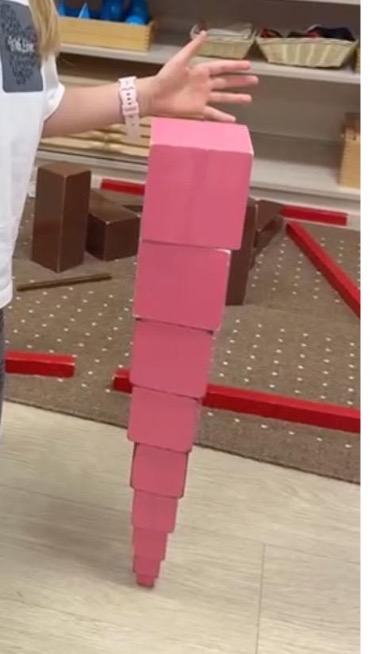
It is very important to notice such moments – and to rejoice in interesting construction solutions in their own right. This helps children see that a construction’s complexity and originality are reasons for interest and joy, alongside beauty and usefulness.
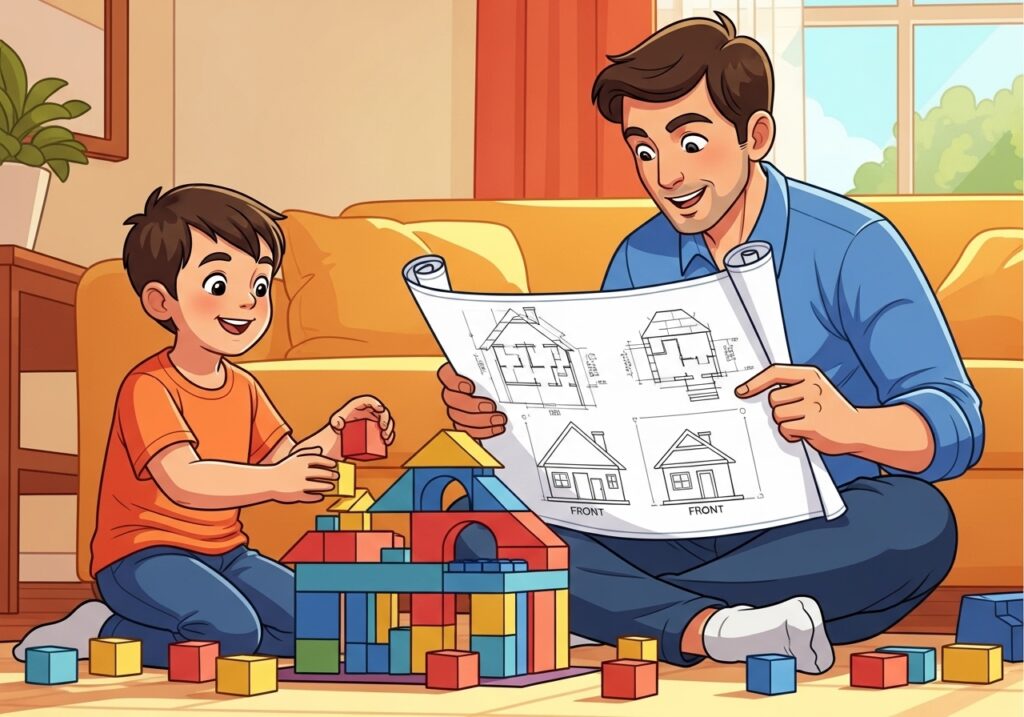
Construction Using Model Drawings
When a construction includes solid shapes that look different from different sides, a natural “trap” appears: the child needs to decide
- a) which flat model shapes can represent a solid shape
- b) which solid shapes are encoded in a drawing
From Construction to Drawing
These tasks help children learn to relate a visual model (drawing) to a real construction. The tasks are arranged from simpler to more complex. It is best to start with simple constructions made of 2–3 pieces and then gradually move to more complex ones.
- Trap riddles: constructions and several drawings, among which the child must choose the correct one. The adult builds, the child selects the matching drawing.
- The child builds a construction, the adult draws a front-view projection, and together you check whether it is correct.
- The adult builds a construction, the child draws a front-view projection, and together you check.
- The child builds a construction, the adult draws two projections, and together you check.
- The adult builds a construction, the child draws two projections, and together you check.
- The child builds a construction, the adult draws three projections, and together you check.
- The adult builds a construction, the child draws three projections, and together you check.
From Drawing to Construction
- Trap riddles: drawings and several constructions that could match them. The adult builds, the child chooses which construction corresponds to the drawing.
- The adult draws one projection, the child builds, the adult checks.
- The child draws two projections, the adult builds, the child checks.
- The adult draws two projections, the child builds, the adult checks.
- The child draws two projections, the adult builds, the child checks.
- The adult draws three projections, the child builds, the adult checks.
- The child draws three projections, the adult builds, the child checks.
Is It Necessary to Build Using Model Drawings?
Not at all. This is simply one possible pathway. For some children it will be fascinating; for others, less so.
If a child prefers to build freely from a construction set-following their own idea or simple conditions-that is also perfectly fine. Construction itself is already a form of modelling: when a child builds a house from blocks, they are holding in mind an image of a real house.
In this case, interest and depth can be added through questions about:
- Who the house is for?
- What kind of character the owner has?
- How this character could be expressed in the construction?
What Can Hinder the Development of Construction
Sometimes adults unintentionally interfere with the development of construction. This happens when an adult:
- builds for the child so that it looks “nice”
- evaluates constructions mainly by appearance rather than by idea
- does not allow time for trying, rebuilding, and changing
- sets overly rigid templates
- rushes the child or interrupts the process
The key thing to remember: the adult should not be a director, but a partner.
It is important for the child to feel that their idea is interesting and valued. Only then do they learn to think and act independently.
Everyday Advice
- Do not rush to ask “What is it?”
Sometimes it is better to say:
“That looks wonderful! Who lives in this house?” - Create the possibility to build and rebuild
Do not take the construction apart straight away-allow the child to return to it later. - Notice the constructive idea
“Oh, you worked out a different way so it wouldn’t fall down.”
How to Talk with a Child During Construction
Helpful phrases:
- “What are you planning?”
- “Which pieces have you decided to use?”
- “How did you work out that this way is better?”
- “What would happen if we made it higher / wider / differently?”
Better to avoid:
- “Let me show you.”
- “That’s wrong.”
- “Make it neater.”
- “You’ve broken everything again.”
These formulations help the child keep ownership of their idea.
Three Common Mistakes – and What to Do Instead
Mistake 1: Focusing only on the result
✔ Instead: show interest in the idea and the search
Mistake 2: Showing “the right way” too early
✔ Instead: think together
Mistake 3: Correcting for the sake of beauty
✔ Instead: respect the child’s authorial logic
Important: these are not parental failures,
but natural adult impulses.
How to Observe Children’s Construction and Notice Real Progress
Progress in construction is not always visible in the external “beauty” of a build.
More often, it shows in how the child acts rather than in what the final result looks like.
1. Look at the process, not only the outcome
Notice how the child:
- tries different options,
- returns to difficult parts,
- rebuilds instead of giving up,
- stays with places where the structure “doesn’t behave”.
If a child remains engaged in the process for longer, this usually means their constructive thinking is becoming more complex.
2. Notice the emergence of an idea (plan)
Gradually, the child’s actions begin to be guided not just by trial and error, but by an idea:
- “This will be the entrance.”
- “This is so it doesn’t fall.”
- “It has to be able to drive.”
Even if the construction is still unstable, the presence of an idea is an important step.
3. Watch for changes in strategy
A clear sign of development is when a child:
- first builds “anyhow”,
- then begins to take conditions into account: height, support, weight, balance,
- changes their approach if the previous one did not work.
This means the child is learning to think through construction.
4. Pay attention to how the child relates to collapse
If earlier a collapse meant the end of the activity, but now becomes a reason to rebuild, this is a significant indicator of development.
The child begins to see failure as information, not as defeat.
5. Notice transfer of experience and ways of acting
Progress can also be seen when a child:
- uses earlier solutions in new constructions,
- refers to previous builds,
- suggests ideas like “like last time, but different”,
- tries to draw a simple plan or drawing for their construction (sometimes after finishing it).
This means experience is being accumulated and generalised.
6. Listen to the talk that accompanies building
Words such as “why”, “if”, “need to”, “so that” show that the child is already working with the problem mentally, not only with their hands.
The Main Rule for an Observer
If you are unsure whether construction is developing, ask yourself one question:
Has the child started to spend longer thinking, trying, and returning to the task?
If the answer is “yes”, progress is happening – even if the constructions still look simple.
How to Feel Competent in Supporting Children’s Construction
Reflect: where are you right now?
1. There is an opportunity to construct at home
- There are blocks or a construction set at home.
- I do not forbid, rush, or interrupt when my child is deeply engaged in building.
2. I create a developmental environment
- There is a place at home for construction where builds can be made and left standing.
- The child has cultural examples in view: for example, photographs of cathedrals, towers, bridges, or other architectural structures.
3. I not only create an environment, but also observe
- I am interested in how my child builds and I show admiration for their constructions.
- Sometimes I build together with my child with genuine interest.
4. I create conditions for the development of construction as an activity
- I ask questions about the idea, the conditions, and the character of the construction.
- I help the child hold on to their intention without replacing it with my own.
- I introduce ways of working with drawings and simple plans.
Mastery is not about building something “beautiful”. It is about helping the child think through form.
Mini Self-Check: “Assess Yourself in One Minute”
Tick the statements that are most often true for you:
- I do not do things for the child in order to make them “better.”
- I can watch the process without interfering.
- I ask about the child’s idea rather than evaluating the result.
- I am calm about rebuilding and unsuccessful attempts.
- I enjoy unusual and unexpected solutions.
- The child has time and space for building.
0–2 items: “I allow”
3–4 items: “I observe”
5–6 items: “I support and create conditions”
Use the self-check as a hint – what steps to take!
How Can an Adult Become Interested in Construction Themselves?
The question may sound strange:
does an adult who is neither an architect nor a designer need to be interested in construction?
Not necessarily – but it is possible.
Architecture is often called “frozen music”, but only someone who has learned to notice differences in form, proportion, style, and era can truly hear this music. One can walk through an unfamiliar city and not notice remarkable buildings at all.
Architectural styles – Gothic and Baroque, Classicism and Modernism – offer fascinating material for looking, comparing, and noticing differences. When this happens, the city becomes “speaking”.
An adult can become interested in architecture together with a child – and then even a walk through one’s own city turns into a source of discovery. For the child, photographs of castles and buildings that were looked at together with parents later become sources of inspiration for their own constructions.
Instead of a Conclusion
Through construction, a child learns to see the world as something that is created.
They begin to experience themselves as an author and to understand that every object was once someone’s idea.
The adult nearby is not a controller, but a co-participant –
someone who helps the child notice, feel, and bring an idea into form.
If an adult nearby knows how to:
- create opportunities for construction (including building with blocks),
- not rush,
- not judge,
- and spark interest,
then they are already doing the most important thing.
When we preserve a child’s right to try, make mistakes, and invent,
we support not only construction, but the development of thinking and personality.
Blocks, building sets, and templates then become a child’s first cultural tools –
tools through which they learn creativity.
What to Read
- Brofman, V., Rabinovitch, I., & Karpov, Y. (2017). Vygotsky in Harlem: Amplification of preschoolers’ development in Vygotskian Early Childhood Education Program (VECEP). In N. Veraksa, & S. Sheridan (Eds.), Vygotsky’s theory in early childhood education and research: Russian and Western values (pp. 81-96). New York, NY: Routledge.
https://www.taylorfrancis.com/chapters/edit/10.4324/9781315098203-7/vygotsky-harlem-vera-brofman-inna-rabinovitch-yuriy-karpov