![[EN] CHILD LAB](https://childlab.co.uk/wp-content/uploads/sites/4/2026/01/child-lab-logo.jpg)
Why Is Reading Important for the Future?
At first glance, reading seems like a skill that everyone inevitably acquires at school. It feels as though anyone who has finished primary school can read. Yet reading is not limited to its “technical” side – the ability to put letters together into words and words into sentences. To read means to know how to engage with questions that feel important and interesting to you, and to address those questions not only to other people or directly to objects, but specifically to books.
What a reader can do (even if they don’t realize it):
- Understands what happened: can follow the plot – who went where, who did what, and what came of it.
- While reading a long book, can hold on to the whole: keeps the overall story in mind.
- Understands how the characters feel: can read emotional states – whether a character is happy, angry, sad, or afraid.
- Responds emotionally: this is about one’s own feelings, when the reader begins to care about the characters – to rejoice in their successes, worry about them, feel afraid with them, or grieve with them. That state of “I can’t put it down, because I care.”
- Relates it to oneself: when the story resonates with personal experience: “Oh! I’ve had the same kind of situation!” or “I’m afraid of the dark in exactly the same way as this character.” The book becomes “about us.” We involuntarily compare ourselves with the characters: “Would I act the same way in his place?”, “Would I like to be as brave as he is?”, “Am I more like this quiet one or that bully?” This helps us understand ourselves better.
All these complex actions are performed by a skilled reader almost simultaneously. If even one component is missing, reading does not truly happen. Those who say that reading is “boring” are, in fact, experiencing difficulties with these skills. The good news is that this ability develops – but only through practice.
What Is Shared Reading?
In this phrase, let us emphasize the word shared, because the very goal here is to build a relationship of togetherness – full of trust, warmth, and understanding. Reading creates ideal conditions for this: you can be close to one another, you can look “in the same direction,” you can share emotions, because you are co-participants in the events unfolding in the book.
You can go fishing together, bake buns, or kick a ball around – all of this brings a child joy and the feeling of being loved, seen, and interesting to someone. Among all these activities, shared reading holds a special place precisely because it offers both togetherness and a unique intimacy, where there is closeness of both body and soul. The tradition of shared reading can become a source of deep, intimate relationships that give a child a lasting sense of security for many years.
Shared reading between a child and an adult is a special kind of activity in which reading happens in a distributed form. First, the adult reads – that is, takes on an important technical task: decoding the written text and turning it into spoken language. Second, the adult helps the text “come alive”: adding intonation and sometimes even different voices, so that the characters come to life and the storyline – with its approaching danger or, on the contrary, its happy ending – becomes emotionally clearer. One day, a mature reader will be able to do all of this independently, and in some cases it will even be important for them to do it alone. But for a young child, what matters is that the adult, by taking on part of the “work,” leaves space for the child’s own experience and feelings.
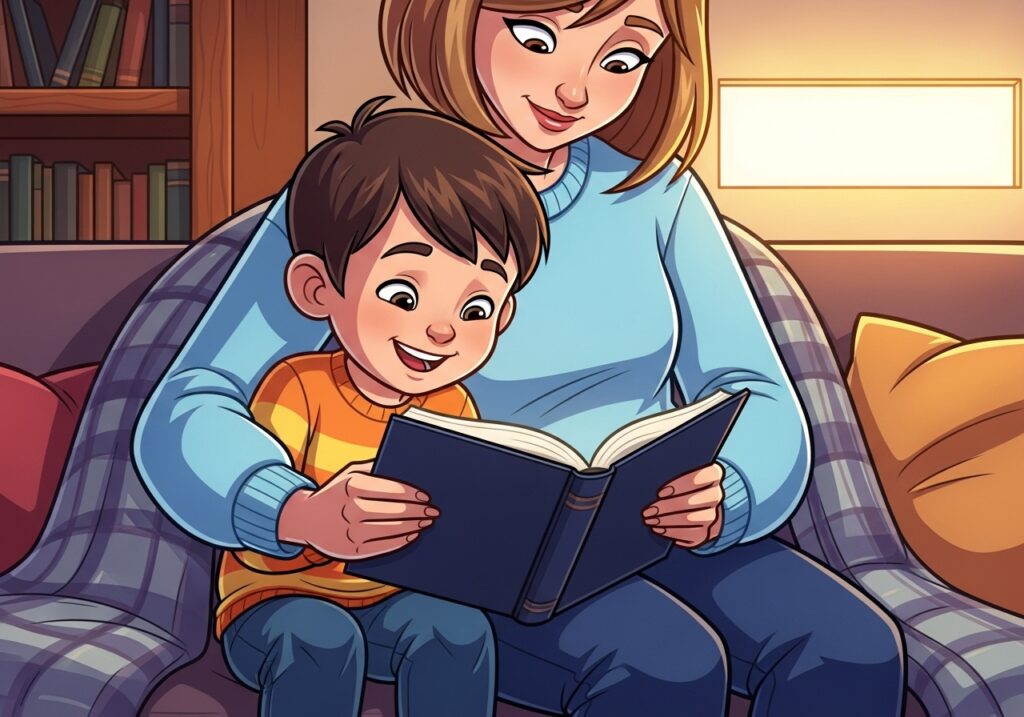
So, in shared reading, the child and the adult do the “work of reading” together: the child can empathize with the characters, and as a result, their own feelings can change and be transformed.
Shared Reading: an unexplored land between play, communication, and reading
Even though we are talking about reading, when it comes to reading fairy tales this activity is something halfway between reading and play.
Play is the creation of an imaginary situation in which there is both an invented world and the real one. Children are perfectly capable of holding this duality of play – “as if.” Dressing up as a princess or a knight, they become a princess or a knight, while at the same time understanding that they remain themselves. A child eagerly offers their mother a sand “pie” to eat, yet would be very surprised if she actually put it in her mouth. It is precisely this duality of play that makes play such a powerful tool for a child’s development: in play, the child tries out different perspectives and learns to see the world from different positions – among them those that feel frightening (for example, monsters) and those the child wants to master (for example, someone brave or beautiful).
Something similar happens when reading fairy tales. All parents know how much children love listening to the same stories over and over again. It may seem that children simply enjoy repetition, that predictability soothes them. Parents are often worn out by the insistent requests to read a familiar book again and again. But what is actually going on? In fact, when we are dealing with a fairy tale – one that includes clashes and conflicts, strong and weak characters, winners and losers – reading such a book opens up many possibilities for the child. And the main one is this: to perceive the book as a play space, a space of “as if.” Isn’t that obvious? Not at all. A child’s initial perception of a book is “literal”: the child is genuinely frightened by scary characters. To turn the content of a book into play requires special work, and this is exactly the work the child does by listening to the same fairy tale many times. What seems like repetition to an adult is, for the child, a change of perspective – from fear to play. In play, you don’t have to be afraid of the monster: the child who plays the monster controls it. The same thing happens in reading: if you perceive a monster or a tiger as a play character, it is no longer frightening. This is precisely why fairy tales need to be repeated – so that this transformation can take place.
As a result, the child discovers a way of reading fiction: it is a make-believe world that exists within the space of the book, yet it is also real. You can imagine yourself in the place of different characters and gain new superpowers through reading.
Let us recall that part of the work is taken on by the adult, who turns the written text into an oral narrative – this makes it easier for the child to focus on the “work of experiencing.”
Shared reading is a space between play, communication, and reading.
Myths About Reading
Myth 1. “The most important thing is to teach children to read.”
This myth is very widespread. At the same time, “reading” is most often understood as its technical side – the decoding of written text. Yet each age has its own developmental tasks. Mastery of reading technique is not a necessary skill for a preschool child. What can and should develop in the preschool years is a relationship with literary text – as a helper in experiencing one’s feelings and transforming one’s relationship with the world. A book can become exactly that in early childhood.
If the “technical” side of reading is overly emphasized for adults, children rather quickly grasp that a certain skill becomes a condition for being approved of. In that case, the book turns into a means of earning an adult’s good attitude, and this can prevent the child from encountering the book as a conversational partner.
Myth 2. “Some children just don’t like reading.”
“I tried reading to him several times, but he doesn’t want to – he runs away, he’s not interested.”
Of course, children differ in temperament, in their ability to regulate their behavior, in their interests and inclinations – this is all true. One child may draw for a long time, completely absorbed, while another may be just as absorbed in building with LEGO. Children have a right to all of this.
The adult’s task is not purposeful shaping, but creating conditions – and observing what resonates and what does not. When it comes to shared reading, this means creating conditions for it: a special, cozy time together, when two (or more) people are brought together by a book.
Myth 3. “Informational books are more important than fairy tales.”
First of all, it is important that reading brings pleasure to all participants. If an adult loves books about cars or ships, it is perfectly fine to read about cars and ships with enthusiasm – this, too, will be valuable. But if there is a conviction that such books are more useful than fantasies, it is worth keeping in mind that every type of book has its own possibilities. Fairy-tale and fantasy books also create opportunities – and these opportunities are unique.
What Develops Through Shared Reading?
A great deal! But let us say right away that reading should not be turned into a “tool for developing” skills like counting, logical reasoning, or memorization. All of this will form in the course of reading on its own – and it will be a side effect. The main effect of reading is the development of the ability to experience the world through text and to become more emotionally sensitive and mature with the help of a book. This is an incredibly complex and important ability that literally opens up a whole world of invaluable resources for the child. These resources allow a person never to be alone, to always have reliable companions in overcoming difficult life situations.
That is why it is not worth interrupting reading with moralizing or didactic questions such as: “So how many piglets were there?” or “Did the goat behave well or badly?”
Through the experience of shared reading with an adult, the child develops and forms:
- Togetherness and trust with the adult: shared reading strengthens attachment.
- Agency: by identifying with characters, the child learns to manage their feelings and transform them. In addition, by identifying with fairy-tale heroes who overcome obstacles, the child receives a model of initiative – when a character meets a challenge and responds to it.
- Self-regulation: the ability to sustain attention over time, in particular to hold both the whole and the parts of a text. In this respect, for older preschoolers, series books that can be read over a long period are especially helpful – returning each time to where the reading stopped before.
- Imagination: it may seem that someone else’s text cannot develop imagination, since it has already been created by another person. Yet the reader is always a co-participant: they imagine the characters and, moreover, fill in and elaborate them. In this sense, a book leaves far more space than a film, where the creators already offer a visual and auditory image – how the character looks, how they walk and speak. The reader must imagine all of this. That is precisely why film adaptations provoke such lively debates: a book allows for many different interpretations. One can also observe how read stories are reflected in children’s own fairy tales – this, too, is a manifestation of imagination.
- Thinking: any story contains many cause-and-effect relationships and different possible developments of events. Very often these relationships are not obvious; they are hidden, and the reader has to reconstruct them. Why, in the fairy tale The Three Little Pigs, did the piglets build different houses rather than identical ones? Why, in The Wolf and the Seven Little Goats, did the wolf go to have his throat softened? Even when some connections are described by the author, there is no guarantee that the child will grasp them immediately. Reading requires constant following of the author’s logic, and in this process the child’s own logical thinking develops.
Finally, let us single out picture books as a special tool for developing imagination, thinking, and emotional intelligence. There are different types of illustrations – more or less realistic, occupying a larger or smaller place in the book’s content (for example, some books consist entirely of pictures; in fact, the pictures are the text. There are also books in which the pictures do not illustrate the verbal text but complement it). Overall, however, the comparison of text and illustration opens up new space for thinking and reflection, because it makes it possible to build new connections.
Learning to Observe: How to See That a Child Is Becoming More and More Engaged in Shared Reading
Level 1. Episodic attention
The child:
- reacts to familiar words or pictures;
- laughs, gets scared, or becomes animated at certain moments;
- may ask occasional, single questions.
Attention comes in waves; the child does not yet hold the whole.
The book begins to “catch” the child – but only briefly so far.
Level 2. Emotional involvement
The child:
- worries about the characters;
- asks specifically for this book to be read;
- reacts to dangerous or funny moments;
- may ask for the same passages to be repeated.
The child appropriates the story emotionally; reading begins to work as a space for experiencing feelings. Repetitions at this stage are not getting stuck – they are the work of experience.
Level 3. Participation in dialogue: thinking together with the book
The child:
- asks “why” and “what if” questions;
- argues with the characters’ actions;
- suggests their own versions of events;
- relates the story to themselves (“I wouldn’t be able to do that,” “I’m afraid too”).
The book becomes a conversational partner; the child learns to handle different points of view.
Level 4. Transfer into one’s own activity: “the story lives in me”
The child:
- plays out the book’s plot;
- draws or invents a continuation;
- uses the characters’ lines in their own speech;
- returns to the story independently.
Shared reading begins to work even outside the reading moment itself.
This is deep engagement, often not noticeable during the reading itself.
How to use this
- There is no need to “determine a level”; it is more important to notice the signs.
- Rejoice in any shift.
- Do not compare with other children – the experience of shared reading is unique for each child.
- Remember: development is non-linear; returns and repetitions of what seems “already passed” are common.
How to Create Conditions for Shared Reading
Reading with a child is a journey into shared worlds, a quiet conversation of the soul, one of the warmest ways to grow closer. But for this magic to happen, it is important to create conditions in which a book becomes a welcome friend.
-
A Library: Our Personal Book Space
The first thing to start with is creating an attractive space at home where books live – not just a shelf, but a real mini-library.
Accessibility. Books should be directly accessible to the child – not on a high mezzanine, but on open shelves at their eye level. Let the child see the spines, reach out, take a book, flip through it, examine the cover. Even a toddler who cannot yet read should have the opportunity to interact with a book as an object – this is the first step toward love.
Replenishment by the child’s choice. Be sure to go together to bookstores and libraries. Allow your son or daughter to choose something on their own, even if it seems to you that it’s “not the right” book (a comic, a dinosaur magazine, a story about robots). This choice is an act of respect for their interests. A book bought at the child’s own request will be valued and reread many times more often.
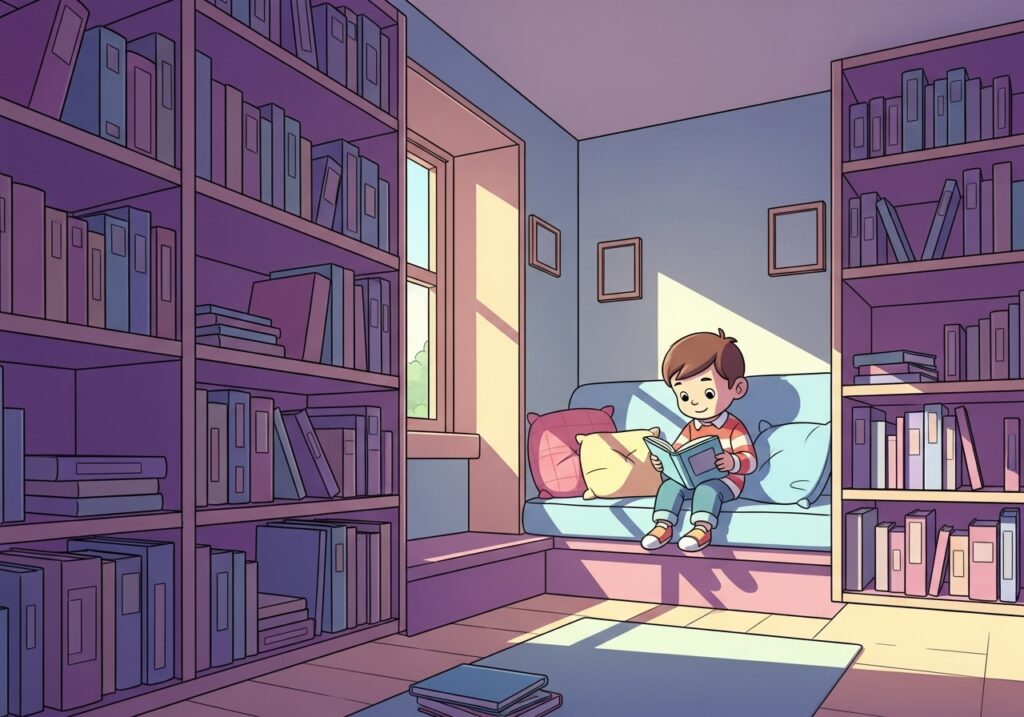
Variety. Fill the library with different genres: fairy tales, poetry, encyclopedias, comics, adventures. And – this is very important – add “books to grow into.” Place on the top shelf several beautiful, complex, “grown-up” illustrated editions (myths, classics, art books). The child will reach for them, leaf through them, ask questions. This creates an atmosphere of mystery and motivates growth: “I’ll read this amazing book when I get a little older.”
-
Place: Where It’s Cozy to Read
Reading needs not only time, but also a special place.
Seclusion for independent reading. When a child is just beginning to read on their own, outside sounds and looks often distract them. Create a small “reading nook” at home: a beanbag or pouf by a floor lamp, a windowsill with soft pillows, a tent made of blankets. This is their personal cave for immersion in a story. At first, one can sit with a book anywhere, but when reading becomes an independent, serious activity, the importance of such a quiet, “one’s own” place increases.
Note for the illustrator: a child and an adult reading together, sitting cozily on a sofa, wrapped in a blanket.
Comfort for shared reading. Reading together requires a different space – spacious and soft. A sofa, a large bed, a carpet with a pile of pillows. The main thing is that both of you are comfortable sitting (or lying) side by side, that the child can snuggle up to you, and that you can both see the pages and pictures. This is a zone of physical and emotional comfort, where your shared story is born.
-
Time: A Ritual to Look Forward To
The strongest magic lies in regularity. Reading should become not a random episode, but a beloved ritual.
Why are rituals so good? They create a sense of safety and anticipation. Remember what the Fox said to the Little Prince?
“It would be better if you came at the same time every day,” said the Fox.
“If you come at four o’clock in the afternoon, then at three o’clock I shall begin to be happy.
And the nearer the hour of the meeting, the happier I shall feel…
But if you come at just any time, I shall never know at what hour my heart is to be ready…
One must observe the rites.”
So it is with reading. When a child knows that every evening, after dinner and before bedtime, there will be twenty minutes of cuddling with a book, they begin to “prepare their heart” for this moment. It is an island of stability and unconditional attention in the flow of days. It is your personal rite.
-
“Safety Rules”
These are perhaps the most important rules. Breaking them can permanently discourage a child from picking up a book.
Never punish with reading. In such cases, reading becomes synonymous with boredom and deprivation. It should be a desired leisure activity, not a bitter medicine.
Never force reading. Do not hover, demand that the child read “just five more lines,” or criticize them for slowness. If the child is tired or not in the mood – put it aside. Pressure breeds resistance. Your task is to interest, to captivate, to show what delight and comfort can be found on the pages.
In the end, creating conditions for reading is not about expensive interiors or huge libraries. It is about attention, respect, and a willingness to give time. It is about preparing the heart together for meeting a story. Start small: find fifteen minutes today, settle comfortably in your “place,” open the book the child chose, and simply begin. The magic will come on its own.
-
How to Read Picture Books: Simple Secrets
Illustrations in children’s books are not just decoration, but a whole world that can – and should – be “read” together with the child.
- Teach children to “read” pictures the same way you read text.
- Choose high-quality illustrations – artists who convey character and life.
For the youngest (up to 3 years): clarity and simplicity matter
Young children need to understand quickly: what is depicted? The best illustrations for this age are clear, with distinct contours, where objects do not overlap and are shown against a neutral background.
You can:
- Ask three magic questions: “Who is this?”, “What is he like?” (what kind of beak, what kind of paws), “What is he doing?”
- Explore together. If a child has never seen a real chicken or fox, the picture is their main source of knowledge. Examine every detail: “Here is the comb, here are the feathers.” Artists like the Charushins observed animals for years so that you could show a child their real, living essence.
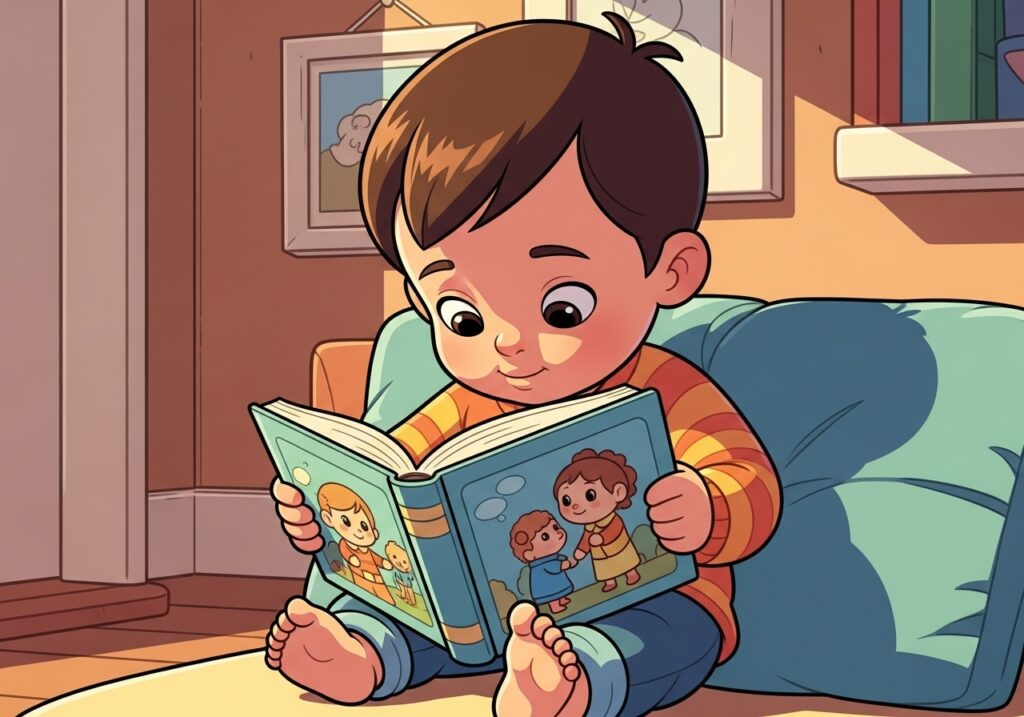
For older children (4–6 years): searching and discoveries
Children love “finding everyone” in complex scenes. This is where books with multi-figure compositions, such as wimmelbooks, come in handy.
You can:
- Encourage searching: “Let’s find everyone who is hiding on this page!”
- Make questions more complex: “Where is this character looking?”, “What do you think he wants?”. These are the first steps toward understanding others’ feelings and thoughts – the foundation of future emotional intelligence.
For younger schoolchildren (7–10 years)
Examining details opens up cause-and-effect relationships. In addition, children are already able to notice artistic features of illustrations and distinguish one artist’s style from another’s.
You can:
- Look at the pictures and note what seems unexpected in them; try to understand why the artist depicted the character or setting in this particular way.
- Compare different illustrations to the same text and choose the one you like best. Here, arguments matter most: why does this picture seem more fitting to you than that one? Remarkably, this helps to understand the text more deeply and, most importantly, to develop one’s own attitude toward it. This is how the foundations of a reader’s position are laid.
Everyday Tips
- Choose books together
- Reread favorite books
- Stop at the most exciting moment so that you’re eager to continue reading the next day
- Reread favorite passages
- Connect the book’s content with your own experience (“That happened to me too…”)
It’s better not to say:
- “Listen carefully.”
- “I’m reading – don’t interrupt.”
- “Hurry up.”
- “What did you understand from this?”
Try saying instead:
- “What do you think he’s feeling right now?”
- “Who are you rooting for most here?”
- “Shall we read some more, or stop for now?”
- “I felt scared / amused here too.”
Three common mistakes – and what to do instead
Mistake 1: Turning reading into a lesson
✔ Instead: turn reading into a meeting
Mistake 2: Asking “checking” questions
✔ Instead: share your own experience
Mistake 3: Being afraid of repetition
✔ Instead: see repetition as a path from fear to play
It is important that shared reading be a shared joy. Read only those books that are interesting for you yourself to read.
Assess yourself: how consistently do I create conditions for shared reading?
How to feel competent in shared reading with your child:
Check the statements that are most often true for your family.
Not “ideally,” but in real life.
- Time
- We have a more or less regular time for reading
- Reading is not canceled at the first sign of fatigue or haste
- Space
- There is a place where it is comfortable to read together
- Books are accessible to the child
- Choice
- The child can choose what we will read
- I am calm about requests to read the same book again
- Atmosphere
- There are no tests or evaluations during reading
- It is okay to interrupt, discuss, and flip back
- The adult’s position
- I read not “for usefulness,” but for shared experience
- I allow myself to be involved, not only to lead
0–3 statements: Conditions are created episodically
This is normal. Fatigue and lack of time often get in the way.
Even rare episodes of shared reading already have value.
4–7 statements: Conditions exist, but are still unstable
You are in the process of building a ritual.
A bit more regularity will strengthen the effect.
8–10 statements: Conditions are created consistently
Shared reading has already become part of life, not a task.
Now it can develop “on its own.”
In this way, we create a map of what is already working.
Any established element (time, place, or atmosphere) is already a strong support.
Answering the question, “What is easiest for me to make a bit more regular?” helps you move forward.
Shared reading does not rest on inspiration, but on small, repeated conditions. And if you begin to notice and support them, you are already doing a great deal.
How to Learn to Love Reading Yourself
It is well known that, for development, children need a role model – an example embodied by an adult. Yes, there are adults who do not like reading themselves – and this does not at all mean that their children will not come to love reading. There are also many reading adults whose children’s interest in reading does not awaken, or fades at some point. Each individual case can be looked at separately in order to understand causes and effects – after all, reading is a holistic process in which a person participates with their whole personality, with all their motives and interests.
However, shared reading is one way to make up for what was missed, because in recent decades a literal revolution has taken place in children’s literature. A great many new and interesting books have appeared, including on topics that children’s book authors previously did not address. One could even set oneself a small research task and try to understand what exactly has changed in children’s literature compared to one’s own childhood.
Instead of a conclusion. What to do with children who already read.
Daniel Pennac formulated ten rights for parents of children who have already begun to read. These rules are meant to ensure that the joy of reading and the child’s development as a reader are not destroyed.
- The right not to read
Do not force a child to read. Find ways to spark their interest in reading. - The right to skip
A child has the right to skip boring pages (for example, descriptions of nature) and read what interests them. - The right not to finish
Never force a child to finish a book that did not interest them. There is so much fascinating material in the world – your child will certainly find something they like! - The right to reread
Allow children to reread a favorite book as many times as they want. - The right to read anything at all
At first glance, this rule may seem controversial, but it is important. In the school world, every child experiences enough prohibitions; therefore, in home reading they should have the complete and unconditional right to choose what to read. Allow this, excluding only truly harmful books from the range of choice. - The right to bovarism (from Madame Bovary)
Never mock adolescents’ ideals. Be tolerant, even if you understand that your child’s favorite hero is far from real life. - The right to read anywhere
Do not forbid children to read in bed, on the subway or bus, even while eating. If a child takes a book with them, that is the best thing you could hope for: they have come to love reading! - The right to read aloud
Sometimes a child may want to read aloud to you a passage they especially liked. Listen, give them your time. Reading aloud is useful: it develops diction, auditory and visual memory. But most importantly, it means that the child wants to share the joy of reading with you. Value this! - The right to “zone out”
Never forbid this! Even two pages read broaden one’s horizons. If a reader comes across a book they have not yet “grown into,” this is also beneficial: the book will remain in memory, and the child will recall it at the right moment. - The right to remain silent about what has been read
It is normal if a child does not want to discuss what they have read with you. Most likely, this simply means that they are not ready yet; it does not necessarily mean that the reader was indifferent to the book. Do not pry – just wait.
What to read?
- Pennac, D. (2006). The rights of the reader. London, Walker Books.
- Trelease, J. (2013). The Read-Aloud Handbook. Penguin Publishing Group.
https://www.penguinrandomhouse.com/books/310944/the-read-aloud-handbook-by-jim-trelease/ - Chambers, A. (1996). Tell Me: Children, Reading, and Talk. Routledge.
- Fox, M. (2001). Reading Magic: How Your Child Can Learn to Read Before School – and Other Read-Aloud Miracles. Pan Macmillan.